Is It Time We Stopped Shouting About The Dietary Guidelines?

The recent report by the advisory committee to the USDA dietary guidelines has certainly caused a media stir in the past week or so. There’s a lot of nutritional common sense in the report – eat more fruit, veg, and dairy, reduce carbs and sweetened drinks/snacks, and moderate alcohol intake. Yet there’s a kicker – from both a health and a sustainability perspective, Americans should apparently be guided to consume less animal-based foods.

10982813_934682089898559_3461048965358255082_oWhen the report was released, my Twitter notifications, Facebook feed and email inbox exploded. Memes like the one to the left appeared on every (virtual) street corner, and the report was mentioned in every online newsletter, whether agricultural or mainstream media. It’s this press coverage rather than the content of the report, that really concerns me.

Individuals don’t pay a lot of attention to a government report on nutrition. Despite the fact that six updates to the guidelines have been released since their inception in 1980, we are all still eating too many Twinkies in front of the TV and super-sized takeout meals in the car, rather than chowing down on broccoli and lentil quinoa bake.
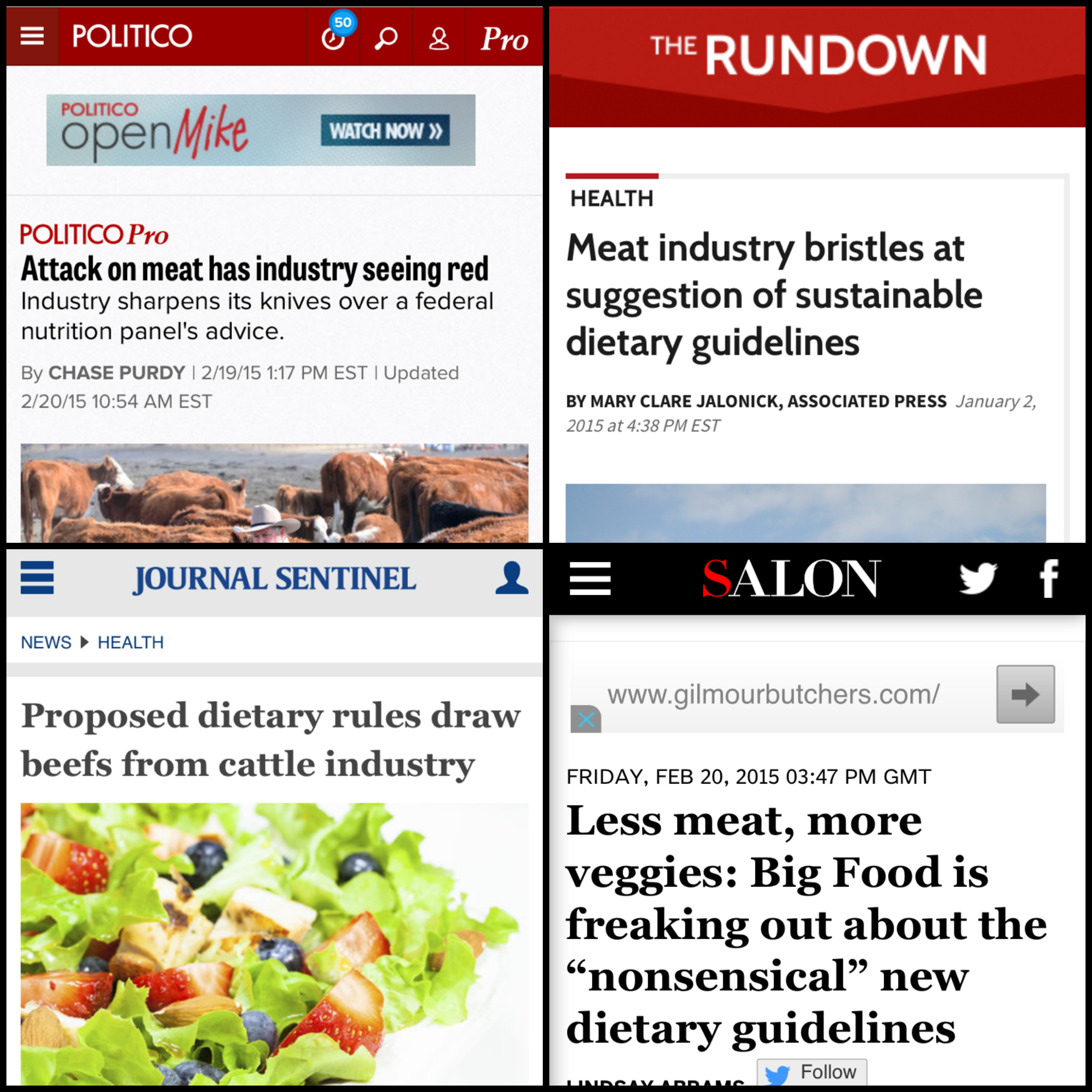
Headlines CollageYet people do pay attention to headlines like “Less meat, more veggies: big food is freaking out about the “nonsensical” new dietary guidelines” and others shown to the left. The media sub-text is that big bad food producers (so different from the lovely local farmer who sells heirloom breed poultry at $18/lb at the farmers market) are appalled by the release of this governmental bad science that’s keeping them from their quest to keep you unhealthily addicted to triple cheeseburgers washed down with a 500-calorie soda, and will do anything to suppress it.

This makes me wonder – at what point do we need quiet, stealthy change, rather than loud protests that attract the attention of people who would otherwise never have read about the guidelines? At what point does industry protesting seem like a modern version of “The lady doth protest too much“?

Rather than posting on Facebook or Twitter that the report is nonsense because the committee of nutritionists ventured into the bottomless pit that is sustainability; why don’t we instead extol the virtues of producing high-quality, nutritious, safe and affordable lean meat, and aim to reach the people who haven’t seen the hyperbolic headlines or read the guidelines simply because they’ve seen a lot of talk about them on Twitter? The old showbiz saying that there’s no such thing as bad publicity certainly applies here – the extent of the reporting on the industry backlash against the report means they have probably been noted by far more people that they otherwise might.

The impact of the dietary guidelines recommendations upon purchasing programs is far higher than on individuals, and does give rise to concern. Globally, one in seven children don’t have enough food, and school lunches are often the only guaranteed source of high-quality protein available to children in impoverished families. I may be being overly sceptical, but I suspect that if meat consumption in schools is reduced, it’s unlikely to be replaced with a visually and gastronomically-appealing, nutritionally-complete vegetarian alternative.

Sustainability doesn’t just mean carbon, indeed, environmentally it extends far further than the land, water and energy use assessed by the dietary guidelines advisory committee into far bigger questions. These include the fact that we cannot grow human food crops on all types of land; water quality vs. quantity; the need to protect wildlife biodiversity in marginal and rangeland environments; the use of animal manures vs. inorganic fertilisers; environmental costs of sourcing replacements for animal by-products in manufacturing and other industries; and many other issues. Simply stating that meat-based diet X has a higher carbon footprint or land use than plant-based diet Y is not sufficient justification for 316 million people to reduce their consumption of a specific food. Indeed, despite the conclusions of the committee, data from the US EPA attributing only 2.1% of the national carbon footprint to meat production suggests that even if everybody reduced their intake of beef, lamb and pork, it would have a negligible effect on carbon emissions.

Could we all reduce our individual environmental impact? Absolutely. Yet as stated with regards to dietary change in the advisory report, it has to be done with consideration for our individual biological, medical and cultural requirements. As humans, we have biological and medical requirements for dietary protein, and some would even argue that grilling a 16-oz ribeye is a cultural event. I have every sympathy for the USDA committee*, who were faced with a Herculean task to fulfill, but in this case, they only succeeded in cutting off one head from the multi-craniumed Hydra – and it grew another 50 in its place.

*Many people have already commented on the suitability (or not) of the committee to evaluate diet sustainability, but to give them their due, they do appear to have looked beyond greenhouse gases to land, water and energy use. They are nutrition specialists, not sustainability experts, but it would be difficult (impossible) to find a committee comprising people who were all experts in nutrition, sustainability, economics, policy, behaviour and all the other facets of the report. Nonetheless, the sustainability recommendations appear to be based on a small number of papers, many of which are based on dietary information from other regions (Germany, UK, Italy) which will also have different levels of animal and crop production. As somebody who was born and bred in the UK before moving to the USA I find it difficult to believe that the average American’s diet uses substantially more land (for example) than the average UK person, as cited in the report.

A Christmas Wish – May All Your Cows Be Like Your Best Cow

I love conversations that leave my brain firing on a million cylinders and open my mind to new ideas. I was lucky enough to have three such discussions this past week, one at an organic research farm; another at a 300-cow Jersey operation; and the most recent with three faculty at the University of Oxford with regards to the interactions between animal welfare and livestock sustainability.

Animal welfare is a touchy subject – many people appear to define excellent welfare as only including a narrow range of production systems or practices; and although everybody has their own image of what a “happy” animal looks like, it’s not always easy to identify or describe those systems without anthropomorphizing. Indeed, I’ve become increasingly aware that promoting improved productivity and efficiency as a means to improve sustainability can be misconstrued as encouraging the agricultural equivalent of a owning a Victorian dancing bear or cymbal-playing monkey – a “force the animals to perform, regardless of the cost in terms of animal welfare”-type philosophy (see picture below).

Troll


Yet such suggestions entirely miss the point, as any system that is consistently detrimental  to animal welfare is neither productive nor efficient on a long-term basis. We humans don’t perform well if we’re chronically underfed, stressed, sick, or housed in unfavorable environmental conditions – and neither do livestock.

Personally, my agricultural utopia would be one where all livestock operations, regardless of size, location or production system, exhibit both high productivity and excellent animal welfare. Admittedly, this leads to the difficult task of not only defining excellent welfare, but also the metrics and benchmarks by which it can be assessed within each operation. However, there is one overarching metric that can be measured, and improved on any farm or ranch – animal health. By definition, an animal that is chronically sick, lame or in pain cannot be said to be a example of good welfare.

As consumers, we want to know that the animals that provide us with milk, meat and eggs are healthy. Indeed, I imagine that even the most militant vegan opposed to the consumption of animal products would agree that animal health should be paramount. As producers, making sure that livestock are healthy is as ethically important as treating workers well. Plus, healthy animals are easier to manage: they grow faster; they have fewer incidents of  illness or death; and they produce more milk, meat or eggs. These improvements in efficiency and productivity also mean that we need less feed, less land, less water and have a lower carbon footprint per unit of food produced.

Let’s consider lameness in dairy cattle. A major animal welfare issue, it costs between $120 and $216 per incidence (UK costs below)* and is a major cause of cows being culled at or even before the end of their second lactation. Similarly, mastitis has a huge impact on both cow longevity and productivity, and costs the US dairy industry $1.7-2.0 billion per year. If just these two health issues were addressed, how many associated dairy cattle health and welfare issues would be improved; how much could dairy farm profitability be enhanced; and how much would the public image of dairy improve?

Every herd has its best cow – the one who is never lame, doesn’t suffer from mastitis, metritis or ketosis; and gets back in calf easily – all while having a high milk (and components) yield. There is no magic bullet to improve productivity and efficiency –  yet the discussions I’ve had in the past week conclusively demonstrated that that does mean suiting your system to your available resources and, though excellent health, nutrition, breeding and management, allowing every cow to perform like your best cow, every single day. I wish you a Merry Christmas and hope that in 2015, all your cows will be like your best cow.

*Lameness costs £180 pounds per incidence in the UK, or £15,000 per average herd annually. Mastitis costs the UK dairy industry £170 million per year.

Would Being Vegan Really Solve Climate Change? Not if We Don’t Kill the Cows.

OLYMPUS DIGITAL CAMERAA friend of mine drew my attention to this NPR blogger, who makes the point that being “good” isn’t zero sum (a situation where what is gained by one side or cause, is lost by another). If you’re concerned about the environment, you can both recycle cans and buy a more climate-friendly car. If you are passionate about children’s education, you can volunteer in the classroom and financially support literary projects. In most cases, doing good is not an either/or.

Which made me think a little more about the definition of “good”. To that writer it meant being vegan or vegetarian, in the belief that such a diet would improve animal welfare and environmental impact. Yet this is exactly where the conflict arises for me – if we were all vegan or vegetarian, what would happen to the sheep, the cow, the pig and the chicken?

I posed that question to a vegan on Twitter recently and he, in all sincerity, answered that we, as a vegan population, would care for the animals, but would not enslave or control them. Imagine the beautiful utopia where we all have time to calve a cow or throw some grain to feral pigs before we set off to work, expecting nothing in return. Or in a more realistic scenario, we’d have more meat than we knew what to do with simply through car accidents if we suddenly let loose the USA’s 87.7 million cattle (never mind the 62.1 million pigs, 5.2 millon sheep and 9+ billion chickens).

Anti-animal agriculture activists often purport that a cow can live for 20+ years in her “natural” state compared to a farmed animal – so being a data nerd, I did the maths*. Let’s assume that 1) cows first calve at two years of age and that 90% of cows (38.3 million of them in the US at present) have a calf every year**; 2) 85% of those calves survive (mortality would go up due to predation, assuming we wouldn’t shoot wolves, coyotes etc.); and 3) each cow or bull lives for 20 years. Admittedly that doesn’t account for the cattle that would die from starvation through lack of available grazing in 5, 10 or 20 years time, but being good vegans, we’d feed them, right?


Within five years we’d have 602 million cattle in the USA, within 20 years we’d have 3.7 billion – a 40-fold increase on our current national herd. That’s 40x more cattle belching methane, drinking water and producing waste, every single day, all as a result of our changing our diet in an attempt to reduce environmental impact.


It’s a nice, simplistic, oft-suggested argument that we shouldn’t eat meat or dairy products in order to save the planet, yet the conflict between veganism, animal welfare, and environmental impact is clear. Climate change will be solved by us turning vegan? Not unless we reconcile ourselves to killing animals without eating them.

*I’m British, and as such, cannot use the American term “math” as opposed to the British “maths”
**90% is the US average for cow-calf herds, in which few hormones or other reproductive aids are used

Vegetarians May Preach – But We’re Not All Members of the Choir

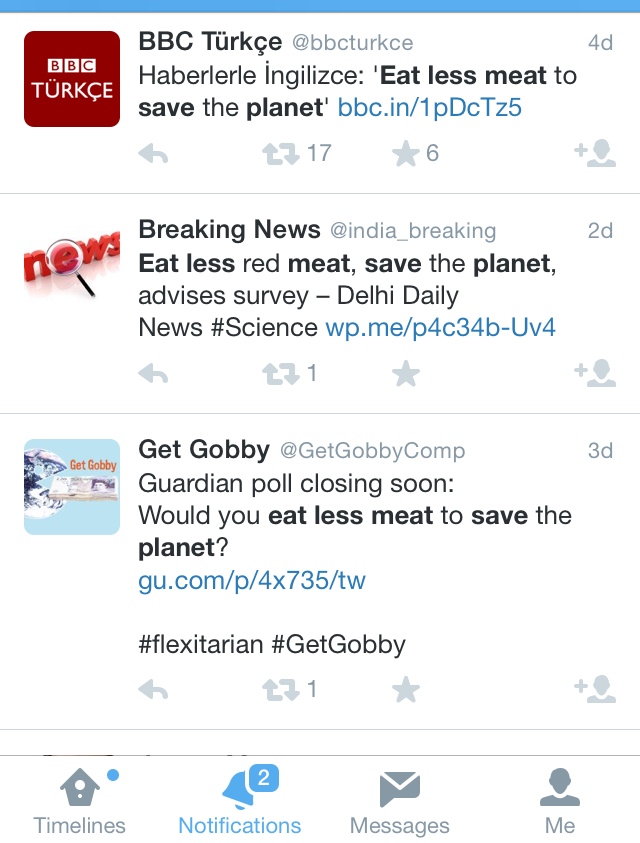
Less meatThe  suggestion that we should eat less meat in order to save the planet pops up with monotonous regularity in my twitter feed. Interestingly, those who make this claim are almost always vegetarian, vegan or profess to eat very little meat. This is rather like me asserting that we could mitigate climate change and save resources by eating fewer bananas and curbing our windsurfing habits. I loathe bananas, and if you ever see me windsurfing you’d better be sure that there’s a nearby hospital bed and neck brace with my name on it. As you can imagine, giving up either activity would have little impact on my life.

This is why I find it interesting and rather facile that those who do not eat meat proclaim fleshy abstinence as the way forwards. It’s easy to preach a solution that has no impact on your life – far harder to make a dietary or lifestyle change that actually impacts you.

The “eat less meat” movement would have far more credibility if it was promoted by a hunting, fishing, grilling, hamburger-lover who publicly declared his/her love for meat in all it’s many forms, and bemoaned the fact that they felt they should forgo the steak in favor of the tofu stir-fry. Yet this doesn’t happen. Why? Because the vast majority of us simply don’t feel that an intangible threat (we can’t see or feel climate change, or conceptualize the quantity of oil reserves remaining) is sufficient to make us give up our carnitas burrito. In reality, meat eating is only likely to decline if it becomes too expensive or subject to regulatory sanctions (e.g. rationing similar to that in Britain during WWII). The influx of papers suggesting that we should reduce consumption therefore fall on deaf ears.

So let’s face the facts. Neither the national or global population is likely to reduce meat consumption in the near future, and the rising income per capita in India and China will increase demand for meat still further. Instead of making recommendations based on notional utopias, let’s focus on areas where we can really improve.

Amazing gains in productivity have allowed the beef, dairy, pork and egg industry to considerably reduce resource use and greenhouse gas emissions over the last century. With a culture of continuous improvement and access to technologies that improve productivity, we can feed the future population using even fewer resources.

Let’s make better use of the multifarious by-products from the human food and fiber industry. Ruminants are blessed with the ability to digest fibers and plant materials that we either can’t or won’t eat – using by-product feeds to replace corn and soy refutes the claim that livestock compete with humans for food.

Finally, take a look at your own plate. Globally, 33% of food is wasted. Just think of the reductions in resource use we could achieve (and people we could feed) if all the crops planted, fruit picked, and milk, meat and eggs produced were consumed, rather than just 2/3 of them.

We evoke change by leading by example – I’m off to enjoy a steak, conventionally-raised using 12% less water, 19% less feed and 33% less land than its equivalent in 1977. You’d better believe that if there’s any left, it’s going in a sandwich tomorrow. As my Grandma used to say: Waste not, want not.

Beef is Killing the Planet…and Elvis is Riding a Rainbow-Belching Unicorn

BurgerMy Twitter feed just exploded. Yet another study has been released claiming that if we all just gave up beef, the planet would be saved, Elvis would come back from the dead, and rainbow-belching unicorns would graze the Northern Great Plains. I may have exaggerated a little with the latter two claims, but the extent of media coverage related to the paper “Land, irrigation water, greenhouse gas and reactive nitrogen burdens of meat, eggs and dairy production in the United States” seems to suggest that the results within are as exciting as seeing Elvis riding one of those unicorns…but they’re also about as believable.

Much as we’d all like to stick our fingers in our ears and sing “La la la la” whenever anybody mentions greenhouse gases or water footprints, we cannot deny that beef has an environmental impact. Yet, here’s the rub – so does every single thing we eat. From apples to zucchini; Twinkies to organically-grown, hand-harvested, polished-by-mountain-virgins, heirloom tomatoes. Some impacts are positive (providing habitat for wildlife and birds), some are negative (nutrient run-off into water courses), but all foods use natural resources (land, water, fossil fuels) and are associated with greenhouse gas emissions.

So is this simply another attack on the beef industry from vegetarian authors out to promote an agenda? Possibly. The inclusion of multiple phrases suggesting that we should replace beef with other protein sources seems to indicate so. But regardless of whether it’s part of the big bad vegan agenda, or simply a paper from a scientist whose dietary choices happen to complement the topic of his scientific papers, the fact remains that it’s been published in a world-renowned journal and should therefore be seen as an example of good science.

Or should it?

I’m the first to rely on scientific, peer-reviewed papers as being the holy grail for facts and figures, but there’s a distressing trend for authors to excuse poor scientific analysis by stating that high-quality data was not available. It’s simple. Just like a recipe – if you put junk in, you get junk out. So if one of the major data inputs to your analysis (in this case, feed efficiency data) is less than reliable, the accuracy of your conclusions is….? Yep. As useful as a chocolate teapot.

Feed efficiency is the cut-and-paste, go-to argument for activist groups opposed to animal agriculture. Claims that beef uses 10, 20 or even 30 lbs of corn per lb of beef are commonly used (as in this paper) as justification for abolishing beef production. However, in this case, the argument falls flat, because, rather than using modern feed efficiency data, the authors employed USDA data, which has not been updated for 30 years. That’s rather like assuming a computer from the early 1980’s (I used to play “donkey” on such a black/green screened behemoth) is as efficient as a modern laptop, or that the original brick-sized “car phones” were equal to modern iPhones. If we look back at the environmental impact of the beef industry 30 years ago, we see that modern beef production uses 30% fewer animals, 19% less feed, 12% less water, 33% less land and has a 16% lower carbon footprint. Given the archaic data used, is it really surprising that this latest paper overestimates beef’s environmental impact?

The authors also seem to assume that feed comes in a big sack labeled “Animal Feed” (from the Roadrunner cartoon ACME Feed Co?) and is fed interchangeably to pigs, poultry and cattle. As I’ve blogged about before, we can’t simply examine feed efficiency as a basis for whether we should choose the steak or the chicken breast for dinner, we also have to examine the potential competition between animal feed and human food. When we look at the proportion of ingredients in livestock diets that are human-edible (e.g. corn, soy) vs. inedible (e.g. grass, other forages, by-products), milk and beef are better choices than pork and poultry due to the heavy reliance of monogastric animals on concentrate feeds. By-product feeds are also completely excluded from the analysis, which makes me wonder precisely what the authors think happens to the millions of tons of cottonseed meal, citrus pulp, distillers grains, sunflower seed meal etc, produced in the USA each year.

Finally, the authors claim that cattle use 28x more land than pigs or poultry – although they acknowledge that cattle are raised on pasture, it’s not included in the calculations, which assume that cattle are fed feedlot diets for the majority of their life. This is a gross error and underlines their complete ignorance of the U.S. beef industry. Without cow-calf operations, the U.S. beef industry simply would not exist – efficient use of rangeland upon which we cannot grow human food crops both provides the foundation for the beef industry and creates and maintains habitats for many rare and endangered species of plants, insects, birds and animals.

Want to know how to reduce the environmental impact of food production overnight? It’s very simple – and it doesn’t involve giving up beef. Globally we waste 30% of food – and in developed countries that’s almost always avoidable at the consumer level. Buy the right amount, don’t leave it in the fridge to go moldy, and learn to use odd bits of food in soups or stews. Our parents and grandparents did it out of necessity – we can do it to reduce resource use and greenhouse gas emissions; and take the wind out of the sails of bean-eating anti-beef activists.

Are We Increasing Resource Use and Taking Beef from the Mouths of Hungry Children?

Bull eatingCan we really afford to lose the sustainability advantages that productivity-enhancing tools provide?

Beta agonists have been a hotly debated topic in the media recently, after it was suggested that the use of Zilmax™ might be related to welfare issues in supplemented cattle (see note 1), and Tyson announced that they would not purchase cattle produced using the feed supplement.

As the global population increases and consumer interest in food production sustainability continues to grow, we know that to maintain the continuous improvements in beef sustainability that we’ve seen over the past half-century, we need to ensure that economic viability, environmental responsibility and social acceptability are all in place. All cattle producers obviously have the choice as to what tools and practices are used within their operation, but what are the big picture environmental and economic implications of removing technology use from beef production? Let’s look at two tools – beta agonists and implants (see note 2 below for an explanation of these tools).

Figure 1. Extra Cattle NeededIn a traditional beef production system using both tools, we’d need 85 million total cattle (see note 3) to maintain the U.S. annual production of 26 billion lbs of beef (see note 4). If we removed beta-agonists from U.S. beef production we’d need an extra 3.5 million total cattle to support beef production; losing access to implants would require an extra 9.9 million cattle; and removing both tools would increase total cattle numbers to 100 million (a 15 million head increase) to maintain the current beef supply (see note 5).

If we need more cattle to maintain beef supply, we use more resources and have a greater carbon footprint.

If we removed beta-agonists, we would need more natural resources to maintain U.S. beef production:

  • More water, equivalent to supplying 1.9 million U.S. households annually (195 billion gallons)
  • More land, equivalent to an area just bigger than Maryland (14.0 thousand sq-miles)
  • More fossil fuels, equivalent to heating 38 thousand U.S. households for a year (3,123 billion BTU)

If we removed implants, we would need more natural resources to maintain U.S. beef production:

  • More water, equivalent to supplying 4.5 million U.S. households annually (457 billion gallons)
  • More land, equivalent to the area of South Carolina (31.6 thousand sq-miles)
  • More fossil fuels, equivalent to heating 45 thousand U.S. households for a year (3,703 billion BTU)

If we removed both beta-agonists and implants, we would need more natural resources to maintain U.S. beef production:

  • More water, equivalent to supplying 7.3 million U.S. households annually (741 billion gallons)
  • More land, equivalent to the area of Louisiana (51.9 thousand sq-miles)
  • More fossil fuels, equivalent to heating 98 thousand U.S. households for a year (8,047 billion BTU)

Water infographic

Land infographicFuel infographicBeef production costs would also increase if these tools weren’t used. Feed costs would increase by 4.0% without beta-agonists, 8.1% without implants and 11.0% without both tools. These costs ultimately would be passed on through every segment of the beef supply chain (including the retailer or food service segment) and ultimately onto the consumer, making beef a less-affordable protein choice.

In a world where one in seven children currently do not have enough food, keeping food affordable is key to improving their health and well-being. If we use productivity-enhancing tools in one single animal, the extra beef produced is sufficient to supply seven schoolchildren with their beef-containing school meals for an entire year. Is that a social sustainability advantage that we can afford to lose?

Although animal welfare is paramount for all beef production stakeholders from the cow-calf operator to the retailer, it is possible that the consumer perception of productivity-enhancing tools  may be harmed by negative comments on media articles relating to Zilmax™. There is no doubt that we will need to use technologies within food production in order to feed the growing global population, yet we need consumer acceptance of both the technologies that we use, and the reasons why we use them, in order to continue to secure market access for U.S. beef.

Consumer acceptance therefore needs to be a key component of our mission to continuously improve beef sustainability. That does not mean giving in to the uninformed whims of those who blithely assert that we could feed the world by returning to the production systems of the 1940’s or ’50s, but does offer an opportunity to reach out, listen to and engage in a dialogue with our friends, family, customers and colleagues about the advantages that technology offers. We have a bright future ahead, but only if we keep the torch alight.

To read more conversation about the use of technologies within beef production (including the real-life experiences of feedyard operators who use these tools) and for facts and figures relating to beef production, please check out the following websites: Feedyard Foodie, Ask a FarmerFacts About Beef, and the U.S. Farmers and Ranchers Alliance.

Footnotes

1) Merck Animal Health have since pledged to conduct a thorough investigation into the issue and have temporarily suspended Zilmax™ sales in the U.S. and Canada.

2) Beta agonists are animal feed ingredients that help cattle maintain their natural muscle-building ability and add about 20-30 pounds of additional lean muscle instead of fat. Implants (sometimes called growth promotants or growth hormones), are placed into the ear and release hormones slowly, helping cattle maintain natural muscle-building ability while also decreasing the amount of fat gained. 

3) Includes beef cows, calves, bulls, replacement animals, stockers and feedlot cattle plus calves and cull cows from the dairy system.

4) Although this is a considerable amount of beef, it’s still not enough to fulfill current demand for beef in the USA and overseas. 

5) This work was presented as a poster at the Joint Annual Meeting of the American Dairy Science Association and American Society of Animal Science in Indianapolis, IN in July 2013. The poster is available for download here

Meatless Mondays.. or More Veg Mondays?

I consider myself to be an omnivore. I love meat – the smell of grilling beef or lamb turns me into a human version of Scooby Doo drooling and begging for a Scooby snack, and I’ve been known to arm-wrestle people for the last bratwurst. I love vegetables even more than meat – anyone examining my grocery-shopping list might conclude that I have an entire colony of rabbits to support with radishes, asparagus and zucchini, and I simply don’t understand those people who don’t find immense pleasure in eating “green stuff”. Given that the Meatless Mondays campaign apparently aims to “introduce consumers to the wide variety of healthy, delicious plant-based foods available”, you might think I’d be all over it like butter on a baked potato (be still my beating heart). Yet the very phrase causes my blood pressure to rise. Snacking on carrots, celery and olives in Delta Airlines’ Sky Lounges rather than buying deep-fried Taco Bell at the airport fills me with joy, but when I order a pizza, it’s always the vegetarian supreme…with added Italian sausage.

There it is – the added sausage. Meaty, spicy goodness that adds another layer of flavor to my pizza and that, as meat, I consider to be an essential component of my diet. In the US we are more food-centered than ever before – Facebook albums are titled “food porn” and chefs are celebrities. Yet we also seem to be moving towards a culture where individual foods or nutrients are demonized. “Fat-free” and “sugar-free” are marketing terms that imply that specific nutrients are undesirable in our diet; whole aisles are devoted to gluten-free foods despite the fact that celiac disease found in less than 1% of the population; and who doesn’t have a friend who is diligently avoiding carbs, dairy or red meat on “health grounds”? Why has our society evolved to the point where those who can afford the greatest variety of foods are the most likely to demand a gluten-free, dairy-free, low-carbohydrate, macrobiotic diet as a mark of their elite status?*

Abstinence, whether on dietary or moral grounds, has always been synonymous with purity, sacrifice, and a certain level of sanctimoniousness. I am purer than you because I don’t give in to my dark desires for <<insert your sin of choice here>>. The Meatless Mondays campaign plays the abstinence hand beautifully – give up your selfish meat-eating habits for one day per week and you too can save the world by eating a bean burrito. The Humane Society of the United States inevitably supports the Meatless Mondays campaign, their comment (expressed verbatim in almost every press-release) being that it “helps spare animals from factory farms, helps our environment, and improves our health”. If “meatless” is the way forwards, meat must be an undesirable food and vegetarian diets must be healthier, just as fat-free Oreo cookies would be presumed to be a wiser nutritional choice than regular Oreos (interestingly, their calorie contents are almost identical). Yet the national carbon footprint would be reduced by less than half of one percent if everybody adopted Meatless Mondays for an entire year, and the propounded effects of meat consumption on health have not been borne out by science.

When a school district or college campus adopts the Meatless Mondays campaign, I don’t hear the buzz of black helicopters and see the hand of Wayne Pacelle on the throttle. However, I am deeply disappointed that a campaign demonizing meat consumption, suggesting that eating a hamburger is comparable to the environmental equivalent of driving at 120 mph in a Hummer or the health effects of smoking 20 cigarettes per day, is considered by so many to be a positive move forwards in feeding a hungry world. I am not suggesting that we should all eat a 16 oz T-bone steak for every meal, or that vegetarianism or veganism are not valid dietary choices. Indeed, I propose that meat-eaters be afforded the same courtesy as vegetarians or vegans – to choose foods according to their individual or religious beliefs.

So what is the future for Meatless Mondays? It’s very simple. If this campaign really aims to expose people to a wider range of vegetables and plant-based food choices, let’s simply christen it “More Veg Mondays”. Have an extra helping of broccoli with your steak, try eggplant parmegana alongside your hotdog, or replace crackers with raw celery and radishes. Rather than demonizing individual foods, let’s celebrate the fabulous variety of choices that are available to us and that allow us the opportunity to eat a balanced diet every single day. Ironically, yesterday my Monday was almost meatless – I spent the day traveling and subsisting on dried mango, chocolate-covered coffee beans and vitamin water in Chilean airports. However, I made up for it once I reached Córdoba – the Iberian ham on my pizza was the best I ever tasted, and made better by the rocket, tomatoes and olives that accompanied it (see picture above). Eat more vegetables? In an instant. Give up meat on Mondays? As Charlton Heston would say: only when you pry it from my cold dead hands.

*Please note that I do not include those who have demonstrable food allergies in this group

Can We Please Have Calls for Moderating Meat Consumption… in Moderation?

Do we need to moderate meat consumption in order to feed the world in 2050? Given beef producers’ track record of ingenuity, it’s possible but not probable.

A Twitter follower (Tweep? Twriend? Twquaintance?) asked yesterday whether we could really supply 9+ billion people with 250 lb of meat per capita in 2050. The question stemmed from a recent paper in which Stockholm scientists claimed that we would all have to reduce meat consumption by 75% by 2050 in order to have enough water to supply the population, and a subsequent rejoinder from the American Society of Animal Science in which several scientists noted the flaws in the Swedish paper, the importance of animal-source foods in the diet and the use of marginal land for grazing livestock.

On Twitter, the comment was made that there appear to be two distinct sides to this argument – one side (the environmentalists and anti-animal agriculture groups) warning that we need to drastically cut meat consumption in order to feed everybody, and the other (the meat industry) turning a blind eye and effectively promoting the idea that we can eat all the meat that we like without having any environmental impact.

Globally, we’re nowhere near 250 lb meat consumption per capita, even US consumers who are often portrayed as meat-guzzling bacon-o-philes by the Huffington Post et al. have an average annual consumption of 171 lb according to the USDA. As current beef consumption is 58 lb per capita in the USA, that’s a lot of pork and chicken that will presumably make up the difference. There’s no doubt that increases in both population size and per capita income in regions such as China and India will have a significant impact on global meat consumption by 2050. However, I have to admit I find the “blind eye” comment a little hard to swallow, given, for example, the beef industry’s commitment to measuring and mitigating both resource use and carbon emissions through current life cycle analysis research, and involvement with groups such as the Global Roundtable for Sustainable Beef.

There is no doubt that beef production uses considerable amounts of land and water, yet should we expect producers to effectively shoot themselves in the foot and suggest that consumers forgo a cheeseburger in favor of an alfalfa sprout salad? Isn’t improved efficiency a characteristic of every successful industry? The motor industry is a major contributor to environmental concerns, yet automobile manufacturers aren’t saying “we’re going to produce cars in the same way that we did in the ‘50s, you’ll just have to drive less”. Instead, the message is something akin to “we’re making cars more energy-efficient so that you can continue to drive without worrying about your car’s environmental impact.

That’s exactly what the beef industry has done, is doing and will continue to do into the future. Since 1977, the US beef industry has cut water use by 12%, land use by 33% and the carbon footprint of one lb of beef by 16%. Providing that producers are still able to use management practices and technologies that improve efficiency, further reductions should be seen in future. Yet we have to look beyond the idea that the USA can feed the world by itself. I’m writing this post from Brazil, which has a huge beef industry, yet on average, Brazilian beef cattle first calve at 4 years of age, only 67% of cows have a calf each year and beef animals take 3 years to reach slaughter weight. Comparisons to the equivalent US figures (2 years, 91% and 15 months respectively), show the potential for amazing reductions in resource use from Brazilian beef production, and this, along with other less-efficient systems, is where we have to focus in future. It’s not about forcing US-style production on every producer; it’s about enabling producers to make the best and most efficient use of resources according to their management system and region. Brazil has just approved the use of beta-agonists in beef production, which will allow the production of more beef using fewer resources. This is just one step on the road to improved efficiency.

So do we need to moderate meat consumption in order to feed the world in 2050? I’d love to be able to answer this by citing a published paper that has taken improvements in meat industry productivity over the next 40 years into account rather than assuming a “business as normal” outcome. In the absence of such a paper, I’ll give a Magic 8-Ball type answer: Given beef producers’ track record of ingenuity, it’s possible but not probable. Globally, there are huge opportunities for improved efficiency and concurrent reductions in resource use from all meat production systems – the key is not to reduce meat production but simply to produce it more efficiently.

All Aboard the “Eat Less Meat” Bandwagon

One of the main criteria for publishing scientific research is that it should be novel, yet not a week goes by without yet another paper concluding that we have to reduce meat consumption in order to mitigate climate change. That’s the headline in media coverage relating to the latest paper from a researcher at the The Woods Hole Research Center (published in Environmental Letters), which examines nitrous oxide emissions (a highly potent greenhouse gas (GHG)) in 2050 under various scenarios.

It’s an interesting paper, not least for some of the assumptions buried within the model. Based on data from the FAO, the authors assume that meat consumption will increase by 14% in the developed world and 32% in the developing world by 2050. Coupled with the predicted population global increase (from the current 7 billion to 8.9 billion in 2050), it’s not surprising that a 50% reduction in meat consumption would be predicted to have a significant effect on total GHG. It’s rather akin to suggesting that each person will own two automobiles in 2050, so we should reduce car manufacture.

However, the more striking result is buried in Figure 1, showing that if efficiency of manure management and fertilizer application were improved, this would have a more significant effect on GHG emissions than reducing meat consumption. Given the considerable improvements in cropping practices, crop genetics and yields over the past 50 years there is absolutely no reason why this should not be achieved in the next 40 years.

Alas, a headline suggesting that agriculture needs to continue to improve manure and fertilizer efficiency just isn’t as sexy as the “eat less meat, save the planet” message so often propounded by the mass media. They say that bad news sells – it’s a shame that the lay press are so enamored with messages that denigrate ruminant production, rather than taking a broader look at the options available for mitigating future climate change.

*Thanks to Jesse R. Bussard for bringing this one to the forefront of my “to do “ list.

Taking the pledge – Meat as the new Mephistopheles?

Post-prohibition, is meat the new devil?

My Grandpa, a strict Methodist, took the pledge to abstain from alcohol back in the 1940’s when the church was endorsing Prohibition via the Temperance movement in the UK. It was an entirely personal choice for him, one that he felt was right for his lifestyle and a cause that he didn’t try to recruit other people to join. Admittedly it filtered down to his children and even had some influence on his grandchildren, although for my brothers, cousins and me the effect is now somewhat akin to adding a single ice-cube to a tumbler of whiskey.

In 1889, George Sim described slum areas where drinking was commonplace thus:

The gin-palace is heaven to them compared to the hell of their pestilent homes… The drink dulls every sense of shame, takes the sharp edge from sorrow, and leaves the drinker for awhile in a fools’ paradise… It is not only crime and vice and disorder flourish luxuriantly in these colonies, through the dirt and discomfort bred of intemperance of the inhabitants, but the effect upon the children is terrible. The offspring of drunken fathers and mothers inherit not only a tendency to vice, but they come into the world physically and mentally unfit to conquer in life’s battle. The wretched, stunted, misshapen child-object one comes upon in these localities is the most painful part of our explorers’ experience. The country asylums are crowded with pauper idiots and lunatics, who owe their wretched condition of the sin of the parents, and the rates are heavily burdened with the maintenance of the idiot offspring of drunkenness.

Given such strong words, it’s not surprising that alcohol was considered by many to be the root of all evil. In this modern world, where a myriad of organizations exist to help us with our addictions to the more insidiously hedonistic pleasures in life*, surely we are beyond taking the pledge?

Alas no, the Environmental Working Group is at it again, this time with a pledge that they aim to get 100,000 supporters to sign. That’s right, you can save the planet by simply clicking a button on the internet stating that:

I pledge to skip meat one day a week and to include more healthy fruits and vegetables in my diet. Not only will I be doing something good for my body, I’ll also be doing something good for the environment.

So, let’s assume 100,000 people sign up for this. That will cut the USA’s carbon footprint by 0.00014% (it would only be 0.44% if the entire population took the pledge *and* actually stuck to it). Hardly a significant environmental effect.

What would you replace meat with? Jack-in-a-Box Jalapeno poppers? A couple of Twinkies? A 1/2 lb soy burger? It’s rational to assume that giving up meat for one day a week will not suddenly cause everybody to have more time to cook, or to prepare fresh exotic salads from scratch – the basic food preferences will stay the same, simply without meat.

So the chicken breast, hamburger or pork chop is replaced by a vegetarian burrito – one from Chipotle no less, which has made a big play of not using rbST and other hormones. According to USDA’s nutrient database, the calorie content of an 8 oz steak is 581 calories with 35 grams of fat.  An 8 oz pork chop has 524 calories with 38 grams of fat. The vegetarian burrito? Chipotle lists nutritional information by ingredient, luckily the handy dandy My Fitness Pal website has put together all those ingredients –  750 calories with 27 grams of fat. Hardly a short-cut to becoming a lean, mean fitness machine.

Life is all about choices, and all dietary choices have environmental and health consequences. The Temperance movement believed abstaining from alcohol made for a better life and (via Methodism) a promise of a better afterlife. Can the same really said of abstaining from meat for one day per week? Should meat be renamed Mephistopheles – or is abstention simply another short-term panacea by which we can feel better about our health, environment and karma via bad science and vegetarian spin?

*Personally, I need a “Cinnabon Lovers Anonymous” help-group