Planes, Trains and Automobiles: Why Mass Food Transport is Eco-Friendly

Food transportation. It’s the curse of the modern world. Just think how much brighter and sunnier the planet would be if we all shopped locally, tootling along on our bicycles to pick up freshly-baked bread and a dozen eggs just as our grandparents would have done. A brave new world unemcumbered by gas pumps and trucks. Except…. Well, no. It’s not that simple.

Food miles 2 In many cases, transport is a tiny proportion of total greenhouse gas emissions per unit of food – for example, it’s less than 1% of the carbon footprint of one lb of beef. However, food miles are often cited as an environmental proxy to differentiate between food choices, the assumption being that an egg which travels 2,000 miles across the country is less environmentally-friendly than one produced in the next county. Indeed, one farm website proclaims that “We do not ship anything anywhere. We encourage folks to find their local producers and patronise them”, while on the same page, a customer testimonial proudly proclaims: “I drive to <Farm X> 150 miles one-way in order to buy clean meat for my family”.
Food miles 4Given the dichotomy between these two statements, let’s compare buying eggs from a grocery store with a local farm (full analysis here). Food miles are far greater for eggs that have traveled from Texas to Virginia to be sold in the grocery store (2,405 miles round-trip), compared to driving to the local farm (300 miles round-trip); and the fuel efficiency is far worse for a truck (5.4 mpg) than a car (22.6 mpg); yet a modern truck can carry 23,400 dozen eggs.
Food miles 6Unless your car is packed to the roof with eggs, traveling to the farm to buy them emits 55X more greenhouse gas emissions than driving to the store to buy them. Bottom line? Unless the local farm is closer than the store, or you’re able to walk/cycle there*, it’s more environmentally-friendly to buy eggs from the store, because the greenhouse gas emissions attributable to one dozen eggs out of 23,400 dozen is a tiny fraction of the total.
One report claims that greenhouse gas emissions from one large container ship is equivalent to 50 million cars – however, in this instance it’s the result of sulphur dioxide emissions from poor quality shipping fuel rather than inefficiency. Mass transport may not have a feel-good factor associated with driving out to a farm, but it allows us to enjoy a wide variety of affordable foods with a low carbon footprint – essential factors for a sustainable food future.
*Which begs the question of how many eggs you can carry on a bicycle…

Is It Time We Stopped Shouting About The Dietary Guidelines?

The recent report by the advisory committee to the USDA dietary guidelines has certainly caused a media stir in the past week or so. There’s a lot of nutritional common sense in the report – eat more fruit, veg, and dairy, reduce carbs and sweetened drinks/snacks, and moderate alcohol intake. Yet there’s a kicker – from both a health and a sustainability perspective, Americans should apparently be guided to consume less animal-based foods.

10982813_934682089898559_3461048965358255082_oWhen the report was released, my Twitter notifications, Facebook feed and email inbox exploded. Memes like the one to the left appeared on every (virtual) street corner, and the report was mentioned in every online newsletter, whether agricultural or mainstream media. It’s this press coverage rather than the content of the report, that really concerns me.

Individuals don’t pay a lot of attention to a government report on nutrition. Despite the fact that six updates to the guidelines have been released since their inception in 1980, we are all still eating too many Twinkies in front of the TV and super-sized takeout meals in the car, rather than chowing down on broccoli and lentil quinoa bake.

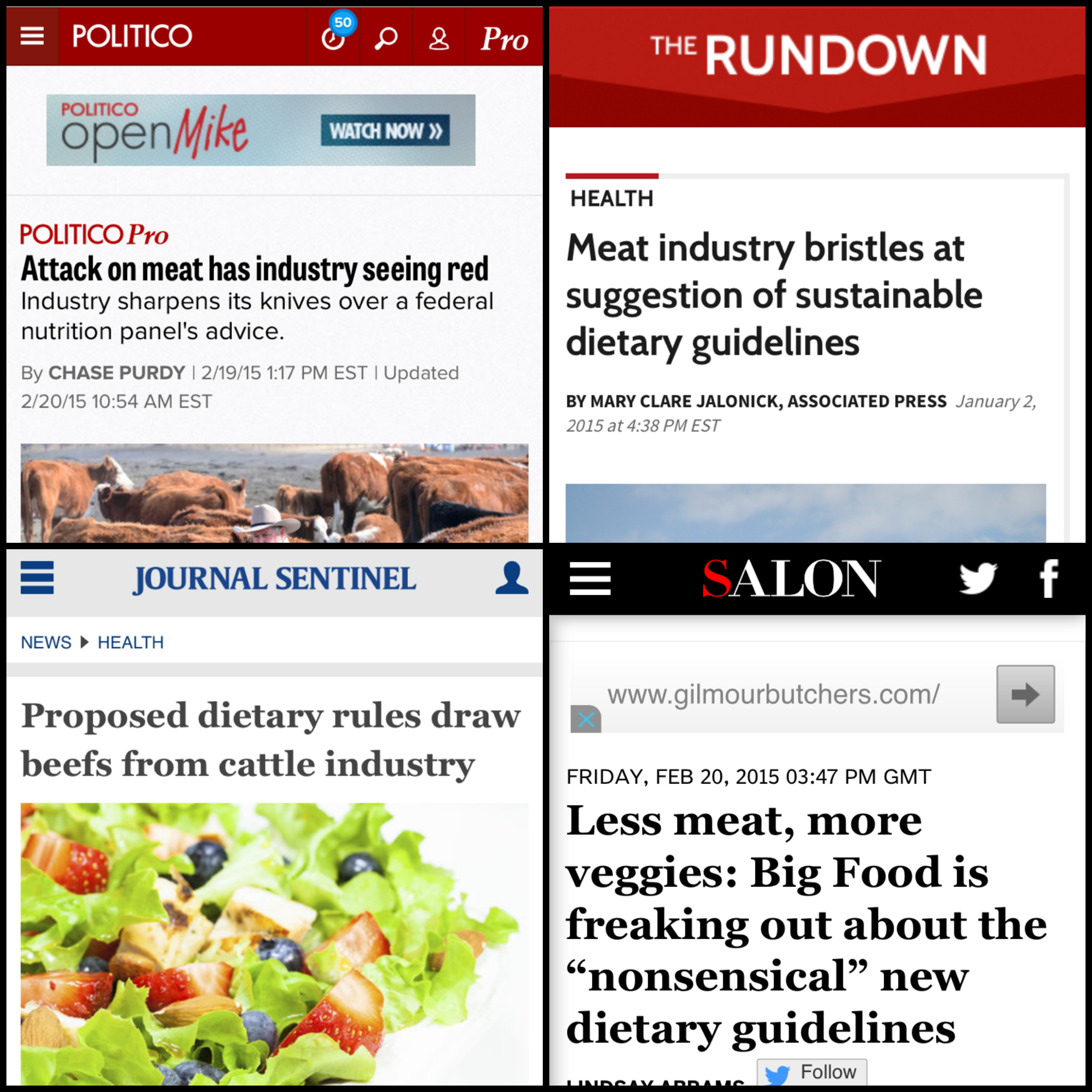
Headlines CollageYet people do pay attention to headlines like “Less meat, more veggies: big food is freaking out about the “nonsensical” new dietary guidelines” and others shown to the left. The media sub-text is that big bad food producers (so different from the lovely local farmer who sells heirloom breed poultry at $18/lb at the farmers market) are appalled by the release of this governmental bad science that’s keeping them from their quest to keep you unhealthily addicted to triple cheeseburgers washed down with a 500-calorie soda, and will do anything to suppress it.

This makes me wonder – at what point do we need quiet, stealthy change, rather than loud protests that attract the attention of people who would otherwise never have read about the guidelines? At what point does industry protesting seem like a modern version of “The lady doth protest too much“?

Rather than posting on Facebook or Twitter that the report is nonsense because the committee of nutritionists ventured into the bottomless pit that is sustainability; why don’t we instead extol the virtues of producing high-quality, nutritious, safe and affordable lean meat, and aim to reach the people who haven’t seen the hyperbolic headlines or read the guidelines simply because they’ve seen a lot of talk about them on Twitter? The old showbiz saying that there’s no such thing as bad publicity certainly applies here – the extent of the reporting on the industry backlash against the report means they have probably been noted by far more people that they otherwise might.

The impact of the dietary guidelines recommendations upon purchasing programs is far higher than on individuals, and does give rise to concern. Globally, one in seven children don’t have enough food, and school lunches are often the only guaranteed source of high-quality protein available to children in impoverished families. I may be being overly sceptical, but I suspect that if meat consumption in schools is reduced, it’s unlikely to be replaced with a visually and gastronomically-appealing, nutritionally-complete vegetarian alternative.

Sustainability doesn’t just mean carbon, indeed, environmentally it extends far further than the land, water and energy use assessed by the dietary guidelines advisory committee into far bigger questions. These include the fact that we cannot grow human food crops on all types of land; water quality vs. quantity; the need to protect wildlife biodiversity in marginal and rangeland environments; the use of animal manures vs. inorganic fertilisers; environmental costs of sourcing replacements for animal by-products in manufacturing and other industries; and many other issues. Simply stating that meat-based diet X has a higher carbon footprint or land use than plant-based diet Y is not sufficient justification for 316 million people to reduce their consumption of a specific food. Indeed, despite the conclusions of the committee, data from the US EPA attributing only 2.1% of the national carbon footprint to meat production suggests that even if everybody reduced their intake of beef, lamb and pork, it would have a negligible effect on carbon emissions.

Could we all reduce our individual environmental impact? Absolutely. Yet as stated with regards to dietary change in the advisory report, it has to be done with consideration for our individual biological, medical and cultural requirements. As humans, we have biological and medical requirements for dietary protein, and some would even argue that grilling a 16-oz ribeye is a cultural event. I have every sympathy for the USDA committee*, who were faced with a Herculean task to fulfill, but in this case, they only succeeded in cutting off one head from the multi-craniumed Hydra – and it grew another 50 in its place.

*Many people have already commented on the suitability (or not) of the committee to evaluate diet sustainability, but to give them their due, they do appear to have looked beyond greenhouse gases to land, water and energy use. They are nutrition specialists, not sustainability experts, but it would be difficult (impossible) to find a committee comprising people who were all experts in nutrition, sustainability, economics, policy, behaviour and all the other facets of the report. Nonetheless, the sustainability recommendations appear to be based on a small number of papers, many of which are based on dietary information from other regions (Germany, UK, Italy) which will also have different levels of animal and crop production. As somebody who was born and bred in the UK before moving to the USA I find it difficult to believe that the average American’s diet uses substantially more land (for example) than the average UK person, as cited in the report.

A Christmas Wish – May All Your Cows Be Like Your Best Cow

I love conversations that leave my brain firing on a million cylinders and open my mind to new ideas. I was lucky enough to have three such discussions this past week, one at an organic research farm; another at a 300-cow Jersey operation; and the most recent with three faculty at the University of Oxford with regards to the interactions between animal welfare and livestock sustainability.

Animal welfare is a touchy subject – many people appear to define excellent welfare as only including a narrow range of production systems or practices; and although everybody has their own image of what a “happy” animal looks like, it’s not always easy to identify or describe those systems without anthropomorphizing. Indeed, I’ve become increasingly aware that promoting improved productivity and efficiency as a means to improve sustainability can be misconstrued as encouraging the agricultural equivalent of a owning a Victorian dancing bear or cymbal-playing monkey – a “force the animals to perform, regardless of the cost in terms of animal welfare”-type philosophy (see picture below).

Troll


Yet such suggestions entirely miss the point, as any system that is consistently detrimental  to animal welfare is neither productive nor efficient on a long-term basis. We humans don’t perform well if we’re chronically underfed, stressed, sick, or housed in unfavorable environmental conditions – and neither do livestock.

Personally, my agricultural utopia would be one where all livestock operations, regardless of size, location or production system, exhibit both high productivity and excellent animal welfare. Admittedly, this leads to the difficult task of not only defining excellent welfare, but also the metrics and benchmarks by which it can be assessed within each operation. However, there is one overarching metric that can be measured, and improved on any farm or ranch – animal health. By definition, an animal that is chronically sick, lame or in pain cannot be said to be a example of good welfare.

As consumers, we want to know that the animals that provide us with milk, meat and eggs are healthy. Indeed, I imagine that even the most militant vegan opposed to the consumption of animal products would agree that animal health should be paramount. As producers, making sure that livestock are healthy is as ethically important as treating workers well. Plus, healthy animals are easier to manage: they grow faster; they have fewer incidents of  illness or death; and they produce more milk, meat or eggs. These improvements in efficiency and productivity also mean that we need less feed, less land, less water and have a lower carbon footprint per unit of food produced.

Let’s consider lameness in dairy cattle. A major animal welfare issue, it costs between $120 and $216 per incidence (UK costs below)* and is a major cause of cows being culled at or even before the end of their second lactation. Similarly, mastitis has a huge impact on both cow longevity and productivity, and costs the US dairy industry $1.7-2.0 billion per year. If just these two health issues were addressed, how many associated dairy cattle health and welfare issues would be improved; how much could dairy farm profitability be enhanced; and how much would the public image of dairy improve?

Every herd has its best cow – the one who is never lame, doesn’t suffer from mastitis, metritis or ketosis; and gets back in calf easily – all while having a high milk (and components) yield. There is no magic bullet to improve productivity and efficiency –  yet the discussions I’ve had in the past week conclusively demonstrated that that does mean suiting your system to your available resources and, though excellent health, nutrition, breeding and management, allowing every cow to perform like your best cow, every single day. I wish you a Merry Christmas and hope that in 2015, all your cows will be like your best cow.

*Lameness costs £180 pounds per incidence in the UK, or £15,000 per average herd annually. Mastitis costs the UK dairy industry £170 million per year.

Would Being Vegan Really Solve Climate Change? Not if We Don’t Kill the Cows.

OLYMPUS DIGITAL CAMERAA friend of mine drew my attention to this NPR blogger, who makes the point that being “good” isn’t zero sum (a situation where what is gained by one side or cause, is lost by another). If you’re concerned about the environment, you can both recycle cans and buy a more climate-friendly car. If you are passionate about children’s education, you can volunteer in the classroom and financially support literary projects. In most cases, doing good is not an either/or.

Which made me think a little more about the definition of “good”. To that writer it meant being vegan or vegetarian, in the belief that such a diet would improve animal welfare and environmental impact. Yet this is exactly where the conflict arises for me – if we were all vegan or vegetarian, what would happen to the sheep, the cow, the pig and the chicken?

I posed that question to a vegan on Twitter recently and he, in all sincerity, answered that we, as a vegan population, would care for the animals, but would not enslave or control them. Imagine the beautiful utopia where we all have time to calve a cow or throw some grain to feral pigs before we set off to work, expecting nothing in return. Or in a more realistic scenario, we’d have more meat than we knew what to do with simply through car accidents if we suddenly let loose the USA’s 87.7 million cattle (never mind the 62.1 million pigs, 5.2 millon sheep and 9+ billion chickens).

Anti-animal agriculture activists often purport that a cow can live for 20+ years in her “natural” state compared to a farmed animal – so being a data nerd, I did the maths*. Let’s assume that 1) cows first calve at two years of age and that 90% of cows (38.3 million of them in the US at present) have a calf every year**; 2) 85% of those calves survive (mortality would go up due to predation, assuming we wouldn’t shoot wolves, coyotes etc.); and 3) each cow or bull lives for 20 years. Admittedly that doesn’t account for the cattle that would die from starvation through lack of available grazing in 5, 10 or 20 years time, but being good vegans, we’d feed them, right?


Within five years we’d have 602 million cattle in the USA, within 20 years we’d have 3.7 billion – a 40-fold increase on our current national herd. That’s 40x more cattle belching methane, drinking water and producing waste, every single day, all as a result of our changing our diet in an attempt to reduce environmental impact.


It’s a nice, simplistic, oft-suggested argument that we shouldn’t eat meat or dairy products in order to save the planet, yet the conflict between veganism, animal welfare, and environmental impact is clear. Climate change will be solved by us turning vegan? Not unless we reconcile ourselves to killing animals without eating them.

*I’m British, and as such, cannot use the American term “math” as opposed to the British “maths”
**90% is the US average for cow-calf herds, in which few hormones or other reproductive aids are used

Vegetarians May Preach – But We’re Not All Members of the Choir

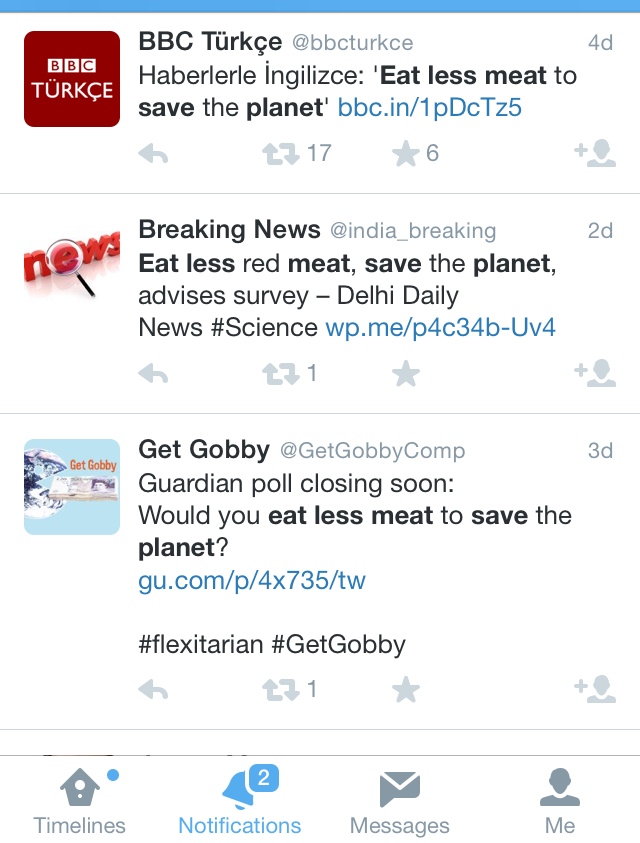
Less meatThe  suggestion that we should eat less meat in order to save the planet pops up with monotonous regularity in my twitter feed. Interestingly, those who make this claim are almost always vegetarian, vegan or profess to eat very little meat. This is rather like me asserting that we could mitigate climate change and save resources by eating fewer bananas and curbing our windsurfing habits. I loathe bananas, and if you ever see me windsurfing you’d better be sure that there’s a nearby hospital bed and neck brace with my name on it. As you can imagine, giving up either activity would have little impact on my life.

This is why I find it interesting and rather facile that those who do not eat meat proclaim fleshy abstinence as the way forwards. It’s easy to preach a solution that has no impact on your life – far harder to make a dietary or lifestyle change that actually impacts you.

The “eat less meat” movement would have far more credibility if it was promoted by a hunting, fishing, grilling, hamburger-lover who publicly declared his/her love for meat in all it’s many forms, and bemoaned the fact that they felt they should forgo the steak in favor of the tofu stir-fry. Yet this doesn’t happen. Why? Because the vast majority of us simply don’t feel that an intangible threat (we can’t see or feel climate change, or conceptualize the quantity of oil reserves remaining) is sufficient to make us give up our carnitas burrito. In reality, meat eating is only likely to decline if it becomes too expensive or subject to regulatory sanctions (e.g. rationing similar to that in Britain during WWII). The influx of papers suggesting that we should reduce consumption therefore fall on deaf ears.

So let’s face the facts. Neither the national or global population is likely to reduce meat consumption in the near future, and the rising income per capita in India and China will increase demand for meat still further. Instead of making recommendations based on notional utopias, let’s focus on areas where we can really improve.

Amazing gains in productivity have allowed the beef, dairy, pork and egg industry to considerably reduce resource use and greenhouse gas emissions over the last century. With a culture of continuous improvement and access to technologies that improve productivity, we can feed the future population using even fewer resources.

Let’s make better use of the multifarious by-products from the human food and fiber industry. Ruminants are blessed with the ability to digest fibers and plant materials that we either can’t or won’t eat – using by-product feeds to replace corn and soy refutes the claim that livestock compete with humans for food.

Finally, take a look at your own plate. Globally, 33% of food is wasted. Just think of the reductions in resource use we could achieve (and people we could feed) if all the crops planted, fruit picked, and milk, meat and eggs produced were consumed, rather than just 2/3 of them.

We evoke change by leading by example – I’m off to enjoy a steak, conventionally-raised using 12% less water, 19% less feed and 33% less land than its equivalent in 1977. You’d better believe that if there’s any left, it’s going in a sandwich tomorrow. As my Grandma used to say: Waste not, want not.

Farm Better and Feed the World…. Without Farmers?

Where's the beef...without ranchers?

Where’s the beef…without ranchers?

The New York Times is putting on a “Food for Tomorrow: Farm Better. Eat Better. Feed the World” conference in NY next month. This is a great idea – we all need to think more about our food choices and how we’re going to produce enough food to supply the population in 40 years time, when we’re predicted to have another 2-3 billion mouths to feed.

So just as a debate on the future of healthcare would include presentations from doctors and surgeons; or a discussion about how education could be improved would showcase teachers and lecturers; this conference is going to feature farmers, meat processors and animal and crop scientists, right?

No. Firstly, we have Michael Pollan, author and journalism professor, famous for the suggestion that if you can’t pronounce it, you shouldn’t eat it. Looks like quinoa, gnocchi and beignets are off the lunch menu? When participating in a recent radio panel discussion with Mr. Pollan it was frightening to note how uninformed he appeared to be about the realities of livestock production versus the activist rhetoric (or indeed, the common courtesies of polite conversation).

Secondly, Danielle Nierenberg. I had the pleasure of being on a panel in Washington DC with Ms Nierenberg when she was still on-staff at HSUS. She was vehemently against the use of technology in livestock production and claimed that all housed or confined cattle were kept in filthy disease-ridden conditions. She further claimed that, contrary to the World Health Organization’s information on the topic, bird flu did not exist in small backyard poultry flocks in Asia and that biosecurity in large poultry operations was responsible for its spread.

Thirdly, a spokesman from the Union of Concerned Scientists. A pseudo-scientific organization that is opposed to so-called industrial agriculture, GMOs, antibiotic use in agriculture, agribusiness, the USDA nutrition guidelines…. the list goes on.

Amongst the remaining 14 speakers, there is a self-proclaimed activist, a chef, a politician, 3 reporters, 2 academics, and finally, two representatives from the retail sector – Panera Bread (known most recently for their “EZ-chicken” campaign which was rescinded after outrage amongst agricultural advocates) and Walmart. The sole representative of the farming community is an organic dairy producer with a herd of 85 Ayrshire cows from Wales.

I’m not suggesting that none of these people have valid opinions on how food should be produced – as consumers, we all do. However, the fact that conventional food producers and processors aren’t involved in the discussion makes me wonder whether this is simply an opportunity for those who most often criticize the current food system to shake each other’s hands, nod happily in agreement and make proclamations about how things “should be”, without discussing the practicality or feasibility of these solutions with those who farm the land and raise livestock every single day.

Almost inevitably, the conclusions coming out of this conference will be that you should reduce consumption of processed and conventionally-produced foods, and that if you are going to eat a small amount of meat, it should be organically-raised. That’s a beautiful shiny picture – I wonder what it will mean to the single mother trying to feed four children on a $10,000 salary; or the livestock producer who simply cannot make a living producing organic cattle?

Starvation isn’t sustainable for anybody – to feed the world in 2050 we need real solutions that improve crop and animal performance while reducing resource use. Solutions that are provided by farmers and ranchers working together with geneticists, nutritionists, consultants, veterinarians, crop scientists, soil scientists and meat scientists to improve the productivity of their farm.

To bastardize the old saying: “Give a man a fish and you feed him for a day; teach a man to fish and you feed him for a lifetime; give a man a panel of 17 food “experts” and you’ll feed him for…..?” Cynically, I’d suggest the answer may be less than one meal.

Beef is Killing the Planet…and Elvis is Riding a Rainbow-Belching Unicorn

BurgerMy Twitter feed just exploded. Yet another study has been released claiming that if we all just gave up beef, the planet would be saved, Elvis would come back from the dead, and rainbow-belching unicorns would graze the Northern Great Plains. I may have exaggerated a little with the latter two claims, but the extent of media coverage related to the paper “Land, irrigation water, greenhouse gas and reactive nitrogen burdens of meat, eggs and dairy production in the United States” seems to suggest that the results within are as exciting as seeing Elvis riding one of those unicorns…but they’re also about as believable.

Much as we’d all like to stick our fingers in our ears and sing “La la la la” whenever anybody mentions greenhouse gases or water footprints, we cannot deny that beef has an environmental impact. Yet, here’s the rub – so does every single thing we eat. From apples to zucchini; Twinkies to organically-grown, hand-harvested, polished-by-mountain-virgins, heirloom tomatoes. Some impacts are positive (providing habitat for wildlife and birds), some are negative (nutrient run-off into water courses), but all foods use natural resources (land, water, fossil fuels) and are associated with greenhouse gas emissions.

So is this simply another attack on the beef industry from vegetarian authors out to promote an agenda? Possibly. The inclusion of multiple phrases suggesting that we should replace beef with other protein sources seems to indicate so. But regardless of whether it’s part of the big bad vegan agenda, or simply a paper from a scientist whose dietary choices happen to complement the topic of his scientific papers, the fact remains that it’s been published in a world-renowned journal and should therefore be seen as an example of good science.

Or should it?

I’m the first to rely on scientific, peer-reviewed papers as being the holy grail for facts and figures, but there’s a distressing trend for authors to excuse poor scientific analysis by stating that high-quality data was not available. It’s simple. Just like a recipe – if you put junk in, you get junk out. So if one of the major data inputs to your analysis (in this case, feed efficiency data) is less than reliable, the accuracy of your conclusions is….? Yep. As useful as a chocolate teapot.

Feed efficiency is the cut-and-paste, go-to argument for activist groups opposed to animal agriculture. Claims that beef uses 10, 20 or even 30 lbs of corn per lb of beef are commonly used (as in this paper) as justification for abolishing beef production. However, in this case, the argument falls flat, because, rather than using modern feed efficiency data, the authors employed USDA data, which has not been updated for 30 years. That’s rather like assuming a computer from the early 1980’s (I used to play “donkey” on such a black/green screened behemoth) is as efficient as a modern laptop, or that the original brick-sized “car phones” were equal to modern iPhones. If we look back at the environmental impact of the beef industry 30 years ago, we see that modern beef production uses 30% fewer animals, 19% less feed, 12% less water, 33% less land and has a 16% lower carbon footprint. Given the archaic data used, is it really surprising that this latest paper overestimates beef’s environmental impact?

The authors also seem to assume that feed comes in a big sack labeled “Animal Feed” (from the Roadrunner cartoon ACME Feed Co?) and is fed interchangeably to pigs, poultry and cattle. As I’ve blogged about before, we can’t simply examine feed efficiency as a basis for whether we should choose the steak or the chicken breast for dinner, we also have to examine the potential competition between animal feed and human food. When we look at the proportion of ingredients in livestock diets that are human-edible (e.g. corn, soy) vs. inedible (e.g. grass, other forages, by-products), milk and beef are better choices than pork and poultry due to the heavy reliance of monogastric animals on concentrate feeds. By-product feeds are also completely excluded from the analysis, which makes me wonder precisely what the authors think happens to the millions of tons of cottonseed meal, citrus pulp, distillers grains, sunflower seed meal etc, produced in the USA each year.

Finally, the authors claim that cattle use 28x more land than pigs or poultry – although they acknowledge that cattle are raised on pasture, it’s not included in the calculations, which assume that cattle are fed feedlot diets for the majority of their life. This is a gross error and underlines their complete ignorance of the U.S. beef industry. Without cow-calf operations, the U.S. beef industry simply would not exist – efficient use of rangeland upon which we cannot grow human food crops both provides the foundation for the beef industry and creates and maintains habitats for many rare and endangered species of plants, insects, birds and animals.

Want to know how to reduce the environmental impact of food production overnight? It’s very simple – and it doesn’t involve giving up beef. Globally we waste 30% of food – and in developed countries that’s almost always avoidable at the consumer level. Buy the right amount, don’t leave it in the fridge to go moldy, and learn to use odd bits of food in soups or stews. Our parents and grandparents did it out of necessity – we can do it to reduce resource use and greenhouse gas emissions; and take the wind out of the sails of bean-eating anti-beef activists.

We’re Off to Eat at Chipotle, the Chipotle Burrito of Oz

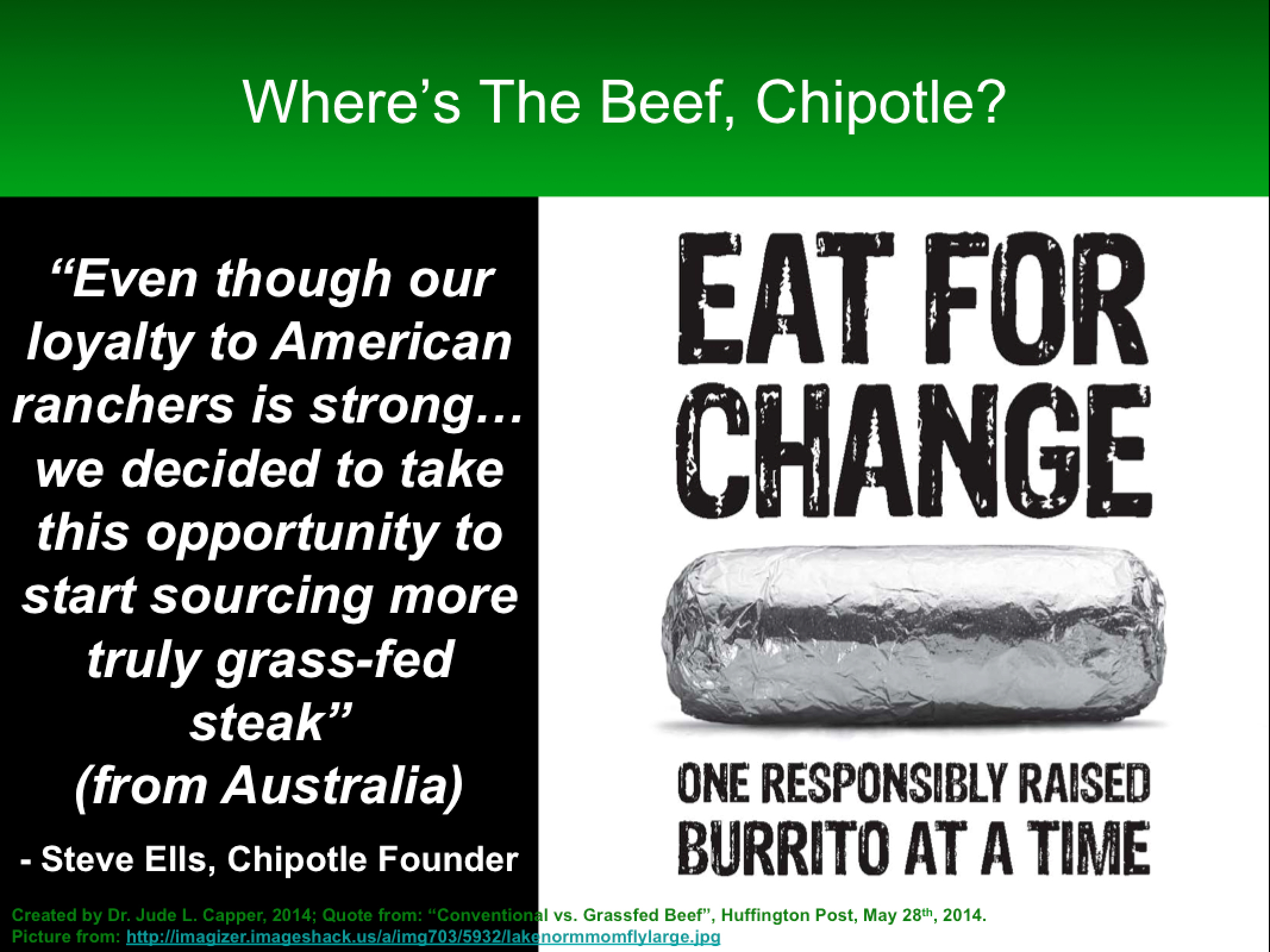
Chipotle 1Another day, another jalapeño in the salsa of Food With Integrity spin from Chipotle. After their recent decision to source grass-fed beef from Australia, citing a lack of supply from US ranchers; Texas Agriculture Commissioner Staples yesterday praised Chipotle for their willingness to discuss the matter. Yet in a world where companies can be made or broken by PR, the likelihood of Chipotle Chairman Steve Ells responding to Staples’ queries regarding their beef choices with “Our mind is made up, we’re not prepared to discuss it further.” was highly unlikely. Instead, their defensive response to Staples simply stated that they were happy to engage in dialogue.

Dialogue is great, but note that it doesn’t actually mean that any decisions will change. After all, I’m happy to dialogue with opponents of GMO crops and vaccines, but have any of those discussions made me change my stance on the safety, efficacy and importance of these technologies? No.

Rather than being applauded for their willingness to debate, Chipotle should instead be questioned about the apparent incompatibility between their Food With Integrity slogan, and their beef choices. As stated in the response to Staples, Chipotle only uses 23% of the beef on a carcass, relying on other buyers to provide a market for the remainder. Yet as we strive to feed an ever-increasing population using fewer resources and with less waste, wouldn’t it be more sustainable for Chipotle aim to use as much of each carcass as possible? After all, authentic Mexican food uses many different cuts, organs and variety meats – shouldn’t Food With Integrity derive more than chips and salsa from its supposed region of origin?

As discussed by California ranchers here, the issue appears not to be related to a scarcity of US beef per se, but rather beef at a price that Chipotle wants to pay. Given their claims of support for US beef producers, paying grass-fed ranchers the premium that they need for their production systems to be economically viable would show more integrity than importing beef from overseas. Ranchers should not be expected to operate at a loss for the privilege of supplying Chipotle with a premium product, of which three-quarters will be discarded.

I recently had a Twitter conversation with a follower who asserted that when assessing sustainability (economic viability, environmental responsibility and social acceptability), we should put “people and planet” ahead of “profit”. I disagree, as I firmly believe that all three have to balance – if any one is prioritized, the business will not achieve long-term sustainability. Yet in this instance, Food With Integrity appears to demote all three (while attempting to maintain Chipotle’s profit margin):

Chipotle 2

  • Reduced economic viability for US beef producers;
  • Increased environmental impact of shipping beef from over 8,000 miles away;
  • Reduced social acceptability for Chipotle’s brand within the agriculture industry.

Planning to eat at Chipotle this weekend? I’m willing to bet you’re not a US beef producer.

Are We Producing More Food…and Feeding Fewer People?

Waste foodI’m ashamed to admit that the picture to the left is of the lunch table that a media colleague and I left last week – after spending an hour lamenting the fact that in the US, 40% of food is wasted (30% globally). Admittedly, that waste isn’t all down to restaurant portions (in our defense, we both had to fly home, so doggie bags weren’t an option) – however, according to FAO data here, consumer waste accounts for anything between 5% (in Subsaharan Africa) and 39% of total waste (North America and Oceania). The difference (anything from 61% – 95%) is made up from losses between production and retailing.

Losses from production to retail comprise by far the biggest contribution to waste in the developing world, which makes absolute sense – if food is your biggest household cost and hunger is a constant and real danger, the concept of wasting purchased food would seem ridiculous. In the developing world, a myriad of factors play into food insecurity including low agricultural yields, lack of producer education (particularly for women, who are often the main agricultural workers), political instability and military conflict (Pinstrup-Andersen 2000). However, possibly the biggest threat to food security is a lack of sanitary and transport infrastructure (Godfray et al. 2010) – building a milk pasteurization plant is a great opportunity to improve shelf-life, but can only be effective if producers have the facilities to refrigerate and transport milk. Improving tomato yields can reap economic dividends, but if they are transported to markets packed into plastic bags on the back of a bicycle, the wastage is huge. I’m not going to pretend I have the solutions to global food wastage, but what can we do in our own households?

Just as our grandparents learned during WWI and WWII – when food is scarce, you make the most of every single drop of milk or ounce of grain. Yet in the modern developed world, we can afford to waste almost 2/5 of our household food through not understanding expiration dates (cheese does not spontaneously combust into a listeria-ridden ooze at midnight on the day of the expiration date); throwing away the “useless” parts of food waste (radish leaves and wilted celery are actually really good in soup); or simply buying more than we need. In a recent study of greenhouse gases associated with US dairy production, the carbon footprint of a gallon of milk was increased by almost 20% simply because of the amount of “old” milk that consumers poured down the sink each day.

To go back to the picture above, it’s tempting to blame the restaurants – portion sizes tend to be huge, so in this carb-conscious world, it’s not “our fault” if we forgo the last 500 calories by leaving half a plateful of potato chips – they should have just served a smaller portion in the first place, right? Well, maybe. If we’re feeding dairy cows or beef cattle and seeing more than 5-10% feed unconsumed, we’ll reduce the amount fed. I’m sure that exactly the same practice would pay dividends in the restaurant world, and I’d be willing to bet that they could charge exactly the same price.

I spend most of my time myth-busting, showing that the modern beef and dairy industries are far more efficient than the farming systems of 40 or 70 years ago and that we now produce more food using far fewer resources. However, are we really feeding more people if we’re wasting 40% of our food? To suggest that we return to a practice from the WWII era feels almost heretical, but here’s an idea – rather than defining “sustainable” systems as those producing artisan cheeses from heirloom breeds cared for by hemp-wearing liberal arts graduates, why doesn’t every restaurant (or suburb) have a small herd of backyard pigs? Collect the waste food, boil it for 30 min to avoid disease issues, feed to pigs, produce bacon. What could be better? Admittedly, my mother country has banned this practice (I’m beginning to wonder if anything will be permissible in Europe soon), but let’s start the pigswill revolution! Doesn’t “You don’t have to eat that last potato, it’ll make some really good bacon and help us feed those 1 in 7 kids in our local area who don’t have enough food” sound more realistic than “Think of all the starving orphans who would enjoy your PB&J sandwich” (to which the continual smart-a** answer was “I’ll just mail to to them). Let’s do what the livestock industry does best – recycle waste resources to make safe, affordable, nutritous meat!

All Aboard the “Eat Less Meat” Bandwagon

One of the main criteria for publishing scientific research is that it should be novel, yet not a week goes by without yet another paper concluding that we have to reduce meat consumption in order to mitigate climate change. That’s the headline in media coverage relating to the latest paper from a researcher at the The Woods Hole Research Center (published in Environmental Letters), which examines nitrous oxide emissions (a highly potent greenhouse gas (GHG)) in 2050 under various scenarios.

It’s an interesting paper, not least for some of the assumptions buried within the model. Based on data from the FAO, the authors assume that meat consumption will increase by 14% in the developed world and 32% in the developing world by 2050. Coupled with the predicted population global increase (from the current 7 billion to 8.9 billion in 2050), it’s not surprising that a 50% reduction in meat consumption would be predicted to have a significant effect on total GHG. It’s rather akin to suggesting that each person will own two automobiles in 2050, so we should reduce car manufacture.

However, the more striking result is buried in Figure 1, showing that if efficiency of manure management and fertilizer application were improved, this would have a more significant effect on GHG emissions than reducing meat consumption. Given the considerable improvements in cropping practices, crop genetics and yields over the past 50 years there is absolutely no reason why this should not be achieved in the next 40 years.

Alas, a headline suggesting that agriculture needs to continue to improve manure and fertilizer efficiency just isn’t as sexy as the “eat less meat, save the planet” message so often propounded by the mass media. They say that bad news sells – it’s a shame that the lay press are so enamored with messages that denigrate ruminant production, rather than taking a broader look at the options available for mitigating future climate change.

*Thanks to Jesse R. Bussard for bringing this one to the forefront of my “to do “ list.