Is It Time We Stopped Shouting About The Dietary Guidelines?

The recent report by the advisory committee to the USDA dietary guidelines has certainly caused a media stir in the past week or so. There’s a lot of nutritional common sense in the report – eat more fruit, veg, and dairy, reduce carbs and sweetened drinks/snacks, and moderate alcohol intake. Yet there’s a kicker – from both a health and a sustainability perspective, Americans should apparently be guided to consume less animal-based foods.

10982813_934682089898559_3461048965358255082_oWhen the report was released, my Twitter notifications, Facebook feed and email inbox exploded. Memes like the one to the left appeared on every (virtual) street corner, and the report was mentioned in every online newsletter, whether agricultural or mainstream media. It’s this press coverage rather than the content of the report, that really concerns me.

Individuals don’t pay a lot of attention to a government report on nutrition. Despite the fact that six updates to the guidelines have been released since their inception in 1980, we are all still eating too many Twinkies in front of the TV and super-sized takeout meals in the car, rather than chowing down on broccoli and lentil quinoa bake.
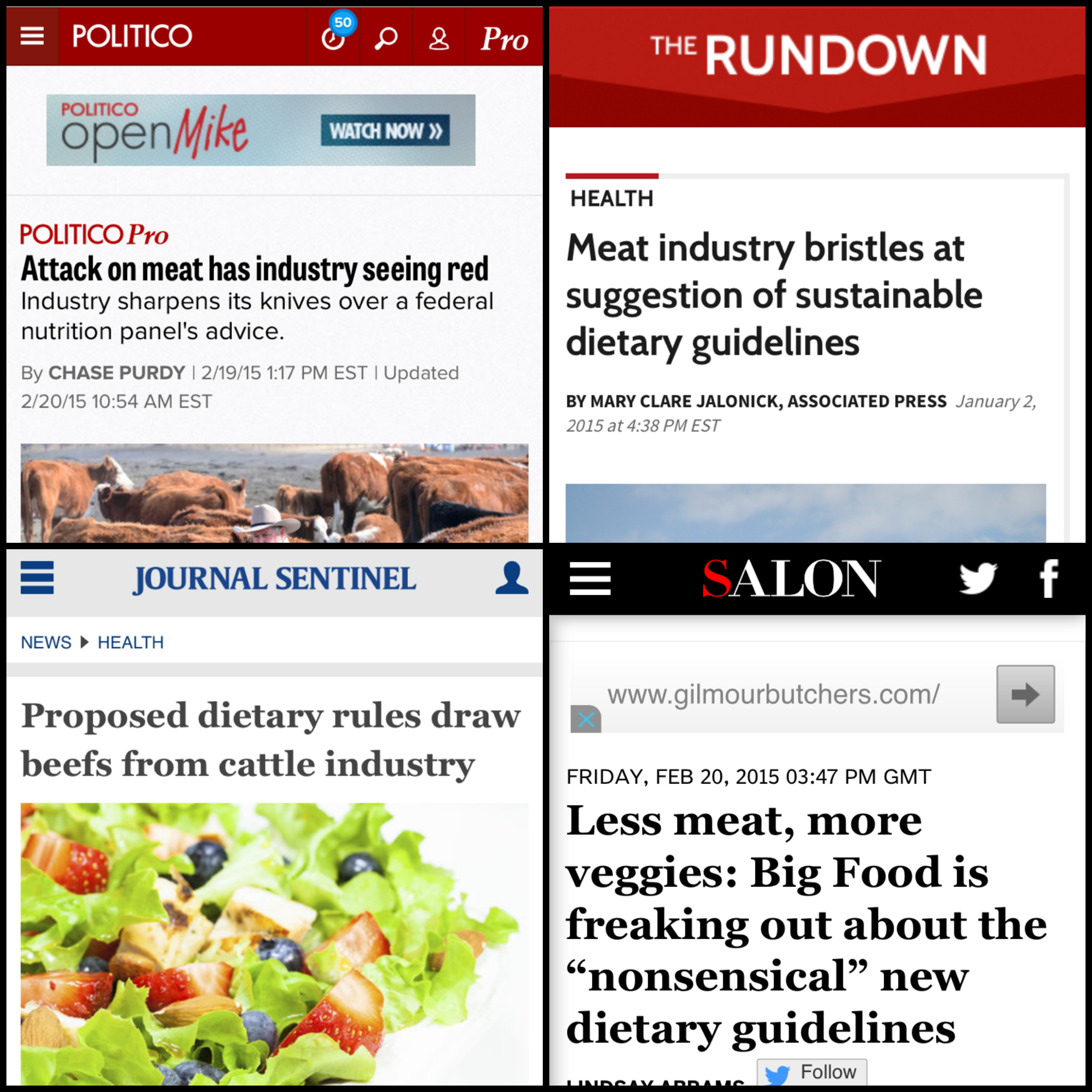
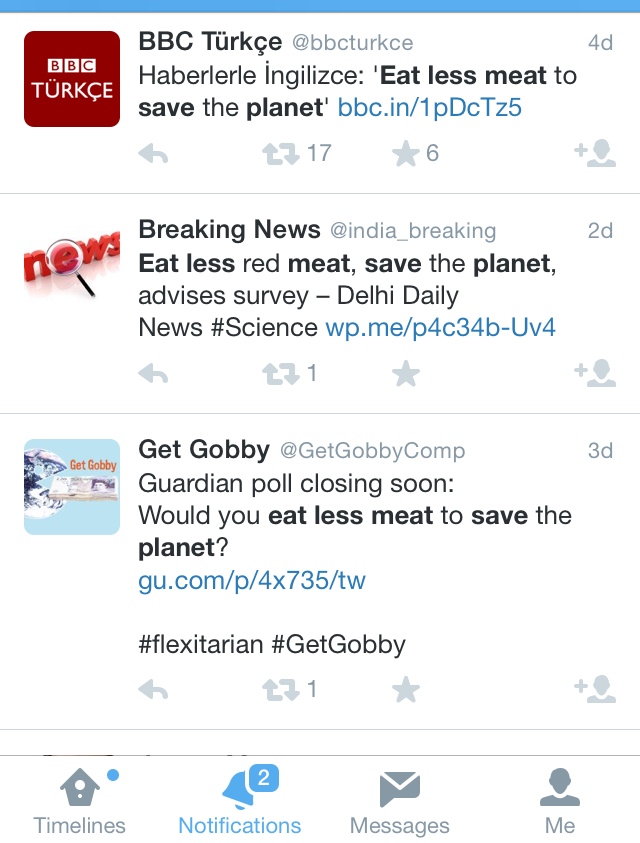
Headlines CollageYet people do pay attention to headlines like “Less meat, more veggies: big food is freaking out about the “nonsensical” new dietary guidelines” and others shown to the left. The media sub-text is that big bad food producers (so different from the lovely local farmer who sells heirloom breed poultry at $18/lb at the farmers market) are appalled by the release of this governmental bad science that’s keeping them from their quest to keep you unhealthily addicted to triple cheeseburgers washed down with a 500-calorie soda, and will do anything to suppress it.

This makes me wonder – at what point do we need quiet, stealthy change, rather than loud protests that attract the attention of people who would otherwise never have read about the guidelines? At what point does industry protesting seem like a modern version of “The lady doth protest too much“?

Rather than posting on Facebook or Twitter that the report is nonsense because the committee of nutritionists ventured into the bottomless pit that is sustainability; why don’t we instead extol the virtues of producing high-quality, nutritious, safe and affordable lean meat, and aim to reach the people who haven’t seen the hyperbolic headlines or read the guidelines simply because they’ve seen a lot of talk about them on Twitter? The old showbiz saying that there’s no such thing as bad publicity certainly applies here – the extent of the reporting on the industry backlash against the report means they have probably been noted by far more people that they otherwise might.

The impact of the dietary guidelines recommendations upon purchasing programs is far higher than on individuals, and does give rise to concern. Globally, one in seven children don’t have enough food, and school lunches are often the only guaranteed source of high-quality protein available to children in impoverished families. I may be being overly sceptical, but I suspect that if meat consumption in schools is reduced, it’s unlikely to be replaced with a visually and gastronomically-appealing, nutritionally-complete vegetarian alternative.

Sustainability doesn’t just mean carbon, indeed, environmentally it extends far further than the land, water and energy use assessed by the dietary guidelines advisory committee into far bigger questions. These include the fact that we cannot grow human food crops on all types of land; water quality vs. quantity; the need to protect wildlife biodiversity in marginal and rangeland environments; the use of animal manures vs. inorganic fertilisers; environmental costs of sourcing replacements for animal by-products in manufacturing and other industries; and many other issues. Simply stating that meat-based diet X has a higher carbon footprint or land use than plant-based diet Y is not sufficient justification for 316 million people to reduce their consumption of a specific food. Indeed, despite the conclusions of the committee, data from the US EPA attributing only 2.1% of the national carbon footprint to meat production suggests that even if everybody reduced their intake of beef, lamb and pork, it would have a negligible effect on carbon emissions.

Could we all reduce our individual environmental impact? Absolutely. Yet as stated with regards to dietary change in the advisory report, it has to be done with consideration for our individual biological, medical and cultural requirements. As humans, we have biological and medical requirements for dietary protein, and some would even argue that grilling a 16-oz ribeye is a cultural event. I have every sympathy for the USDA committee*, who were faced with a Herculean task to fulfill, but in this case, they only succeeded in cutting off one head from the multi-craniumed Hydra – and it grew another 50 in its place.

*Many people have already commented on the suitability (or not) of the committee to evaluate diet sustainability, but to give them their due, they do appear to have looked beyond greenhouse gases to land, water and energy use. They are nutrition specialists, not sustainability experts, but it would be difficult (impossible) to find a committee comprising people who were all experts in nutrition, sustainability, economics, policy, behaviour and all the other facets of the report. Nonetheless, the sustainability recommendations appear to be based on a small number of papers, many of which are based on dietary information from other regions (Germany, UK, Italy) which will also have different levels of animal and crop production. As somebody who was born and bred in the UK before moving to the USA I find it difficult to believe that the average American’s diet uses substantially more land (for example) than the average UK person, as cited in the report.

Are Animals As Innocent As Vehement Vegans Vow?

Another week, another argument with vegans. Reading this blog you could suppose that I spend all my time arguing with the no-meat brigade. Thankfully it’s not that common – it’s just that it always seems to inspire another blog post.

Why arguing is pointlessThis time it was a particularly vehement vegan (VV?) who insisted that I was a rapist and murderer because I work in the animal science industry. It’s not the first time I’ve heard those claims – indeed, I’m beginning to wonder if there’s a vegan argument flow chart out there (see below, click to enlarge), as all the conversations seem to follow the same pattern and use similar (if not identical) phrases.

Vegan flow chartDon’t get me wrong, I don’t believe that the power of my mighty tweets will help these hapless vegans see the light and immediately go out for a steak. I have absolutely no problem with anybody being vegan, vegetarian, pescetarian, fruitarian, or whatever their dietary and ethical choices are. I respect those choices, even more so because I used to be a vegan myself (As a side-note, I was told by VV that it’s not possible to be an ex-vegan, so I obviously wasn’t a “real” vegan in the first place.) However, I do have an issue with being called a rapist* and murderer, particularly a murderer of “innocent animals”. So please, let’s stop the cute, fluffy, anthropomorphic nonsense. If somebody really thinks they know what it feels like to be a cow, maybe they need professional help, rather than arguments on twitter.

Yes, animals are killed to produce meat. If you have a problem with that then perhaps you should indeed consider being vegetarian or vegan. But are animals innocent? Not in the pure, clean-living, non-malicious sense of the word. Consider the billions of predatory animals who murder other (innocent?) animals every single day for food. Consider the penguin. Or more specifically, the penguin prostitute, who will offer sex to single male penguins in exchange for stones with which to build her nest. Consider the male mouse, lion, or hanuman langur (Old World monkey) who practice infanticide – killing entire litters of their mate’s offspring if they suspect that they are not the father. Consider homosexual necrophiliac ducks, who will repeatedly rape a dead male mallard. Even on the farm it’s not all peace and love – the top-ranking cow in the hierarchy gets first pick of the feed and the best mattress to lie on. Why? Because animals aren’t innocent. It’s a good marketing trick to show cute little baby animals that tug at our heartstrings and make us think twice about eating the cheeseburger, but animals are no more innocent than we are.

CarnistThe ultimate vegan insult is one of “carnism” – literally the opposite of veganism (as in carn- or carne-, latin for meat), which includes the theory that that meat-eaters practice speciesism in considering themselves to be superior to animals. Yet by decrying the murder practiced by so many animal species, aren’t vegans the epitome of speciesism? On a higher plane by virtue of a cruelty-free life? Let’s get real. To quote Alfred, Lord Tennyson: “Tho Nature, red in tooth and claw…” – a world where every life is sacred and cruelty does not exist is not a description of planet earth, and if it was, there’s every chance that we humans would have been wiped out eons ago.

*Cows are not raped. The definition of rape is “Unlawful sexual intercourse or any other sexual penetration of the vagina, anus, or mouth of another person, with or without force, by a sex organ, other body part, or foreign object, without the consent of the victim.” and, as any dairy farmer will tell you, a cow will not stand to be served unless she is in heat (estrus). Trying to rape a dairy cow would be an exercise in futility.

A Christmas Wish – May All Your Cows Be Like Your Best Cow

I love conversations that leave my brain firing on a million cylinders and open my mind to new ideas. I was lucky enough to have three such discussions this past week, one at an organic research farm; another at a 300-cow Jersey operation; and the most recent with three faculty at the University of Oxford with regards to the interactions between animal welfare and livestock sustainability.

Animal welfare is a touchy subject – many people appear to define excellent welfare as only including a narrow range of production systems or practices; and although everybody has their own image of what a “happy” animal looks like, it’s not always easy to identify or describe those systems without anthropomorphizing. Indeed, I’ve become increasingly aware that promoting improved productivity and efficiency as a means to improve sustainability can be misconstrued as encouraging the agricultural equivalent of a owning a Victorian dancing bear or cymbal-playing monkey – a “force the animals to perform, regardless of the cost in terms of animal welfare”-type philosophy (see picture below).

Troll


Yet such suggestions entirely miss the point, as any system that is consistently detrimental  to animal welfare is neither productive nor efficient on a long-term basis. We humans don’t perform well if we’re chronically underfed, stressed, sick, or housed in unfavorable environmental conditions – and neither do livestock.

Personally, my agricultural utopia would be one where all livestock operations, regardless of size, location or production system, exhibit both high productivity and excellent animal welfare. Admittedly, this leads to the difficult task of not only defining excellent welfare, but also the metrics and benchmarks by which it can be assessed within each operation. However, there is one overarching metric that can be measured, and improved on any farm or ranch – animal health. By definition, an animal that is chronically sick, lame or in pain cannot be said to be a example of good welfare.

As consumers, we want to know that the animals that provide us with milk, meat and eggs are healthy. Indeed, I imagine that even the most militant vegan opposed to the consumption of animal products would agree that animal health should be paramount. As producers, making sure that livestock are healthy is as ethically important as treating workers well. Plus, healthy animals are easier to manage: they grow faster; they have fewer incidents of  illness or death; and they produce more milk, meat or eggs. These improvements in efficiency and productivity also mean that we need less feed, less land, less water and have a lower carbon footprint per unit of food produced.

Let’s consider lameness in dairy cattle. A major animal welfare issue, it costs between $120 and $216 per incidence (UK costs below)* and is a major cause of cows being culled at or even before the end of their second lactation. Similarly, mastitis has a huge impact on both cow longevity and productivity, and costs the US dairy industry $1.7-2.0 billion per year. If just these two health issues were addressed, how many associated dairy cattle health and welfare issues would be improved; how much could dairy farm profitability be enhanced; and how much would the public image of dairy improve?

Every herd has its best cow – the one who is never lame, doesn’t suffer from mastitis, metritis or ketosis; and gets back in calf easily – all while having a high milk (and components) yield. There is no magic bullet to improve productivity and efficiency –  yet the discussions I’ve had in the past week conclusively demonstrated that that does mean suiting your system to your available resources and, though excellent health, nutrition, breeding and management, allowing every cow to perform like your best cow, every single day. I wish you a Merry Christmas and hope that in 2015, all your cows will be like your best cow.

*Lameness costs £180 pounds per incidence in the UK, or £15,000 per average herd annually. Mastitis costs the UK dairy industry £170 million per year.

Would Being Vegan Really Solve Climate Change? Not if We Don’t Kill the Cows.

OLYMPUS DIGITAL CAMERAA friend of mine drew my attention to this NPR blogger, who makes the point that being “good” isn’t zero sum (a situation where what is gained by one side or cause, is lost by another). If you’re concerned about the environment, you can both recycle cans and buy a more climate-friendly car. If you are passionate about children’s education, you can volunteer in the classroom and financially support literary projects. In most cases, doing good is not an either/or.

Which made me think a little more about the definition of “good”. To that writer it meant being vegan or vegetarian, in the belief that such a diet would improve animal welfare and environmental impact. Yet this is exactly where the conflict arises for me – if we were all vegan or vegetarian, what would happen to the sheep, the cow, the pig and the chicken?

I posed that question to a vegan on Twitter recently and he, in all sincerity, answered that we, as a vegan population, would care for the animals, but would not enslave or control them. Imagine the beautiful utopia where we all have time to calve a cow or throw some grain to feral pigs before we set off to work, expecting nothing in return. Or in a more realistic scenario, we’d have more meat than we knew what to do with simply through car accidents if we suddenly let loose the USA’s 87.7 million cattle (never mind the 62.1 million pigs, 5.2 millon sheep and 9+ billion chickens).

Anti-animal agriculture activists often purport that a cow can live for 20+ years in her “natural” state compared to a farmed animal – so being a data nerd, I did the maths*. Let’s assume that 1) cows first calve at two years of age and that 90% of cows (38.3 million of them in the US at present) have a calf every year**; 2) 85% of those calves survive (mortality would go up due to predation, assuming we wouldn’t shoot wolves, coyotes etc.); and 3) each cow or bull lives for 20 years. Admittedly that doesn’t account for the cattle that would die from starvation through lack of available grazing in 5, 10 or 20 years time, but being good vegans, we’d feed them, right?


Within five years we’d have 602 million cattle in the USA, within 20 years we’d have 3.7 billion – a 40-fold increase on our current national herd. That’s 40x more cattle belching methane, drinking water and producing waste, every single day, all as a result of our changing our diet in an attempt to reduce environmental impact.


It’s a nice, simplistic, oft-suggested argument that we shouldn’t eat meat or dairy products in order to save the planet, yet the conflict between veganism, animal welfare, and environmental impact is clear. Climate change will be solved by us turning vegan? Not unless we reconcile ourselves to killing animals without eating them.

*I’m British, and as such, cannot use the American term “math” as opposed to the British “maths”
**90% is the US average for cow-calf herds, in which few hormones or other reproductive aids are used

Vegetarians May Preach – But We’re Not All Members of the Choir

Less meatThe  suggestion that we should eat less meat in order to save the planet pops up with monotonous regularity in my twitter feed. Interestingly, those who make this claim are almost always vegetarian, vegan or profess to eat very little meat. This is rather like me asserting that we could mitigate climate change and save resources by eating fewer bananas and curbing our windsurfing habits. I loathe bananas, and if you ever see me windsurfing you’d better be sure that there’s a nearby hospital bed and neck brace with my name on it. As you can imagine, giving up either activity would have little impact on my life.

This is why I find it interesting and rather facile that those who do not eat meat proclaim fleshy abstinence as the way forwards. It’s easy to preach a solution that has no impact on your life – far harder to make a dietary or lifestyle change that actually impacts you.

The “eat less meat” movement would have far more credibility if it was promoted by a hunting, fishing, grilling, hamburger-lover who publicly declared his/her love for meat in all it’s many forms, and bemoaned the fact that they felt they should forgo the steak in favor of the tofu stir-fry. Yet this doesn’t happen. Why? Because the vast majority of us simply don’t feel that an intangible threat (we can’t see or feel climate change, or conceptualize the quantity of oil reserves remaining) is sufficient to make us give up our carnitas burrito. In reality, meat eating is only likely to decline if it becomes too expensive or subject to regulatory sanctions (e.g. rationing similar to that in Britain during WWII). The influx of papers suggesting that we should reduce consumption therefore fall on deaf ears.

So let’s face the facts. Neither the national or global population is likely to reduce meat consumption in the near future, and the rising income per capita in India and China will increase demand for meat still further. Instead of making recommendations based on notional utopias, let’s focus on areas where we can really improve.

Amazing gains in productivity have allowed the beef, dairy, pork and egg industry to considerably reduce resource use and greenhouse gas emissions over the last century. With a culture of continuous improvement and access to technologies that improve productivity, we can feed the future population using even fewer resources.

Let’s make better use of the multifarious by-products from the human food and fiber industry. Ruminants are blessed with the ability to digest fibers and plant materials that we either can’t or won’t eat – using by-product feeds to replace corn and soy refutes the claim that livestock compete with humans for food.

Finally, take a look at your own plate. Globally, 33% of food is wasted. Just think of the reductions in resource use we could achieve (and people we could feed) if all the crops planted, fruit picked, and milk, meat and eggs produced were consumed, rather than just 2/3 of them.

We evoke change by leading by example – I’m off to enjoy a steak, conventionally-raised using 12% less water, 19% less feed and 33% less land than its equivalent in 1977. You’d better believe that if there’s any left, it’s going in a sandwich tomorrow. As my Grandma used to say: Waste not, want not.

Beef is Killing the Planet…and Elvis is Riding a Rainbow-Belching Unicorn

BurgerMy Twitter feed just exploded. Yet another study has been released claiming that if we all just gave up beef, the planet would be saved, Elvis would come back from the dead, and rainbow-belching unicorns would graze the Northern Great Plains. I may have exaggerated a little with the latter two claims, but the extent of media coverage related to the paper “Land, irrigation water, greenhouse gas and reactive nitrogen burdens of meat, eggs and dairy production in the United States” seems to suggest that the results within are as exciting as seeing Elvis riding one of those unicorns…but they’re also about as believable.

Much as we’d all like to stick our fingers in our ears and sing “La la la la” whenever anybody mentions greenhouse gases or water footprints, we cannot deny that beef has an environmental impact. Yet, here’s the rub – so does every single thing we eat. From apples to zucchini; Twinkies to organically-grown, hand-harvested, polished-by-mountain-virgins, heirloom tomatoes. Some impacts are positive (providing habitat for wildlife and birds), some are negative (nutrient run-off into water courses), but all foods use natural resources (land, water, fossil fuels) and are associated with greenhouse gas emissions.

So is this simply another attack on the beef industry from vegetarian authors out to promote an agenda? Possibly. The inclusion of multiple phrases suggesting that we should replace beef with other protein sources seems to indicate so. But regardless of whether it’s part of the big bad vegan agenda, or simply a paper from a scientist whose dietary choices happen to complement the topic of his scientific papers, the fact remains that it’s been published in a world-renowned journal and should therefore be seen as an example of good science.

Or should it?

I’m the first to rely on scientific, peer-reviewed papers as being the holy grail for facts and figures, but there’s a distressing trend for authors to excuse poor scientific analysis by stating that high-quality data was not available. It’s simple. Just like a recipe – if you put junk in, you get junk out. So if one of the major data inputs to your analysis (in this case, feed efficiency data) is less than reliable, the accuracy of your conclusions is….? Yep. As useful as a chocolate teapot.

Feed efficiency is the cut-and-paste, go-to argument for activist groups opposed to animal agriculture. Claims that beef uses 10, 20 or even 30 lbs of corn per lb of beef are commonly used (as in this paper) as justification for abolishing beef production. However, in this case, the argument falls flat, because, rather than using modern feed efficiency data, the authors employed USDA data, which has not been updated for 30 years. That’s rather like assuming a computer from the early 1980’s (I used to play “donkey” on such a black/green screened behemoth) is as efficient as a modern laptop, or that the original brick-sized “car phones” were equal to modern iPhones. If we look back at the environmental impact of the beef industry 30 years ago, we see that modern beef production uses 30% fewer animals, 19% less feed, 12% less water, 33% less land and has a 16% lower carbon footprint. Given the archaic data used, is it really surprising that this latest paper overestimates beef’s environmental impact?

The authors also seem to assume that feed comes in a big sack labeled “Animal Feed” (from the Roadrunner cartoon ACME Feed Co?) and is fed interchangeably to pigs, poultry and cattle. As I’ve blogged about before, we can’t simply examine feed efficiency as a basis for whether we should choose the steak or the chicken breast for dinner, we also have to examine the potential competition between animal feed and human food. When we look at the proportion of ingredients in livestock diets that are human-edible (e.g. corn, soy) vs. inedible (e.g. grass, other forages, by-products), milk and beef are better choices than pork and poultry due to the heavy reliance of monogastric animals on concentrate feeds. By-product feeds are also completely excluded from the analysis, which makes me wonder precisely what the authors think happens to the millions of tons of cottonseed meal, citrus pulp, distillers grains, sunflower seed meal etc, produced in the USA each year.

Finally, the authors claim that cattle use 28x more land than pigs or poultry – although they acknowledge that cattle are raised on pasture, it’s not included in the calculations, which assume that cattle are fed feedlot diets for the majority of their life. This is a gross error and underlines their complete ignorance of the U.S. beef industry. Without cow-calf operations, the U.S. beef industry simply would not exist – efficient use of rangeland upon which we cannot grow human food crops both provides the foundation for the beef industry and creates and maintains habitats for many rare and endangered species of plants, insects, birds and animals.

Want to know how to reduce the environmental impact of food production overnight? It’s very simple – and it doesn’t involve giving up beef. Globally we waste 30% of food – and in developed countries that’s almost always avoidable at the consumer level. Buy the right amount, don’t leave it in the fridge to go moldy, and learn to use odd bits of food in soups or stews. Our parents and grandparents did it out of necessity – we can do it to reduce resource use and greenhouse gas emissions; and take the wind out of the sails of bean-eating anti-beef activists.

Who Needs Scientists? Just Let Mother Nature Design Your Greek Yogurt.

Chobani.jpgHow you get to 100 calories matters. Most companies use artificial sweeteners. We think Mother Nature is sweet enough”. Clever marketing from the greek yogurt company Chobani, simultaneously disparaging alternative brands, and playing the ultimate caring, sharing, natural card with the mention of “Mother Nature”. However, earlier this week, Chobani’s #howmatters hashtag set the twitter feeds alight after their new “witty” tagline on the underside of yogurt lids was posted (below).

howmattersThe wording plays beautifully into what is fast becoming a universal fear of science intruding on our food supply – we want real food; food like our grandparents ate; food from traditional breeds and heirloom varieties – providing it doesn’t take us over 2,000 cal per day or increase our cholesterol levels. Rightly or wrongly, many people blame processed foods with hidden sugars and added chemical preservatives for many health issues in developed countries – the epitome of a #firstworldproblem, given that the corresponding #thirdworldproblem is hunger and malnutrition.

However, this time the twitter anger wasn’t from rampaging mommy bloggers, or infuriated activists, but scientists. After all, without science, would Chobani have a product? Yogurt was first developed in ancient times, but the modern pasteurized, long-shelf-life, greek yogurt is rather different to the cultured milk our ancestors would have enjoyed.

FAGEI have a 100-calorie greek yogurt from a rival brand in my fridge, so let’s examine the ingredients (left). Simply pasteurized skimmed milk and live active yogurt cultures (note, no added sweeteners). Louis Pasteur, a 19th century French scientist developed pasteurization (in addition to his discoveries relating to vaccines and microbial fermentation); biologists developed methods to identify and classify the bacteria that ferment milk into yogurt; and food scientists experimented with the exact mixture of bacteria to produce the desired flavor, texture and color of yogurt,  as well as developing the range of other processes needed to make the yogurt safe, appealing and shelf-stable.

Yes, we could make greek yogurt without scientists – after all, the original recipe didn’t originate in a corporate experimental kitchen. But without hundreds of years of scientific input, could we make Greek yogurt that, at 100 calories per serving, is desirable to the consumer and is a safe, affordable source of vitamins, minerals and protein? No. To imply that we could does a huge disservice to food scientists.

It appears that being a modern-day scientist appears to be somewhat equivalent to clubbing baby seals to death. Caring little for human suffering and illness, the cold and clinical scientist rubs his hands together with glee as he removes all nutrients from real food, replacing them with chemicals, additives and genetically-modified ingredients. As a side-line, he develops cocktails of toxic elements, pesticides and embalming fluid and markets them as vaccines. Yes, science is the enemy. Just remember that next time you take an aspirin for a hangover from pasteurized, fermented beverages.

Breast is Best…But My Baby and I Are Eternally Grateful for “Udder” Alternatives

BreastisbestJust over 11 months ago my life changed forever. As a breast cancer survivor who underwent 6 years of surgery, chemotherapy, radiation, monoclonal antibodies and hormone treatment, I’d resigned myself to that fact that my chance of having children was less than 4%. As a fiercely independent traveler, I was ok with that (sort of…), diverting my attention to work and celebrating the fact that with no ties, I could go to bed at 3am, attend any social event or fly overseas at a moments notice.

Then I found I was pregnant. The most unexpected, amazing, literally mind-blowing event of my entire life. I become “that” pregnant woman, giving up soft cheeses, beef jerky, champagne, ibuprofen and horse-riding overnight and doing absolutely everything I could to nourish the baby growing inside me. In January my baby girl was born, and (to quote my sister-in-law) every single day since then has been like waking up on Christmas morning. I could never have wished for such a beautiful and perfect gift.

When I saw this PETA video starring Emily Deschanel I absolutely sympathized with her opening statement – nothing compares to the joy of raising my child. Yet, as the video progressed and Ms Deschanel described the atrocities that allegedly occur on dairy farms, accompanied by emotive video footage, I became more and more concerned. At the end of the clip Ms Deschanel suggested that the only way forwards was to end the cruelty on factory farms and go vegan. That’s when I almost lost it.

I’ve always supported the dairy industry – I think I may actually be clinically addicted to cheese and my yogurt consumption could be considered an extreme sport; but now I have an even better reason to celebrate dairy farmers – they ensure that I have a happy, healthy baby girl.

There’s no doubt that the “breast is best” slogan is right – babies are mammals, they thrive on mammalian milk – indeed milk is the most highly digestible food available for their little stomachs. However, because of my cancer treatment, I can’t produce enough milk to nourish my baby; so she’s fed both breast-milk and formula.  Until now, I’d never thought about where formula comes from – I’d rather assumed it was a synthetic mix of amino acids produced in a test-tube. In reality, it’s a combination of nonfat cows’ milk*, lactose, and whey protein concentrate (both of the latter ingredients also from cows’ milk); combined with other ingredients to provide the energy, vitamins, minerals and essential fatty acids that my little girl needs to grow and be healthy.

I would do anything for my little girl – I can’t even imagine what it would be like to try and care for her if formula didn’t exist and I could only provide her with half the nutrients she needed through breast-feeding. Alarmingly, the third result on Google for “vegan baby formula” is a recipe for home-made formula based on coconut water and raw almonds. The mind would boggle if I weren’t just terribly worried that somewhere, a mother thinks that this is the right choice for her child. To raise a baby as vegan because of parental ideology would seem irresponsible, if not dangerous – after all, surely breast-feeding is non-vegan?

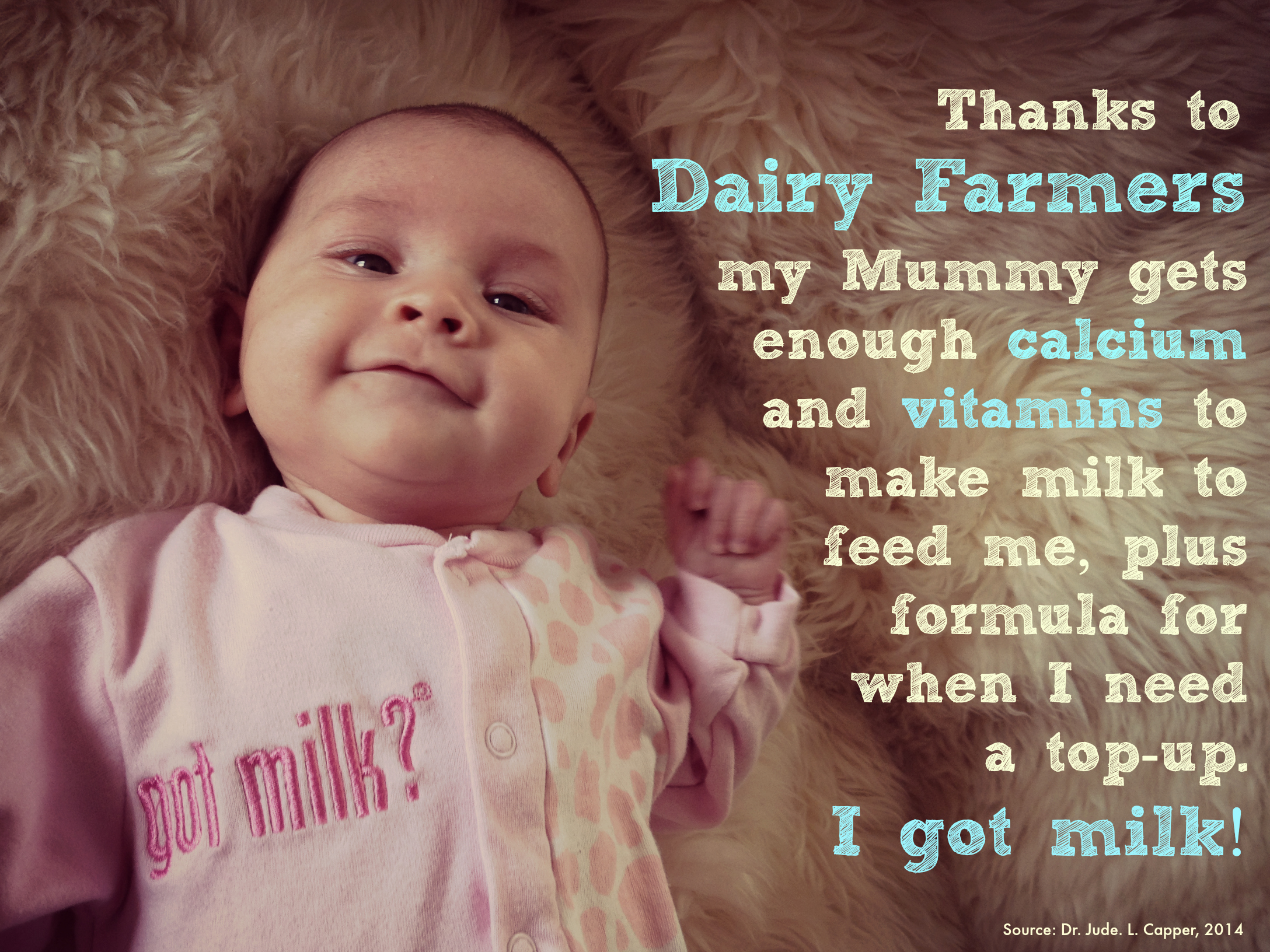
Got milkSo THANK YOU dairy farmers, for the nutrients that I get from my diet and can pass on to my baby, and for the milk that goes into formula to help her grow and thrive. You guys are the best!

 *Soy-based formulas are also available for babies who are allergic to cow’s milk, I’m lucky that my little girl thrives on dairy products! 

Thanks to @DairyCarrie and @AgProudRyan for showing me the PETA video, and to @JodiOleen for reminding me that I’d intended to blog about it.

Are We Producing More Food…and Feeding Fewer People?

Waste foodI’m ashamed to admit that the picture to the left is of the lunch table that a media colleague and I left last week – after spending an hour lamenting the fact that in the US, 40% of food is wasted (30% globally). Admittedly, that waste isn’t all down to restaurant portions (in our defense, we both had to fly home, so doggie bags weren’t an option) – however, according to FAO data here, consumer waste accounts for anything between 5% (in Subsaharan Africa) and 39% of total waste (North America and Oceania). The difference (anything from 61% – 95%) is made up from losses between production and retailing.

Losses from production to retail comprise by far the biggest contribution to waste in the developing world, which makes absolute sense – if food is your biggest household cost and hunger is a constant and real danger, the concept of wasting purchased food would seem ridiculous. In the developing world, a myriad of factors play into food insecurity including low agricultural yields, lack of producer education (particularly for women, who are often the main agricultural workers), political instability and military conflict (Pinstrup-Andersen 2000). However, possibly the biggest threat to food security is a lack of sanitary and transport infrastructure (Godfray et al. 2010) – building a milk pasteurization plant is a great opportunity to improve shelf-life, but can only be effective if producers have the facilities to refrigerate and transport milk. Improving tomato yields can reap economic dividends, but if they are transported to markets packed into plastic bags on the back of a bicycle, the wastage is huge. I’m not going to pretend I have the solutions to global food wastage, but what can we do in our own households?

Just as our grandparents learned during WWI and WWII – when food is scarce, you make the most of every single drop of milk or ounce of grain. Yet in the modern developed world, we can afford to waste almost 2/5 of our household food through not understanding expiration dates (cheese does not spontaneously combust into a listeria-ridden ooze at midnight on the day of the expiration date); throwing away the “useless” parts of food waste (radish leaves and wilted celery are actually really good in soup); or simply buying more than we need. In a recent study of greenhouse gases associated with US dairy production, the carbon footprint of a gallon of milk was increased by almost 20% simply because of the amount of “old” milk that consumers poured down the sink each day.

To go back to the picture above, it’s tempting to blame the restaurants – portion sizes tend to be huge, so in this carb-conscious world, it’s not “our fault” if we forgo the last 500 calories by leaving half a plateful of potato chips – they should have just served a smaller portion in the first place, right? Well, maybe. If we’re feeding dairy cows or beef cattle and seeing more than 5-10% feed unconsumed, we’ll reduce the amount fed. I’m sure that exactly the same practice would pay dividends in the restaurant world, and I’d be willing to bet that they could charge exactly the same price.

I spend most of my time myth-busting, showing that the modern beef and dairy industries are far more efficient than the farming systems of 40 or 70 years ago and that we now produce more food using far fewer resources. However, are we really feeding more people if we’re wasting 40% of our food? To suggest that we return to a practice from the WWII era feels almost heretical, but here’s an idea – rather than defining “sustainable” systems as those producing artisan cheeses from heirloom breeds cared for by hemp-wearing liberal arts graduates, why doesn’t every restaurant (or suburb) have a small herd of backyard pigs? Collect the waste food, boil it for 30 min to avoid disease issues, feed to pigs, produce bacon. What could be better? Admittedly, my mother country has banned this practice (I’m beginning to wonder if anything will be permissible in Europe soon), but let’s start the pigswill revolution! Doesn’t “You don’t have to eat that last potato, it’ll make some really good bacon and help us feed those 1 in 7 kids in our local area who don’t have enough food” sound more realistic than “Think of all the starving orphans who would enjoy your PB&J sandwich” (to which the continual smart-a** answer was “I’ll just mail to to them). Let’s do what the livestock industry does best – recycle waste resources to make safe, affordable, nutritous meat!

Feed = Food? Do livestock really compete with humans for food?

Can we feed up to 10 billion people in 2100 by improving crop yields, reducing deforestation, and reducing meat and dairy consumption? These solutions are among those suggested by Jonathan Foley at the University of Minnesota’s Institute of the Environment to enable the increase in food production required by the future global population. These are logical suggestions, yet the proposal that meat and dairy consumption should be reduced is likely to be the most-debated, particularly as livestock industry stakeholders may regard this as yet another attack on animal agriculture.

The futility of the “Meatless Mondays” campaign has been discussed ad infinitum, yet in contrast to the EWG’s recent report, Foley does not attempt to promote a vegetarian or vegan ideology or to suggest that climate change could be reversed if only we all ate humanely-certified or organic meat. Instead, the report concludes that resources could be saved if we shifted to meat consumption towards pork and poultry production as:

…it takes 30 kilos [66 lb] of grain to produce one kilo [2.2lb] of boneless beef… We’re better off producing grass-fed beef or more chicken and pork, which requires far less grain feed

Based on those data, Foley’s conclusion is entirely logical. However, as Carl Sagan said, “Extraordinary claims require extraordinary evidence” – and here the evidence is lacking. A recent review of feed efficiency by Wilkinson reports that monogastric animals require 4.0 kg (swine) or 2.3 kg (poultry) of feed per kg of gain. Monogastrics are indeed considerably more efficient than their ruminant counterparts as beef animals require 8.8 kg feed per kg gain – considerably more than swine or poultry, but far less than Foley’s estimate.

It would be convenient to argue that the errors in Foley’s feed efficiency data (not to mention religious limitations on pork consumption) negate the report’s conclusions. But isn’t it logical to argue that we should eat meat produced in systems that use fewer resources to produce animal protein? Personally, I spend more than half my time traveling to present precisely that message to the animal industry and to encourage livestock producers to improve efficiency. I absolutely believe that we need to improve productivity and efficiency in order to feed the growing population. However, traditional feed efficiency data have a major flaw – it’s assumed that all animal feed could otherwise be used to feed humans.

Wilkinson suggests that the traditional concept of feed efficiency be re-examined to reflect the quantity of human-edible crop inputs that are used to produce a unit of energy or protein from animal products. For example, humans cannot digest pasture, only 20% of the nutritional value of oilseed meals can be utilized for human food and yet 80% of nutrients within cereals, pulses and soybean meal are human-edible. By partitioning out the human-edible component of animal feed, Wilkinson demonstrates that the human-edible energy feed efficiency ratios for pork and cereal beef are similar (Figure 1*) and that dairy production actually produces twice the amount of human-edible energy than it uses (input:output ratio of 0.5). On a protein basis, cereal beef has a higher human-edible protein feed efficiency ratio (3.0) than pork (2.6), but suckler beef systems where cattle are grazed on pasture again produce more human-edible protein than they consume (input:output ratio of 0.9, Figure 2*). Not only are these revised feed efficiency estimates considerably lower than those quoted by Foley, but they underline the importance of herbivorous grazing animals in utilizing human-inedible forage to produce animal protein.


Numbers have power – it’s always tempting to base a suggestion around a single data point that “proves” the argument. Feed efficiency is a useful metric, but as we face an ever-increasing challenge in balancing food demand, resource availability and consumer expectations, it’s critical that we examine the bigger picture. The ruminant animal has a major evolutionary advantage in its ability to digest forages – we may be better acquainted with the human dietary advantages of probiotic bacteria than our ancestors, but until we are equipped with human rumens (humens?) we cannot hope to effectively make use of all crop resources.

*The importance of acknowledging the human-edible component of feed efficiency was part of my presentation at the Alltech Ruminant Solutions Seminar in Ireland this week – to go to a PDF copy of my presentation please click here.