Defending Conventional Beef in The Wall St Journal Today!

WSJShameless self-promotion, but very excited to have an essay published in The Wall St Journal today defending conventional beef production.

Given my blog subtitle, I thought I should link to it! Would love to read your comments. Article here: http://www.wsj.com/articles/is-feedlot-beef-bad-for-the-environment-1436757037

I Can’t Brie-lieve It’s Nut Cheese

Plastic food, anybody?

Plastic food, anybody?

Am I missing something, or have words ceased to have any meaning? Take the phrase “nut cheese”. Seriously. Now stop giggling like a 12-year old and actually think about it. Would you buy some nut cheese for your grilled cheese sandwich? Fancy some nut cheese on your pizza? Actually, purely from a practical point of view, no, you wouldn’t. Nut cheeses don’t really melt, they are better for spreading on crackers. But, leaving the double entendres  aside, why would we give Edam (sorry…) about nut cheese? Apparently it’s a product that’s made exactly like cheese, if you ignore the fact that (dairy)* milk doesn’t have to be ground with water to separate the solids before the cheesemaking begins. Oh, and the fact that nut cheese made from nuts. Which means that despite the name, it’s not actually cheese.

Why does the concept of nut “cheese” irritate me so? It’s not paranoia that everybody will become so enamoured by nut cheese that the dairy industry will cease to exist (could a non-melting, spreading cheese really compete with a hefty chunk of Wensleydale?); or the suspicion that it’s a dastardly plot to infiltrate nut cheese into our children’s diets and tempt them away from the wonderful world of extra strong Cheddar and ashed-rind goats cheese. It’s simply because it’s yet another fake food. Believe me, I get equally irritated by soy “milk”; orange-colored soft drinks masquerading as “juice” (ahem, Sunny-D); and burgers made of mashed tofu. Why? Because I don’t see the point of plastic fantastic meals. Yes, I’ve eaten vegan cheese, vegetarian sausages and tofu roasts. I ate them when I was vegan** and I felt hypocritical for doing so even then. No, they didn’t taste better than the “real” thing (although one soy ice-cream was amazingly good). No, I couldn’t believe I was tucking into a juicy hot dog when I was simply chewing on something with all the taste and texture of reconstituted shoe leather. No, they didn’t compensate for my brothers gleefully eating bacon sandwiches. They simply seemed like a poor imitation of the diet that I had previously enjoyed as an omnivore.

When I was vegan I loved vegetables, and I still do now as a happy omnivore. I may lose my beef-loving credentials for admitting this, but after presenting a webinar on beef sustainability yesterday, I prepared and ate an entirely vegan meal. Admittedly I didn’t notice that it was vegan until I was chatting with @MomattheMeatCounter afterwards, but more tellingly, I didn’t miss the meat. I love vegetables because they are fabulously diverse. They have a myriad of flavours and textures that no other foods can provide. I could happily eat that same vegan meal two or three times per week. Yet vegetables aren’t meat or dairy, they don’t provide the same flavours and nutrients, and I couldn’t go back to being vegan. Aside from anything else, I’d miss real bacon cheeseburgers.

Which brings me to my major issue with all faux meats and dairy products. If you’re determined to give up animal proteins for ethical reasons, then why eat an ersatz version? Why not celebrate the fabulousness of fruit and vegetables and cook creative plant-based meals rather than eating a make-believe version of an animal-based food? Why are these faux foods often championed by people who otherwise derive their careers from bleating about “natural” foods and telling us that if a third-grader can’t pronounce it, we shouldn’t eat it? Why are millions being invested  in the promise of growing meat in labs or turning pea protein into faux eggs when we could simply eat peas instead?

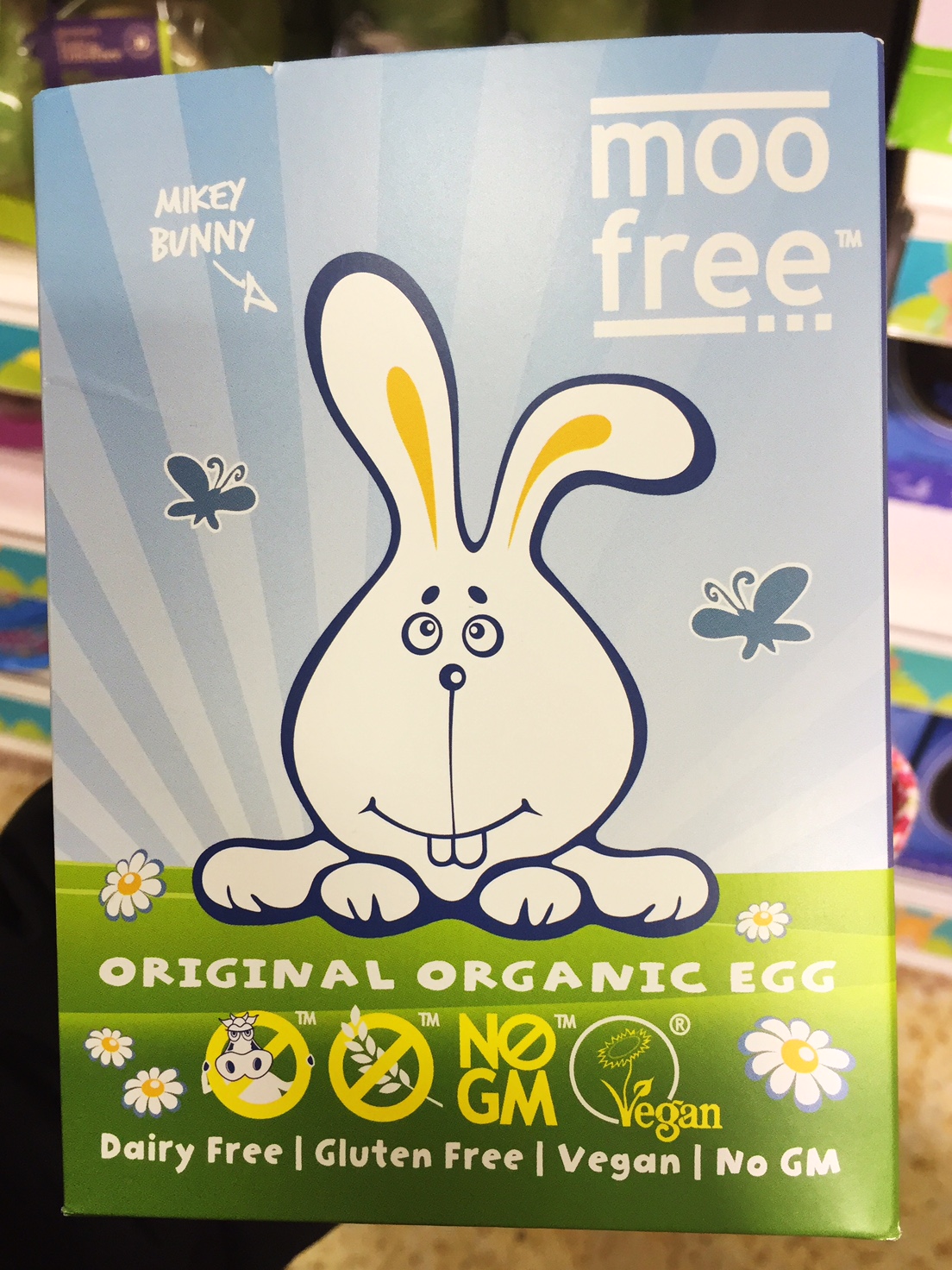
Fake chocolateBelieve me, if I ever have the misfortune to become intolerant to gluten or dairy, I will be seeking real (and naturally gluten and dairy-free!) eggs at Easter rather than a faux chocolate egg with all the supposedly sinful ingredients removed***. Yet this treat was next to the regular chocolate eggs in the supermarket this weekend. A great thing for the small proportion of people who actually have dairy or gluten allergies, but also a clever Easter guilt-inducer to parents everywhere who are convinced that little Crispin and Arabella’s blood chemical levels will otherwise reach “toxic” limits akin to being given an intravenous infusion of the self-proclaimed Food Babe’s nemesis, Starbucks’ Pumpkin Spice Latte.

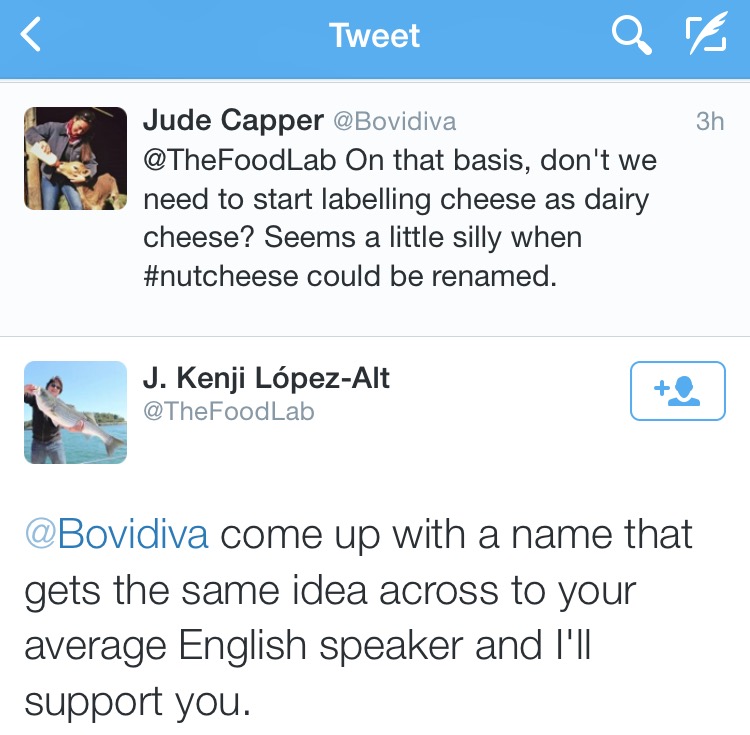
Nut cheese tweetMaybe I’m pedantic, overly irritable about the appropriation of words that are specific to certain foods. Perhaps my European roots run too deeply – after all, I come from a country that designates Stilton cheese as only being produced from milk from cows grazed in three specific counties. Yet it seems like a lazy excuse to suggest that if nut cheese isn’t called cheese it will languish uneaten in the supermarket for months because nobody will understand what it is. In a world where new words are invented every single day (please don’t get my Mother started on the validity of the word “webinar”) is it really conceivable to suggest that marketers can’t find an alternative to “cheese” or “milk” to describe plant-based foods? After all, nobody tries to call tofu “meat”…..yet. Perhaps that will be the next label on the faux food buffet table? I’m sorry, but I Camembert it.

*Even typing (dairy) as a modifier before milk raises my blood pressure a few points.
**I was a strict vegan for 12 months when I was 15. When I was 16 I resumed eating bacon as if pigs were going out of fashion. I still enjoy vegetarian or vegan meals, but I’ve never looked back.
***Yes, I have eaten milk-free milk chocolate – it could easily be used as a substitute for candle wax.

Is It Time We Stopped Shouting About The Dietary Guidelines?

The recent report by the advisory committee to the USDA dietary guidelines has certainly caused a media stir in the past week or so. There’s a lot of nutritional common sense in the report – eat more fruit, veg, and dairy, reduce carbs and sweetened drinks/snacks, and moderate alcohol intake. Yet there’s a kicker – from both a health and a sustainability perspective, Americans should apparently be guided to consume less animal-based foods.
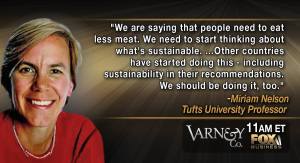
10982813_934682089898559_3461048965358255082_oWhen the report was released, my Twitter notifications, Facebook feed and email inbox exploded. Memes like the one to the left appeared on every (virtual) street corner, and the report was mentioned in every online newsletter, whether agricultural or mainstream media. It’s this press coverage rather than the content of the report, that really concerns me.

Individuals don’t pay a lot of attention to a government report on nutrition. Despite the fact that six updates to the guidelines have been released since their inception in 1980, we are all still eating too many Twinkies in front of the TV and super-sized takeout meals in the car, rather than chowing down on broccoli and lentil quinoa bake.
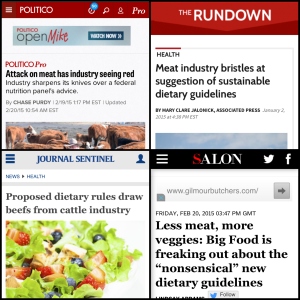
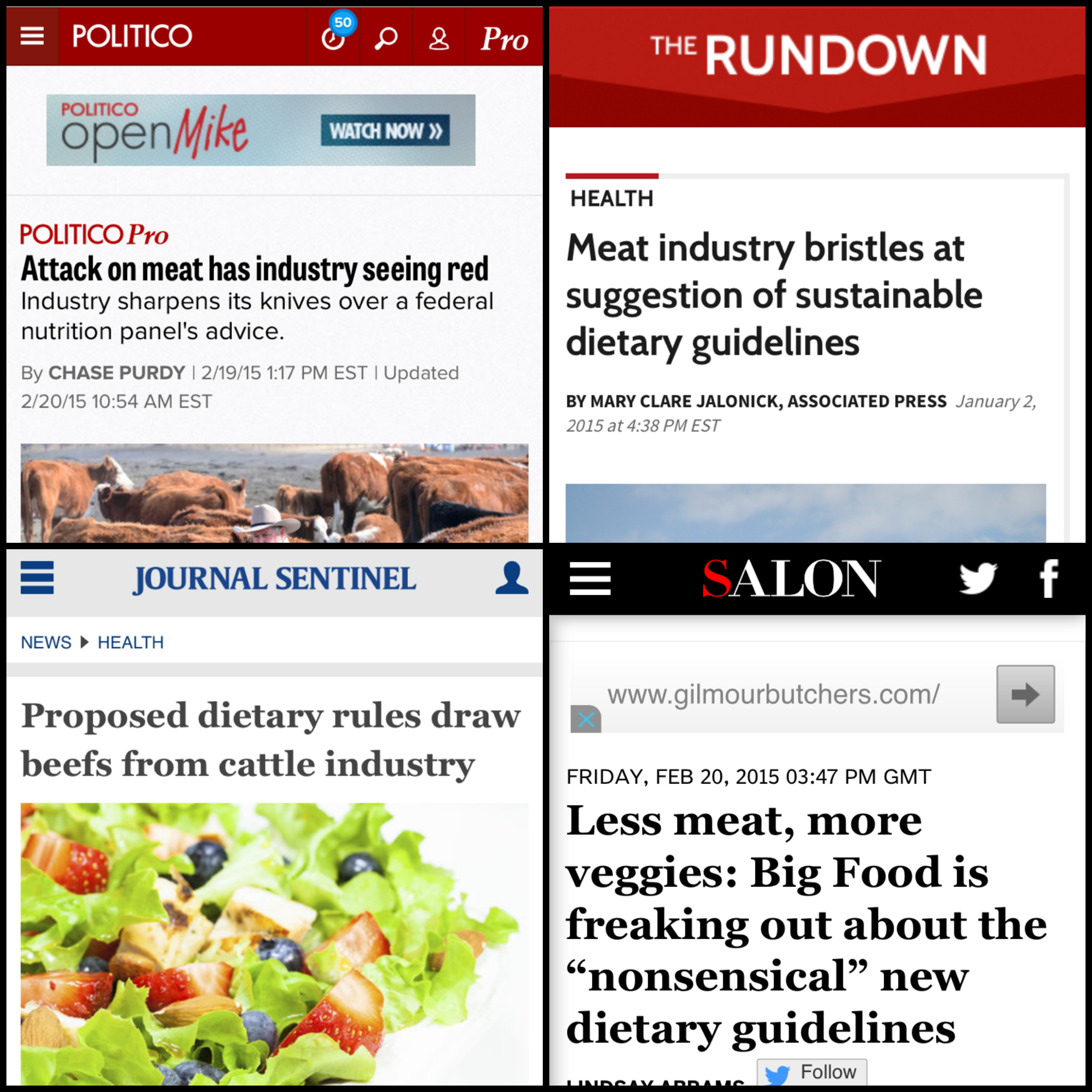
Headlines CollageYet people do pay attention to headlines like “Less meat, more veggies: big food is freaking out about the “nonsensical” new dietary guidelines” and others shown to the left. The media sub-text is that big bad food producers (so different from the lovely local farmer who sells heirloom breed poultry at $18/lb at the farmers market) are appalled by the release of this governmental bad science that’s keeping them from their quest to keep you unhealthily addicted to triple cheeseburgers washed down with a 500-calorie soda, and will do anything to suppress it.

This makes me wonder – at what point do we need quiet, stealthy change, rather than loud protests that attract the attention of people who would otherwise never have read about the guidelines? At what point does industry protesting seem like a modern version of “The lady doth protest too much“?

Rather than posting on Facebook or Twitter that the report is nonsense because the committee of nutritionists ventured into the bottomless pit that is sustainability; why don’t we instead extol the virtues of producing high-quality, nutritious, safe and affordable lean meat, and aim to reach the people who haven’t seen the hyperbolic headlines or read the guidelines simply because they’ve seen a lot of talk about them on Twitter? The old showbiz saying that there’s no such thing as bad publicity certainly applies here – the extent of the reporting on the industry backlash against the report means they have probably been noted by far more people that they otherwise might.

The impact of the dietary guidelines recommendations upon purchasing programs is far higher than on individuals, and does give rise to concern. Globally, one in seven children don’t have enough food, and school lunches are often the only guaranteed source of high-quality protein available to children in impoverished families. I may be being overly sceptical, but I suspect that if meat consumption in schools is reduced, it’s unlikely to be replaced with a visually and gastronomically-appealing, nutritionally-complete vegetarian alternative.

Sustainability doesn’t just mean carbon, indeed, environmentally it extends far further than the land, water and energy use assessed by the dietary guidelines advisory committee into far bigger questions. These include the fact that we cannot grow human food crops on all types of land; water quality vs. quantity; the need to protect wildlife biodiversity in marginal and rangeland environments; the use of animal manures vs. inorganic fertilisers; environmental costs of sourcing replacements for animal by-products in manufacturing and other industries; and many other issues. Simply stating that meat-based diet X has a higher carbon footprint or land use than plant-based diet Y is not sufficient justification for 316 million people to reduce their consumption of a specific food. Indeed, despite the conclusions of the committee, data from the US EPA attributing only 2.1% of the national carbon footprint to meat production suggests that even if everybody reduced their intake of beef, lamb and pork, it would have a negligible effect on carbon emissions.

Could we all reduce our individual environmental impact? Absolutely. Yet as stated with regards to dietary change in the advisory report, it has to be done with consideration for our individual biological, medical and cultural requirements. As humans, we have biological and medical requirements for dietary protein, and some would even argue that grilling a 16-oz ribeye is a cultural event. I have every sympathy for the USDA committee*, who were faced with a Herculean task to fulfill, but in this case, they only succeeded in cutting off one head from the multi-craniumed Hydra – and it grew another 50 in its place.

*Many people have already commented on the suitability (or not) of the committee to evaluate diet sustainability, but to give them their due, they do appear to have looked beyond greenhouse gases to land, water and energy use. They are nutrition specialists, not sustainability experts, but it would be difficult (impossible) to find a committee comprising people who were all experts in nutrition, sustainability, economics, policy, behaviour and all the other facets of the report. Nonetheless, the sustainability recommendations appear to be based on a small number of papers, many of which are based on dietary information from other regions (Germany, UK, Italy) which will also have different levels of animal and crop production. As somebody who was born and bred in the UK before moving to the USA I find it difficult to believe that the average American’s diet uses substantially more land (for example) than the average UK person, as cited in the report.
What Happens When We Don’t Like the Science?

Recently I’ve seen some criticism relating to Dr. Temple Grandin from a few people who are opposed to her ideas on animal welfare – namely that we need to listen to the consumer and understand what they think and want. It doesn’t seem like rocket science, does it? Ignore your consumers wishes and pretty soon you don’t have a market.

Just show consumers the science, not the emotion…” seems to be the battlecry. “If somebody hasn’t published a peer-reviewed paper on it, they shouldn’t be allowed to say it!” Except it’s not as simple as that, is it? Just look at the furore over LFTB (lean finely-textured beef or so-called “pink slime”). A safe, technologically-sound, scientifically-approved product that, once it was labeled pink slime, was utterly undesirable to the consumer. Never mind that they were still happy to eat Twinkies, Slim-fast (just what is that pink powder?) or kelp juice (green slime?), the perception was out there that LFTB was gross, and no matter how much science was quoted, bang, out of beef products it went.

We can talk about science all we like, but sometimes that just isn’t going to get the message across. I can’t imagine that any consumer who goes into a battery chicken (caged layer) house or sees a photo of a pig in a gestation crate says “Wow, what a beautifully efficient and scientific system!” That response becomes even less likely when all they see is a photo of it on Facebook.

So what happens when the science doesn’t play nicely into our perceptions and beliefs? When about social science papers that show that consumers evaluate foods based on emotion, not science? Or survey data that shows that we can take consumers to a farm and explain agriculture…but that it doesn’t change the preconceived ideas that 75% of them already held?* Do we ignore the inconvenient science because we don’t like the answers? Keep banging the same drum and hope that we can maintain the status quo?

Here’s a thought. Rather than looking at agriculture through your own eyes, try and see it through the eyes of somebody else. Part of Dr. Grandin’s success can be attributed to that fact that, because of her autism, she can empathize with animals in handling systems. Isn’t time we followed her example and tried to think outside the cattle chute?

*SHS Foodthink (2012). Building Trust in What We Eat. Available here: http://shsfoodthink.com/white-papers/

Think You’re Brilliant? Don’t Just Say it, Prove it.

Feeding calfI recently had a long and rather tedious conversation with somebody who was trying to convince me that he was brilliant. I say tedious, because the conversation consisted of him telling me how brilliant he was, without actually providing any evidence of his brilliance, save for saying that “Smart people get how brilliant I am”. By definition, if I’m smart, I’m going to get it, right? Aha, he must be brilliant!

Call me picky, but if I am going to believe in somebody’s brilliance, I want examples, proof, something that I can relate to. Otherwise it just seems like a display of arrogant self-aggrandizement – a human peacock flaunting pretty feathers as a proxy for superiority.

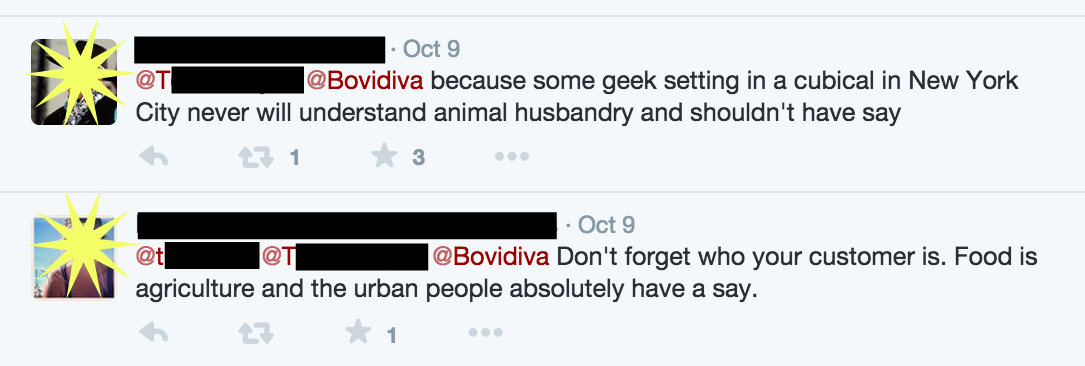
Yet today it struck me that we often exhibit the same behaviors when explaining livestock production to the wider world. 98% of the population has no knowledge or understanding of animal agriculture. Does that mean they aren’t smart enough to understand how brilliant we are? After all, some would claim that “…some geek sitting in a cubicle in New York City never will understand animal husbandry and shouldn’t have (a) say (in livestock production)”* – therefore we don’t have to listen to their opinion.

Twitter geek quote
Regardless of whether or not they understand animal production, the consumer has a huge say in what we do every single day. If supermarket X decides they don’t want beef with from animals given implants because some consumers have concerns about hormones, implants could be effectively removed from cattle production in a matter of weeks. If a proposition is put forwards to ban dehorning, castration or tail docking, it could well pass, especially in more urban states. Precedents exist for both of these examples (Merck Animal Health’s voluntary withdrawal of Zilmax, grocery stores sourcing rbST-free milk and proposition 2 in California to ban battery cages for hens) – and once a precedent is set, other examples may follow.

So how does this relate to last week’s tedious conversation? Actions speak louder than words. Thousands of “we care for our livestock” quotes are instantly negated the moment a new animal rights video is released showing a downer cow or battered piglet. Just a single documented incidence of a manure spillage makes the “we care for the environment” quotes look like industry spin.

We have to be ahead of the curve, showing people what we do every single day – not just through words but through pictures and videos. Calving a cow at 3am, bottle-feeding a calf throughout the night, trudging through the snow to give hay to the in-calf heifers, making sure the manure lagoon is leak-free – these are all facets of livestock production that we have to share. If we just keep saying how brilliant we are without backing it up with evidence that resonates with the consumer, we’re talking to a brick wall. Because, as the saying goes, people don’t care how much you know, until they know how much you care.

*edited for spelling and clarity

Farm Better and Feed the World…. Without Farmers?

Where's the beef...without ranchers?

Where’s the beef…without ranchers?

The New York Times is putting on a “Food for Tomorrow: Farm Better. Eat Better. Feed the World” conference in NY next month. This is a great idea – we all need to think more about our food choices and how we’re going to produce enough food to supply the population in 40 years time, when we’re predicted to have another 2-3 billion mouths to feed.

So just as a debate on the future of healthcare would include presentations from doctors and surgeons; or a discussion about how education could be improved would showcase teachers and lecturers; this conference is going to feature farmers, meat processors and animal and crop scientists, right?

No. Firstly, we have Michael Pollan, author and journalism professor, famous for the suggestion that if you can’t pronounce it, you shouldn’t eat it. Looks like quinoa, gnocchi and beignets are off the lunch menu? When participating in a recent radio panel discussion with Mr. Pollan it was frightening to note how uninformed he appeared to be about the realities of livestock production versus the activist rhetoric (or indeed, the common courtesies of polite conversation).

Secondly, Danielle Nierenberg. I had the pleasure of being on a panel in Washington DC with Ms Nierenberg when she was still on-staff at HSUS. She was vehemently against the use of technology in livestock production and claimed that all housed or confined cattle were kept in filthy disease-ridden conditions. She further claimed that, contrary to the World Health Organization’s information on the topic, bird flu did not exist in small backyard poultry flocks in Asia and that biosecurity in large poultry operations was responsible for its spread.

Thirdly, a spokesman from the Union of Concerned Scientists. A pseudo-scientific organization that is opposed to so-called industrial agriculture, GMOs, antibiotic use in agriculture, agribusiness, the USDA nutrition guidelines…. the list goes on.

Amongst the remaining 14 speakers, there is a self-proclaimed activist, a chef, a politician, 3 reporters, 2 academics, and finally, two representatives from the retail sector – Panera Bread (known most recently for their “EZ-chicken” campaign which was rescinded after outrage amongst agricultural advocates) and Walmart. The sole representative of the farming community is an organic dairy producer with a herd of 85 Ayrshire cows from Wales.

I’m not suggesting that none of these people have valid opinions on how food should be produced – as consumers, we all do. However, the fact that conventional food producers and processors aren’t involved in the discussion makes me wonder whether this is simply an opportunity for those who most often criticize the current food system to shake each other’s hands, nod happily in agreement and make proclamations about how things “should be”, without discussing the practicality or feasibility of these solutions with those who farm the land and raise livestock every single day.

Almost inevitably, the conclusions coming out of this conference will be that you should reduce consumption of processed and conventionally-produced foods, and that if you are going to eat a small amount of meat, it should be organically-raised. That’s a beautiful shiny picture – I wonder what it will mean to the single mother trying to feed four children on a $10,000 salary; or the livestock producer who simply cannot make a living producing organic cattle?

Starvation isn’t sustainable for anybody – to feed the world in 2050 we need real solutions that improve crop and animal performance while reducing resource use. Solutions that are provided by farmers and ranchers working together with geneticists, nutritionists, consultants, veterinarians, crop scientists, soil scientists and meat scientists to improve the productivity of their farm.

To bastardize the old saying: “Give a man a fish and you feed him for a day; teach a man to fish and you feed him for a lifetime; give a man a panel of 17 food “experts” and you’ll feed him for…..?” Cynically, I’d suggest the answer may be less than one meal.

We’re Off to Eat at Chipotle, the Chipotle Burrito of Oz

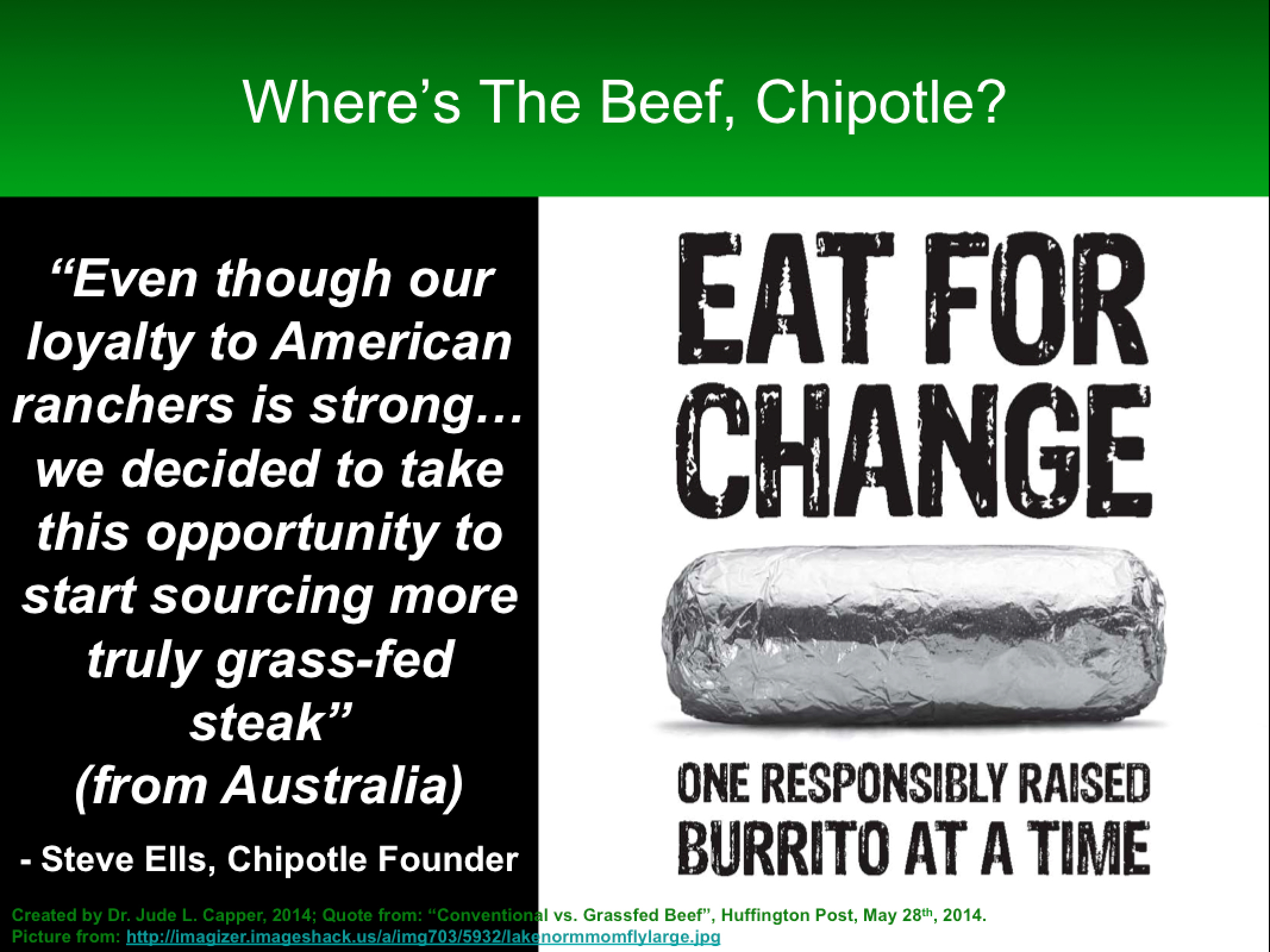
Chipotle 1Another day, another jalapeño in the salsa of Food With Integrity spin from Chipotle. After their recent decision to source grass-fed beef from Australia, citing a lack of supply from US ranchers; Texas Agriculture Commissioner Staples yesterday praised Chipotle for their willingness to discuss the matter. Yet in a world where companies can be made or broken by PR, the likelihood of Chipotle Chairman Steve Ells responding to Staples’ queries regarding their beef choices with “Our mind is made up, we’re not prepared to discuss it further.” was highly unlikely. Instead, their defensive response to Staples simply stated that they were happy to engage in dialogue.

Dialogue is great, but note that it doesn’t actually mean that any decisions will change. After all, I’m happy to dialogue with opponents of GMO crops and vaccines, but have any of those discussions made me change my stance on the safety, efficacy and importance of these technologies? No.

Rather than being applauded for their willingness to debate, Chipotle should instead be questioned about the apparent incompatibility between their Food With Integrity slogan, and their beef choices. As stated in the response to Staples, Chipotle only uses 23% of the beef on a carcass, relying on other buyers to provide a market for the remainder. Yet as we strive to feed an ever-increasing population using fewer resources and with less waste, wouldn’t it be more sustainable for Chipotle aim to use as much of each carcass as possible? After all, authentic Mexican food uses many different cuts, organs and variety meats – shouldn’t Food With Integrity derive more than chips and salsa from its supposed region of origin?

As discussed by California ranchers here, the issue appears not to be related to a scarcity of US beef per se, but rather beef at a price that Chipotle wants to pay. Given their claims of support for US beef producers, paying grass-fed ranchers the premium that they need for their production systems to be economically viable would show more integrity than importing beef from overseas. Ranchers should not be expected to operate at a loss for the privilege of supplying Chipotle with a premium product, of which three-quarters will be discarded.

I recently had a Twitter conversation with a follower who asserted that when assessing sustainability (economic viability, environmental responsibility and social acceptability), we should put “people and planet” ahead of “profit”. I disagree, as I firmly believe that all three have to balance – if any one is prioritized, the business will not achieve long-term sustainability. Yet in this instance, Food With Integrity appears to demote all three (while attempting to maintain Chipotle’s profit margin):

Chipotle 2

  • Reduced economic viability for US beef producers;
  • Increased environmental impact of shipping beef from over 8,000 miles away;
  • Reduced social acceptability for Chipotle’s brand within the agriculture industry.

Planning to eat at Chipotle this weekend? I’m willing to bet you’re not a US beef producer.

Who Needs Scientists? Just Let Mother Nature Design Your Greek Yogurt.

Chobani.jpgHow you get to 100 calories matters. Most companies use artificial sweeteners. We think Mother Nature is sweet enough”. Clever marketing from the greek yogurt company Chobani, simultaneously disparaging alternative brands, and playing the ultimate caring, sharing, natural card with the mention of “Mother Nature”. However, earlier this week, Chobani’s #howmatters hashtag set the twitter feeds alight after their new “witty” tagline on the underside of yogurt lids was posted (below).

howmattersThe wording plays beautifully into what is fast becoming a universal fear of science intruding on our food supply – we want real food; food like our grandparents ate; food from traditional breeds and heirloom varieties – providing it doesn’t take us over 2,000 cal per day or increase our cholesterol levels. Rightly or wrongly, many people blame processed foods with hidden sugars and added chemical preservatives for many health issues in developed countries – the epitome of a #firstworldproblem, given that the corresponding #thirdworldproblem is hunger and malnutrition.

However, this time the twitter anger wasn’t from rampaging mommy bloggers, or infuriated activists, but scientists. After all, without science, would Chobani have a product? Yogurt was first developed in ancient times, but the modern pasteurized, long-shelf-life, greek yogurt is rather different to the cultured milk our ancestors would have enjoyed.

FAGEI have a 100-calorie greek yogurt from a rival brand in my fridge, so let’s examine the ingredients (left). Simply pasteurized skimmed milk and live active yogurt cultures (note, no added sweeteners). Louis Pasteur, a 19th century French scientist developed pasteurization (in addition to his discoveries relating to vaccines and microbial fermentation); biologists developed methods to identify and classify the bacteria that ferment milk into yogurt; and food scientists experimented with the exact mixture of bacteria to produce the desired flavor, texture and color of yogurt,  as well as developing the range of other processes needed to make the yogurt safe, appealing and shelf-stable.

Yes, we could make greek yogurt without scientists – after all, the original recipe didn’t originate in a corporate experimental kitchen. But without hundreds of years of scientific input, could we make Greek yogurt that, at 100 calories per serving, is desirable to the consumer and is a safe, affordable source of vitamins, minerals and protein? No. To imply that we could does a huge disservice to food scientists.

It appears that being a modern-day scientist appears to be somewhat equivalent to clubbing baby seals to death. Caring little for human suffering and illness, the cold and clinical scientist rubs his hands together with glee as he removes all nutrients from real food, replacing them with chemicals, additives and genetically-modified ingredients. As a side-line, he develops cocktails of toxic elements, pesticides and embalming fluid and markets them as vaccines. Yes, science is the enemy. Just remember that next time you take an aspirin for a hangover from pasteurized, fermented beverages.

How Long is Long-Term? Are We in Danger of Sacrificing Food Security to Satisfy GMO Paranoia?

FrankenfoodsMy Twitter feed is being taken over by two things: 1) arguments and 2) comments that are going to cause arguments. Almost every tweet appears to draw a contrary comment – I’m tempted to post “Elephants have four legs and one trunk” just to see how many people reply “No, there’s an elephant in South Africa called Minnie who only has three legs but has two trunks…”

The latest discussions (debates? arguments? long drawn-out 140-character battles?) have related to the safety of GMOs. Without exception, the argument from the nay-sayers comes down to “We don’t know what the long-term effects are, so we should ban them until we can conclude that they’re safe.”

In other words, we’re trying to prove a negative – show me that there’s no adverse effects whatsoever and I’ll believe it’s ok. Utterly impossible. Can you be absolutely sure that the screen you’re reading this on isn’t causing constant, minute but irreparable damage to your eyes? Water, that essential nutrient without which humans, animals and plants would die, can kill through drowning or intoxication. Even oxygen, without which brain cells are irretrievably damaged in just 10 minutes,  causes seizures and death when inhaled at high pressures. Should we ban these, just in case?

Perhaps we should take a long-term approach to all new technologies. iPhones were only introduced seven years ago, yet many of us spend considerable amounts of time typing on them, or holding them to our ears when they’re not in our pockets – what health-damaging consequences could these shiny new toys confer? What about the now-ubiquitous hand sanitizer? Once only the province of hospitals and germophobes, it’s now sloshed around by the gallon. Touted to kill 99.9% of harmful bacteria – what harm could those chemicals be doing to our fragile physiology?

I’ve yet to meet anybody who, when scheduled for quadruple bypass surgery, demanded that the surgeon only used techniques developed in 1964; or a type I diabetes sufferer who would only use insulin produced from pigs, as it was originally in 1923. When I was treated for breast cancer, I jumped at the chance to be part of a clinical trial involving a new monoclonal antibody treatment, regardless of the very slight risk of heart damage. In medicine, we seem happy to trust that science has the answers – not surprisingly, we prefer to survive today and take our changes with side-effects tomorrow.

With regards to food however, the opposite appears to be the case. The first commercial GMO (the Flavr Savr tomato) was introduced in 1994, GM corn and soy were commercialized in 1996, and not one death or disease has been attributed to any of these crops. Yet the “what are the long-term effects?” concern still persists. So how long-term is long enough? 10 years? 20? 50? Should we keep researching and testing these crops for another 80+ years before allowing them onto the market around the year 2100?

If your answer is yes, just pause for a moment and ask your parents, grandparents or even great-grandparents what life was like during the Great Depression in the USA, or World War II in Europe. Consider what life was like when food was scarce or rationed, when, for example, a British adult was only allowed to buy 4 oz of bacon, 8 oz ground beef, 2 oz each of butter and cheese, 1 fresh egg and 3 pints of milk per week. Those quantities of meat and cheese would only be enough to make two modern bacon cheeseburgers.

By 2050, the global population is predicted to be over 9 billion people. I don’t relish the idea of explaining to my grandchildren that they live with food scarcity, civil unrest (food shortages are one of the major causes of conflict) and malnutrition because public paranoia regarding GMOs meant that a major tool for helping us to improve food production was removed from use. In the developed world we have the luxury of choosing between conventional, natural, local, organic and many other production systems. However, we’re in danger of forgetting that not everybody has the same economic, physical or political freedom to choose. If you gave a basket of food to a family in sub-Saharan Africa subsisting on the equivalent of $30 per week, would they refuse it on the basis that the quinoa wasn’t from Whole Foods, the meat wasn’t organic and the tofu wasn’t labeled GMO-free?

When we have sufficient food being supplied to everybody in the world to allow them to be healthy and productive, we can then start refining the food system. Until then, the emphasis should be on finding solutions to world hunger, not forcing food system paranoia onto those who don’t have a choice.

Breast is Best…But My Baby and I Are Eternally Grateful for “Udder” Alternatives

BreastisbestJust over 11 months ago my life changed forever. As a breast cancer survivor who underwent 6 years of surgery, chemotherapy, radiation, monoclonal antibodies and hormone treatment, I’d resigned myself to that fact that my chance of having children was less than 4%. As a fiercely independent traveler, I was ok with that (sort of…), diverting my attention to work and celebrating the fact that with no ties, I could go to bed at 3am, attend any social event or fly overseas at a moments notice.

Then I found I was pregnant. The most unexpected, amazing, literally mind-blowing event of my entire life. I become “that” pregnant woman, giving up soft cheeses, beef jerky, champagne, ibuprofen and horse-riding overnight and doing absolutely everything I could to nourish the baby growing inside me. In January my baby girl was born, and (to quote my sister-in-law) every single day since then has been like waking up on Christmas morning. I could never have wished for such a beautiful and perfect gift.

When I saw this PETA video starring Emily Deschanel I absolutely sympathized with her opening statement – nothing compares to the joy of raising my child. Yet, as the video progressed and Ms Deschanel described the atrocities that allegedly occur on dairy farms, accompanied by emotive video footage, I became more and more concerned. At the end of the clip Ms Deschanel suggested that the only way forwards was to end the cruelty on factory farms and go vegan. That’s when I almost lost it.

I’ve always supported the dairy industry – I think I may actually be clinically addicted to cheese and my yogurt consumption could be considered an extreme sport; but now I have an even better reason to celebrate dairy farmers – they ensure that I have a happy, healthy baby girl.

There’s no doubt that the “breast is best” slogan is right – babies are mammals, they thrive on mammalian milk – indeed milk is the most highly digestible food available for their little stomachs. However, because of my cancer treatment, I can’t produce enough milk to nourish my baby; so she’s fed both breast-milk and formula.  Until now, I’d never thought about where formula comes from – I’d rather assumed it was a synthetic mix of amino acids produced in a test-tube. In reality, it’s a combination of nonfat cows’ milk*, lactose, and whey protein concentrate (both of the latter ingredients also from cows’ milk); combined with other ingredients to provide the energy, vitamins, minerals and essential fatty acids that my little girl needs to grow and be healthy.

I would do anything for my little girl – I can’t even imagine what it would be like to try and care for her if formula didn’t exist and I could only provide her with half the nutrients she needed through breast-feeding. Alarmingly, the third result on Google for “vegan baby formula” is a recipe for home-made formula based on coconut water and raw almonds. The mind would boggle if I weren’t just terribly worried that somewhere, a mother thinks that this is the right choice for her child. To raise a baby as vegan because of parental ideology would seem irresponsible, if not dangerous – after all, surely breast-feeding is non-vegan?

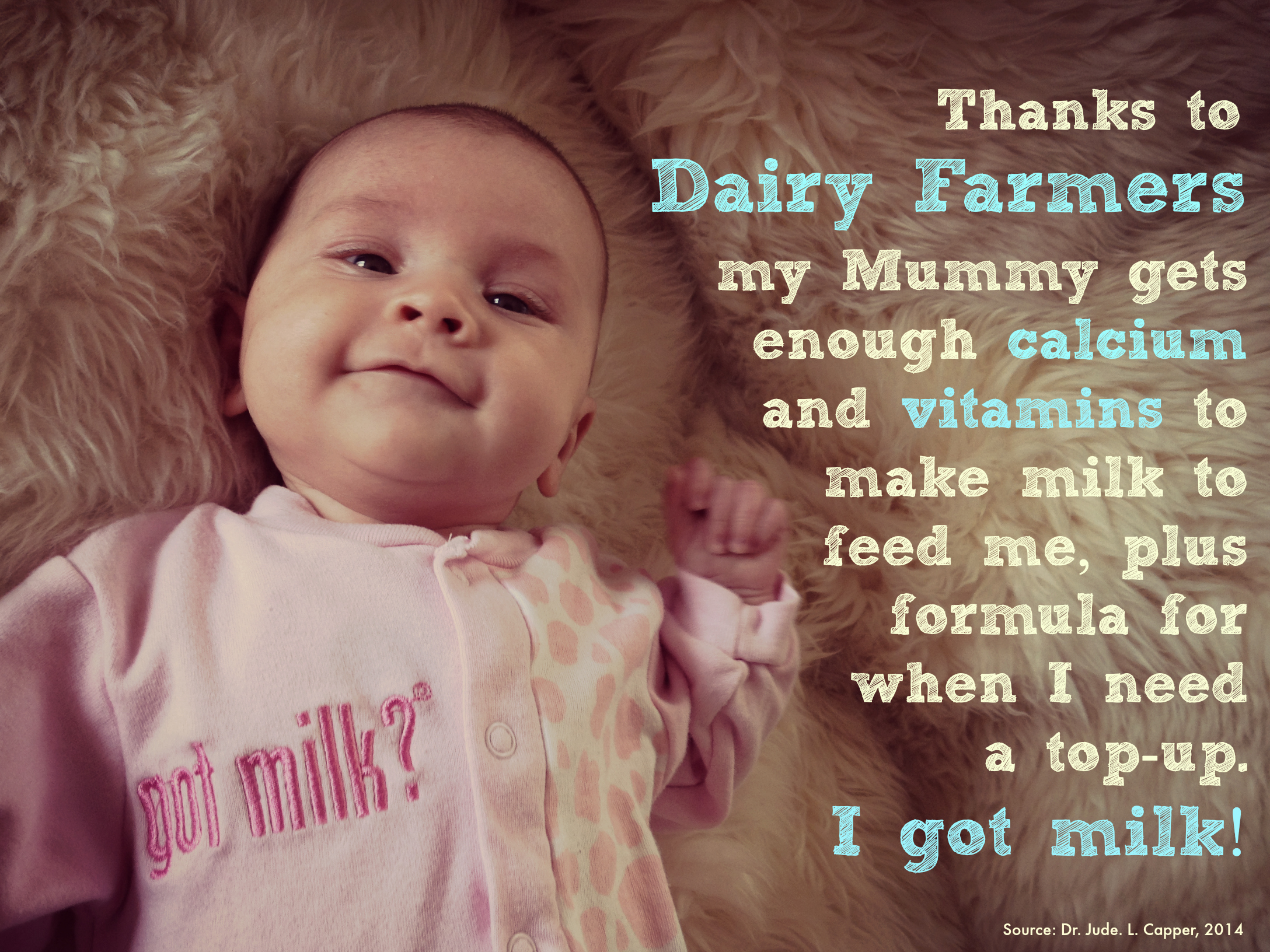
Got milkSo THANK YOU dairy farmers, for the nutrients that I get from my diet and can pass on to my baby, and for the milk that goes into formula to help her grow and thrive. You guys are the best!

 *Soy-based formulas are also available for babies who are allergic to cow’s milk, I’m lucky that my little girl thrives on dairy products! 

Thanks to @DairyCarrie and @AgProudRyan for showing me the PETA video, and to @JodiOleen for reminding me that I’d intended to blog about it.