All Aboard the “Eat Less Meat” Bandwagon

One of the main criteria for publishing scientific research is that it should be novel, yet not a week goes by without yet another paper concluding that we have to reduce meat consumption in order to mitigate climate change. That’s the headline in media coverage relating to the latest paper from a researcher at the The Woods Hole Research Center (published in Environmental Letters), which examines nitrous oxide emissions (a highly potent greenhouse gas (GHG)) in 2050 under various scenarios.

It’s an interesting paper, not least for some of the assumptions buried within the model. Based on data from the FAO, the authors assume that meat consumption will increase by 14% in the developed world and 32% in the developing world by 2050. Coupled with the predicted population global increase (from the current 7 billion to 8.9 billion in 2050), it’s not surprising that a 50% reduction in meat consumption would be predicted to have a significant effect on total GHG. It’s rather akin to suggesting that each person will own two automobiles in 2050, so we should reduce car manufacture.

However, the more striking result is buried in Figure 1, showing that if efficiency of manure management and fertilizer application were improved, this would have a more significant effect on GHG emissions than reducing meat consumption. Given the considerable improvements in cropping practices, crop genetics and yields over the past 50 years there is absolutely no reason why this should not be achieved in the next 40 years.

Alas, a headline suggesting that agriculture needs to continue to improve manure and fertilizer efficiency just isn’t as sexy as the “eat less meat, save the planet” message so often propounded by the mass media. They say that bad news sells – it’s a shame that the lay press are so enamored with messages that denigrate ruminant production, rather than taking a broader look at the options available for mitigating future climate change.

*Thanks to Jesse R. Bussard for bringing this one to the forefront of my “to do “ list.

Is Corn the Soylent Green of the Future?

I recently had the pleasure of watching the 1973 movie Soylent Green starring Charlton Heston. I won’t spoil the ending for those who havent seen it, but the overarching premise of a big company controlling the food supply to an hungry, overcrowded future population strongly resembles some of the current claims made by the more vehement foodies. The anti-animal-agriculture activists appear to have a similar agenda – if only food production was “sustainable” (a word with a million definitions) without any of those “factory farms (that) pose a serious threat to health” and red meats that “have been linked to obesity, diabetes, cardiovascular disease, and certain types of cancer“, life would be much sweeter.

So what’s the answer? It’s very simple. All that animal feed could simply be fed to humans. According to Pimentel at Cornell University, 800 million people could be fed with the grain that livestock eat in the USA each year. If we ignore the fact that field corn (fed to livestock) is not the same as sweet corn (the corn on the cob that we eat), and assume that field corn could easily be processed into a human foodstuff, Pimentel is right.

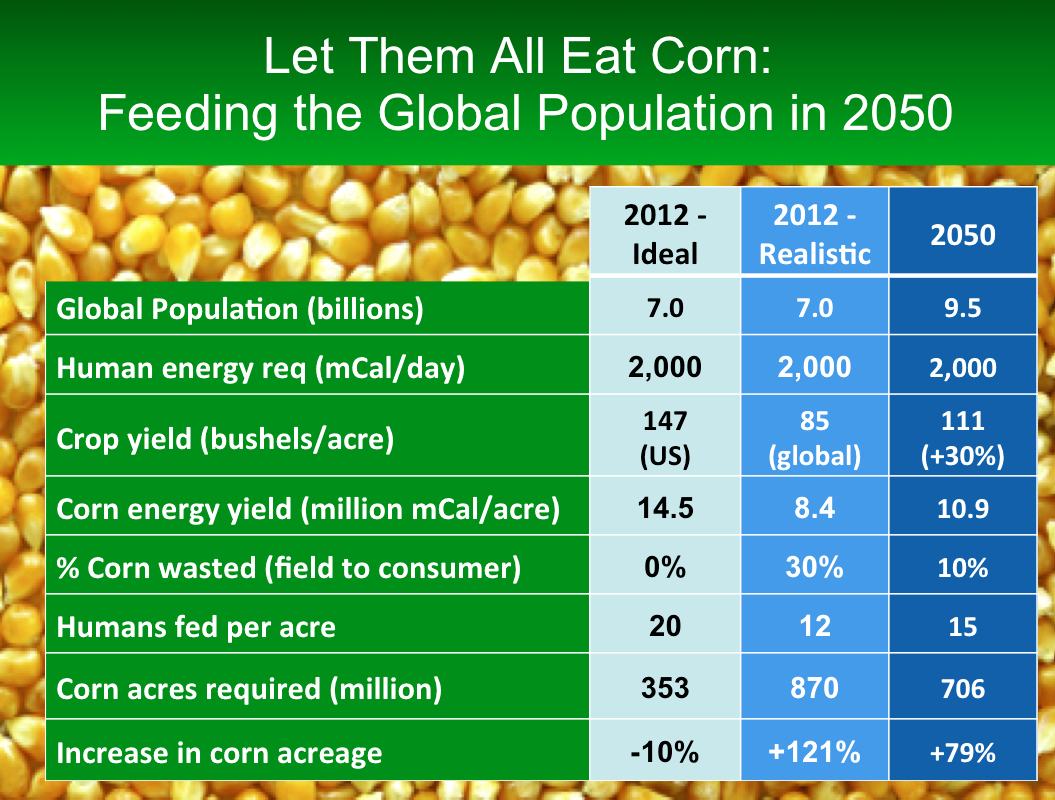
Given the average human nutrient requirement (2,000 kCal/day) and the energy yield of an acre of shelled corn (14.5 million kCal), one acre of corn (at 2011 US yields) could supply 20 people with their energy needs (see table below). On a global basis, we currently harvest around 393.5 million acres of corn, therefore we could supply the entire current global population (7.003 billion) using only 90% of the global corn area. Of course that’s assuming zero waste and US crop yields. If we use a more realistic scenario with global corn yields (85 bushels/acre) and 30% food wastage, we can only feed 12 people per acre and would need to increase current corn acreage by 121% to produce enough food to supply the current population. So what happens by the year 2050 when the population is predicted to reach 9.5 billion people? Assuming that we continue to see increases in yield proportional to those over the past 30 years (30% increase in US yields since 1982), that yield increases are exhibited globally, and that we can cut food waste to 10%, we could feed 15 people per acre and we’ll need to increase corn acreage by 79% to provide sufficient corn to feed the global population.

If our dietary requirements can be met by corn alone, the increase in land use won’t be an issue – land currently devoted to soy, peanuts or wheat can be converted to corn. Yet this simplistic argument for vegetarian/veganism suffers from three major flaws. Firstly, it assumes that the global population would be willing to forgo lower-yielding vegetable crops that add variety to the diet – where are the artichokes, kale or radishes in this dietary utopia?

Secondly, as noted by Simon Fairlie in his excellent book, converting to a vegan monoculture would significantly increase the reliance on chemical fertilizers and fossil fuels due to a lack of animal manures. Given current concern over dwindling natural resources, this is an inherently unsustainable proposition.

Finally, corn is currently vilified by many food pundits. The suggestion that our food supply is controlled by corporations who force monoculture corn upon hapless farmers who are then faced with the choice of complying with big ag or being forced out of business are the purview of food pundits (e.g. Michael Pollan and Joel Salatin) and documentaries such as Food Inc. and King Corn. Not a week goes by without another Mommy blogger or journalist publishing an article on the dangers of high-fructose corn syrup, often concluding that if only this ingredient was removed from our food supply, childhood obesity and pediatric type II diabetes would cease to be an issue for little Johnny and Janie pre-schoolers of the future.

It’s frighteningly easy to visualise the Soylent Green-esque vegan future, whereby food is doled out in pre-measured quantities according to dietary requirements – yet what happens when the whistle-blower of 2050 proclaims “it’s made from CORN!”?

Eating Less Meat, May Not Help You To Live Forever…But It’ll Sure Feel Like It

I know Harvard researchers are smart, I really do. Yet I have to question the latest study reporting that eating red meat is associated with premature death. Published in the Archives of Internal Medicine, the paper analyzed the relationship between mortality and red meat consumption in a total of 121,342 healthcare professionals and concluded that:

Greater consumption of unprocessed and processed red meats is associated with higher mortality risk… replacement of red meat with alternative healthy dietary components may lower the mortality risk.

As a researcher, I know full well that it’s almost impossible to prove a cause-effect relationship. This is particularly difficult in human studies where other dietary and lifestyle factors have to be accounted for. After all, if you have ketchup on your steak, does the lycopene prevent against prostate cancer? “Associated with” is therefore absolutely the correct terminology for the paper’s authors to use. Alas, in the minds of so many, “associated with” translates to “causes” (especially when it’s a bad news story), and everybody panics accordingly.

The results of this report need to be put into context with our other lifestyle choices. If, as reported, eating unprocessed or processed red meat increases the relative risk of mortality by 13% and 20% respectively, how does that compare to all our other daily activities – driving a car, drinking a glass of wine or eating a candy bar? How do we weigh the risk of consuming a steak or slice of pepperoni pizza against the bottle of Mountain Dew or unwashed raw carrot? After all, during the BSE crisis in the UK, data suggested that the risk of dying from falling out of bed and suffering a fatal head injury was far greater than that from contracting vCJD, yet there was immense consumer concern relating to the perceived dangers of beef consumption.

Relative risk is not a measure that many people understand. Within this study, the absolute mortality risks (i.e. the probability of any one person dying) paint a rather different picture. Out of every 100 men, 1.23 men consuming three servings of unprocessed meat (the equivalent of one 9-oz steak) per week were likely to die, versus 1.30 men eating 6 oz of processed meat (bacon, sausage etc) per day (42 oz per week). Given the small difference in those mortality risks (which were similar for women) yet the huge difference (9 oz vs. 42 oz) in weekly meat consumption, we would be better served by focusing more on other factors (bodyweight, exercise, genetic propensity to specific diseases) that contribute the vast majority of our absolute mortality risk rather than assuming that we can live forever if we only replace a hamburger with a vegetarian meatloaf.

Since this study hit the headlines my Facebook newsfeed predictably been over-run by anecdotes about grandparents who lived to the ripe of age of 101 years while eating bacon and eggs for breakfast, corned-beef hash for lunch and three pork chops (with extra heavy cream in the whipped potatoes) for dinner. Without wishing to be flippant, the one certainty in this life is that we’ll all die at some point – if I restricted my meat intake to the suggested 3 oz per day (or less) I have a sneaking feeling that I might not live forever, but it’d sure feel like it.

Flawed Water Use Claims Are Huge Threat to Beef Sustainability

Let’s make a bet. I bet you that within the next five years, the biggest sustainability issue to hit the beef industry won’t be carbon emissions, hormone implant use or ethanol prices, it’ll be water use. Conflict over water rights and declining aquifer levels are already occurring in many areas and those battles will only increase as urban sprawl encroaches onto agricultural land.

Fortunately, scientists at the University of Twente in The Netherlands have calculated the water footprint* of humanity. Published in the highly prestigious Proceedings of the National Academy of Sciences, this study provides valuable evidence as to water consumption across different regions. Within the paper, beef production is singled out as contributing 6.7% to global water flows – less than cereals at 17% or industrial products as 12.2%.

Yet the message accompanying press coverage of the report is anything but positive for conventional beef production – a  ScienceNow press release (tagline: “Up to the minute news from science”) quotes Sandra Postel (director of the Global Water Policy Project) as saying:

…people can opt to eat less meat or to switch from grain-fed beef—which, again, requires about 5300 liters of water for each dollar’s worth of grain fed to a cow—to grass-fed beef, which typically requires only the rainwater falling on a pasture

Interestingly, the 5,300 liter (1,400 gallon) figure is not mentioned in the PNAS study, indeed there is no evidence as to the source for Ms. Postel’s claim. Furthermore, the figure is worthy of an award for what must be the most incomprehensible units ever assigned to water use. Expressing water use per acre or per unit of beef produced gives a solid foundation for understanding and comparison, but a volume unit per economic unit of feed fed to a beef animal? What happens when corn hits $10/bushel or falls to $3/bushel?

It’s a sad reflection upon my social life (or lack thereof) that I spent an hour last night calculating water use per dollar of corn fed. The entire calculation can be seen in the excel spreadsheet below, but in essence we simply need to know the current corn price ($6.335/bushel), the proportion of corn that is irrigated in the USA (15%), water use per acre of irrigated corn (2.1 acre-feet) and corn yield per acre (147.2 bushels).

Using these data, 110 gallons of water (417 liters) are used per $ of corn grain fed to a feedlot steer (equivalent to 44.9 gallons of water per lb boneless beef). That’s in line with the total water use of 367 gallons/lb boneless beef cited by Beckett and Oltjen at UC Davis.

Ms. Postel’s estimate is 12.7x higher than average USA data suggests. An error of this magnitude is huge and has the potential to do immense damage to the beef industry, especially when it’s used as a divisive argument against grain-fed production systems. Yet it’s published as factual data in a scientific press-release (without the need for citations or supporting evidence) and will be read by thousands of consumers with an interest in science. Just imagine the reaction from PETA and HSUS if the beef industry quoted environmental figures unsupported by science – instant loss of credibility.

As an industry, we need to be proactive and conduct assessments of resource use and environmental impact before the anti-animal groups or “impartial” environmental groups produce numbers for us. If we continue avoiding science for fear of what it might reveal, we may soon be reacting to a loss of consumer confidence and market share, rendering long-term sustainability impossible.

* Total water use by humans

Water use spreadsheet

Forget Widgets and Factory Farms – Beef Production is the Circle of Life

The Chipotle short film “Back to the Start” which was featured in a commercial break during the GRAMMY awards on Sunday has been one of the most discussed topics on Facebook and Twitter in the past week.

It is incredibly powerful film. Beautifully animated and featuring Willie Nelson singing Coldplay’s “The Scientist”, the cartoon pigs are pink and symmetrical; the dairy cattle graze green grass (before their incarceration in a barn) and antibiotics come in cute little capsules. It’s even more potent because it represents a classic human theme – a mistake followed by redemption. Walking alone in the cold winter night, the farmer realizes his mistake in intensifying his production system, tears down his barns and lets his animals roam free. Who doesn’t love a classic redemption film?

Many of my agricultural friends have responded to this film with the entirely valid argument that Chipotle lack integrity by producing this film as they only source natural or local-produced meat where available. This marketing strategy therefore condemns a significant proportion of their suppliers who produce conventional meat and dairy. However, the average consumer, who only sees the film because they’re waiting to watch Adele’s latest GRAMMY acceptance speech, don’t read about the integrity conflict, and if they do, may assume it’s a reactive response by the ‘inherently biased’ animal agriculture industry.

The question then becomes, how do we overcome this powerful, yet discriminatory message with the fact that all systems have a valid place in food production? Bill Donald (Immediate Past President of NCBA) attended the World Food Prize in Des Moines this week and told me that the hot topic was the concept of future farms with ‘circular economies’. This means taking the ‘reduce, reuse, recycle‘ concept of a circular economy and incorporating it into agriculture, so that the consumer can see that every stage within the process reduces waste, saves resources and produces both nutritious food and useful by-products. It’s a huge hit with consumers in China who are becoming more concerned about environmental issues.

Ironically, this is nothing new – it’s the basis upon which beef production is founded. We take a human-inedible product such as grass, feed it to animals that provide us with meat, leather, pharmaceuticals and other by-products, use their manure to fertilize and grow the grass, produce more beef… It’s a closed and continuous circle of life that has used fewer resources and emitted less greenhouse gases year on year. Yet that’s a very different image to the intensive, inefficient system portrayed by the Chipotle film.

Agriculture is not and never has been a collection of factories pumping in antibiotics, churning out identical widget animals and releasing toxic green waste into rivers. The challenge ahead of us is to be proactive and to demonstrate beef’s circle of life to consumers – not only the 3 R’s (reduce, reuse, recycle), but the 4 F’s – food, fertilizer and fuel for the future.

Would you like a side of corpse with your meal, Sir?

I was interested to see the following description of Hitler’s* (*see disclaimer below) behavior in a recent Drover’s article:

…[Hitler] was offered a piece of ham and refused, saying “it is like eating a corpse.”

Is it me, or is that remarkably similar language to that used by PETA and HSUS? Before somebody opens a can of Godwin’s Law whoop-ass, I’d like to point out that I’m not trying to prove my point by referring everything I don’t agree with back to Nazism (although it’s a popular way for internet trolls to try to end arguments), nor am I comparing PETA and HSUS to Hitler. After all, PETA are inherently amusing – without PETA we wouldn’t see so many pictures of Pamela Anderson or marvel at the faux-pornographic inventiveness of “Milk Gone Wild“, let alone snigger at their attempts to get Ben & Jerry’s to use human breast milk. However, I can imagine this a headline in the National Enquirer: “Animal Rights Groups Use Hitler Soundbites” – could be a PR nightmare (take note PETA publicity dept)

Still, it’s interesting that simple words can evoke such a violent reaction. As an unrepentant omnivore, I’m well aware that the meat that I eat originates from animals that have been slaughtered (yes, slaughtered – carrots are harvested, animals are slaughtered) in order to provide human food. Therefore according to the definition of a corpse “A dead body, esp. of a human being rather than an animal”, the juicy burger I’m planning to eat for lunch is a 1/4 lb patty of flesh from the corpse of a cow. What is it about human frailties that such a definition instantly makes me feel like Jeffrey Dahmer, whereas “meat” sounds tasty and innocuous like something grown on a tree in a sunlit California valley?

In high school, my friends and I eschewed meat for animal welfare reasons, horrified by the vivisection pictures prominently displayed by the animal rights activists at the local mall. Yet once we grew out of the teenage rebellion stage, these issues seemed to be less important: during my 12-month vegan stint (aged 15) over half the girls in my high-school class were vegetarian, yet my college class contained less than five vegetarians and I only have two in my current circle of friends. If we took children on tours of slaughterhouses as well as farms and museums would the number of adult vegetarians increase? Or would the fact that meat generally appeals to the human palate overcome those images?

The vast majority of farm animals are well cared for and slaughtered in a humane manner in accordance with the regulations applicable to that region. Yet continuing to disguise the facts of food production by replacing “slaughter” with “harvest” (I’ve been rebuked several times by industry colleagues for refusing to use “harvest”) and playing into the consumer fantasy that meat is produced without death occurring may lead us into dangerous waters in future. So are we ready to pick up a package of ground beef flesh and to baste the Christmas turkey corpse? Its unlikely…but it sure would take the wind out of the PETA and HSUS sails wouldn’t it?

*If the name Hitler instantly ticks your “Alert! Cheap rhetoric!” button, feel free to replace with Idi Amin, Pol Pot or “small angry fanatic with ridiculous moustache”

Can Population Control Shrink the Yield Gap? Developing Solutions for Developing Regions

A recent article by Andrew Jack in the Financial Times (the iconic pink-colored newspaper carried by all self-respecting business men on London tube trains each morning) reports that developing countries in Africa will be responsible for the greatest increases in population growth over the next 90 years, with the global population predicted to hit 10 billion by 2100. Given the number of dire predictions currently being bandied around regarding population increases, food demand and climate change it’s easy to become blasé and dismiss it as just another issue that will be solved by the next generation. After all, what difference can we possibly make to rural communities in developing countries?

Rises in per capita are predicted for developing countries over the next century and as Andrew Jack notes, increasing affluence results in improved healthcare, urbanisation and a decline in birth rates. Nonetheless, this pattern is not being currently being exhibited by regions in Africa and S. Asia, which are unable to improve per capita income as population increases overcome economic growth.

So how do we curtail the rise in population growth? Even in a developed country such as the USA, mentioning the politically-charged phrase “population control” often leads to an uncomfortable silence, images of an Orwellian constraint on family size (1 child good, 2 children bad?) or debate over the rights and wrongs of abortion. Yet simply providing access to contraception, considered to be an inherent human right by many women in the developed world, could conceivably (pardon the pun) improve future sustainability.

Reducing the number of children born in developing countries would improve female health and lessen the burden on economic and environmental resources placed by increasing population size. This would be a crucial step forwards in mitigating future food shortages, yet it does not solve the underlying problem. One of the major drivers behind population growth is parental reliance on support from the younger generation. As discussed in Jared Diamond’s excellent book “Guns, Germs and Steel“, higher birth rates potentially allow for a greater number of children to work on the land and improve societal stability. However, the promise of  future affluence is a major stimulant that causes young people to migrate from rural areas to urban regions that are already suffering from significant overcrowding.

A considerable yield gap exists between developing and developed countries, both in terms of animal and crop production. If productivity could be improved and the yield gap reduced, food security would improve in rural areas with positive effects on per capita income and infrastructure, and potential reductions in the number of inner-city migrants. Nonetheless, the major question remains unanswered – how to improve productivity?

If we use dairy farming as an example, a recent report from the Food and Agriculture Organisation noted a negative relationship between productivity and carbon footprint – as we move across the globe from developed to developing regions, productivity decreases and the carbon footprint per kg of milk increases (see graph). Carbon can also be considered a proxy for land, water and energy use, thus reduced productivity increases both resource use and environmental impact. The logical conclusion would therefore be to implement systems and management practices currently seen in N. America, Europe and Australasia in an attempt to educate farmers in S. Asia and Africa. However, sustainability cannot be improved by implementing a one-size-fits-all solution, but calls for a region-specific approach.

Identifying traits within indigenous and imported animal breeds and plant varieties that will make the best use of available resources allows development of production systems that match environmental, social and economic demands. Further implementation of continuous improvement and best management practices in developing countries is crucial in order to improve affluence, reduce population growth and mitigate environmental impact both now and in future. However, this is not a situation that can simply be solved by improving yield per acre, but requires a multifactorial approach coordinating population control, education, food security and human health and welfare. Providing contraception without a concurrent effort to improve agricultural productivity will fail in its prophylactic intent to control either population growth or world hunger.

Feed = Food? Do livestock really compete with humans for food?

Can we feed up to 10 billion people in 2100 by improving crop yields, reducing deforestation, and reducing meat and dairy consumption? These solutions are among those suggested by Jonathan Foley at the University of Minnesota’s Institute of the Environment to enable the increase in food production required by the future global population. These are logical suggestions, yet the proposal that meat and dairy consumption should be reduced is likely to be the most-debated, particularly as livestock industry stakeholders may regard this as yet another attack on animal agriculture.

The futility of the “Meatless Mondays” campaign has been discussed ad infinitum, yet in contrast to the EWG’s recent report, Foley does not attempt to promote a vegetarian or vegan ideology or to suggest that climate change could be reversed if only we all ate humanely-certified or organic meat. Instead, the report concludes that resources could be saved if we shifted to meat consumption towards pork and poultry production as:

…it takes 30 kilos [66 lb] of grain to produce one kilo [2.2lb] of boneless beef… We’re better off producing grass-fed beef or more chicken and pork, which requires far less grain feed

Based on those data, Foley’s conclusion is entirely logical. However, as Carl Sagan said, “Extraordinary claims require extraordinary evidence” – and here the evidence is lacking. A recent review of feed efficiency by Wilkinson reports that monogastric animals require 4.0 kg (swine) or 2.3 kg (poultry) of feed per kg of gain. Monogastrics are indeed considerably more efficient than their ruminant counterparts as beef animals require 8.8 kg feed per kg gain – considerably more than swine or poultry, but far less than Foley’s estimate.

It would be convenient to argue that the errors in Foley’s feed efficiency data (not to mention religious limitations on pork consumption) negate the report’s conclusions. But isn’t it logical to argue that we should eat meat produced in systems that use fewer resources to produce animal protein? Personally, I spend more than half my time traveling to present precisely that message to the animal industry and to encourage livestock producers to improve efficiency. I absolutely believe that we need to improve productivity and efficiency in order to feed the growing population. However, traditional feed efficiency data have a major flaw – it’s assumed that all animal feed could otherwise be used to feed humans.

Wilkinson suggests that the traditional concept of feed efficiency be re-examined to reflect the quantity of human-edible crop inputs that are used to produce a unit of energy or protein from animal products. For example, humans cannot digest pasture, only 20% of the nutritional value of oilseed meals can be utilized for human food and yet 80% of nutrients within cereals, pulses and soybean meal are human-edible. By partitioning out the human-edible component of animal feed, Wilkinson demonstrates that the human-edible energy feed efficiency ratios for pork and cereal beef are similar (Figure 1*) and that dairy production actually produces twice the amount of human-edible energy than it uses (input:output ratio of 0.5). On a protein basis, cereal beef has a higher human-edible protein feed efficiency ratio (3.0) than pork (2.6), but suckler beef systems where cattle are grazed on pasture again produce more human-edible protein than they consume (input:output ratio of 0.9, Figure 2*). Not only are these revised feed efficiency estimates considerably lower than those quoted by Foley, but they underline the importance of herbivorous grazing animals in utilizing human-inedible forage to produce animal protein.


Numbers have power – it’s always tempting to base a suggestion around a single data point that “proves” the argument. Feed efficiency is a useful metric, but as we face an ever-increasing challenge in balancing food demand, resource availability and consumer expectations, it’s critical that we examine the bigger picture. The ruminant animal has a major evolutionary advantage in its ability to digest forages – we may be better acquainted with the human dietary advantages of probiotic bacteria than our ancestors, but until we are equipped with human rumens (humens?) we cannot hope to effectively make use of all crop resources.

*The importance of acknowledging the human-edible component of feed efficiency was part of my presentation at the Alltech Ruminant Solutions Seminar in Ireland this week – to go to a PDF copy of my presentation please click here.

Beware the amateur scientist

Consumer trust. It’s paramount. It’s possibly the only way to ensure sustainability (by which I mean the balance of economic viability, environmental responsibility and social acceptability) of any agricultural practice, system or industry.

Yet there’s an inherent issue with consumer trust – no matter how many times I’m reassured that the consumer trusts science, trusts academics, trusts farmers, there’s one group that they’ll trust above all others – the amateur scientist.

You know the one – they did a back of an envelope calculation based on some data from Wikipedia and a couple of those statistics that “everybody knows” (but nobody can source….). They published it on Twitter, it got picked up in a couple of media articles and now it’s FACT. They have a degree in liberal arts with a minor in German organ music from a small school out East and they’ve read everything ever published with “sustainable” in the title. Next thing you know they’ll have their own slot on Food Network and be touring the “sustainable” speaking circuit. After all, they eat food – so they must be an expert!

Everybody knows amateur scientists aren’t biased and have no agenda, because they’re just an enquiring mind – and enquiring minds want to know. They’re more dangerous than an activist with a ready supply of dynamite and as many balaclavas as their Grandma can knit.

(Inspired by this excellent article in the Irish Times)

Beware the amateur scientist…I mean Judderman…when the moon is fat

Taking the pledge – Meat as the new Mephistopheles?

Post-prohibition, is meat the new devil?

My Grandpa, a strict Methodist, took the pledge to abstain from alcohol back in the 1940’s when the church was endorsing Prohibition via the Temperance movement in the UK. It was an entirely personal choice for him, one that he felt was right for his lifestyle and a cause that he didn’t try to recruit other people to join. Admittedly it filtered down to his children and even had some influence on his grandchildren, although for my brothers, cousins and me the effect is now somewhat akin to adding a single ice-cube to a tumbler of whiskey.

In 1889, George Sim described slum areas where drinking was commonplace thus:

The gin-palace is heaven to them compared to the hell of their pestilent homes… The drink dulls every sense of shame, takes the sharp edge from sorrow, and leaves the drinker for awhile in a fools’ paradise… It is not only crime and vice and disorder flourish luxuriantly in these colonies, through the dirt and discomfort bred of intemperance of the inhabitants, but the effect upon the children is terrible. The offspring of drunken fathers and mothers inherit not only a tendency to vice, but they come into the world physically and mentally unfit to conquer in life’s battle. The wretched, stunted, misshapen child-object one comes upon in these localities is the most painful part of our explorers’ experience. The country asylums are crowded with pauper idiots and lunatics, who owe their wretched condition of the sin of the parents, and the rates are heavily burdened with the maintenance of the idiot offspring of drunkenness.

Given such strong words, it’s not surprising that alcohol was considered by many to be the root of all evil. In this modern world, where a myriad of organizations exist to help us with our addictions to the more insidiously hedonistic pleasures in life*, surely we are beyond taking the pledge?

Alas no, the Environmental Working Group is at it again, this time with a pledge that they aim to get 100,000 supporters to sign. That’s right, you can save the planet by simply clicking a button on the internet stating that:

I pledge to skip meat one day a week and to include more healthy fruits and vegetables in my diet. Not only will I be doing something good for my body, I’ll also be doing something good for the environment.

So, let’s assume 100,000 people sign up for this. That will cut the USA’s carbon footprint by 0.00014% (it would only be 0.44% if the entire population took the pledge *and* actually stuck to it). Hardly a significant environmental effect.

What would you replace meat with? Jack-in-a-Box Jalapeno poppers? A couple of Twinkies? A 1/2 lb soy burger? It’s rational to assume that giving up meat for one day a week will not suddenly cause everybody to have more time to cook, or to prepare fresh exotic salads from scratch – the basic food preferences will stay the same, simply without meat.

So the chicken breast, hamburger or pork chop is replaced by a vegetarian burrito – one from Chipotle no less, which has made a big play of not using rbST and other hormones. According to USDA’s nutrient database, the calorie content of an 8 oz steak is 581 calories with 35 grams of fat.  An 8 oz pork chop has 524 calories with 38 grams of fat. The vegetarian burrito? Chipotle lists nutritional information by ingredient, luckily the handy dandy My Fitness Pal website has put together all those ingredients –  750 calories with 27 grams of fat. Hardly a short-cut to becoming a lean, mean fitness machine.

Life is all about choices, and all dietary choices have environmental and health consequences. The Temperance movement believed abstaining from alcohol made for a better life and (via Methodism) a promise of a better afterlife. Can the same really said of abstaining from meat for one day per week? Should meat be renamed Mephistopheles – or is abstention simply another short-term panacea by which we can feel better about our health, environment and karma via bad science and vegetarian spin?

*Personally, I need a “Cinnabon Lovers Anonymous” help-group