Putting Ourselves in the Cow’s Hooves?

Angus heiferIf you could walk like a cow, look like a cow, experience what it’s like for a cow to go to slaughter, would you eat less meat*?

Stanford researchers are trying to answer this question by putting people on their hands-and-knees and giving them a virtual reality helmet so that they see themselves as a cow on her way to slaughter, then documenting whether their meat consumption changes over the following week.

I am no psychology scholar, but surely the short-term response to such an ill-conceived experiment would be “heck yeah!” providing that the participant didn’t have a psychopathic-level lack of empathy? As humans, we are well-equipped to understand short- and long-term consequences, we know that the interaction between a cull cow and a captive bolt is unlikely to end happily, and just the atmosphere of a slaughterhouse would be enough to turn many people’s stomachs.

So, is this research addressing a crucial knowledge gap? After all, many of us want to know more about the food that we eat each day – perhaps being able to empathize with a cow would help us make better choices? I suspect that if all those who routinely buy grass-fed dairy or beef “experienced” life as a pasture-fed dairy cow on a rainy February day in upstate New York might change their mind about the relative welfare benefits of housing vs. pasture.

Alas no, this is less about animal-human interactions, and more about reducing the perceived environmental impact of our dietary choices. The head researcher states that: “In this case, empathy toward the animal also coincides with an environmental benefit, which is that [not eating] animals consumes less energy.”

Here’s a thought. Let’s all embrace our inner cows and reduce our meat consumption accordingly – we could make it yet another rationale for adopting Meatless Mondays! We’ll cut the US’s national greenhouse gas emissions by less than one-third of one percent but it’ll make us feel better about ourselves as we tuck into our salad sandwich.

Just one thing though – the wheat harvested to produce that bread caused the death of 25x more animals than are killed to produce a lb of meat. Time to don the virtual reality helmet again and see yourself as a fieldmouse with a combine harvester bearing down on you… I’ll take the captive bolt over the combine harvester blades every time thanks.

*Many thanks to Dr. Jennifer Thomson for bringing this article to my attention.

Are We Producing More Food…and Feeding Fewer People?

Waste foodI’m ashamed to admit that the picture to the left is of the lunch table that a media colleague and I left last week – after spending an hour lamenting the fact that in the US, 40% of food is wasted (30% globally). Admittedly, that waste isn’t all down to restaurant portions (in our defense, we both had to fly home, so doggie bags weren’t an option) – however, according to FAO data here, consumer waste accounts for anything between 5% (in Subsaharan Africa) and 39% of total waste (North America and Oceania). The difference (anything from 61% – 95%) is made up from losses between production and retailing.

Losses from production to retail comprise by far the biggest contribution to waste in the developing world, which makes absolute sense – if food is your biggest household cost and hunger is a constant and real danger, the concept of wasting purchased food would seem ridiculous. In the developing world, a myriad of factors play into food insecurity including low agricultural yields, lack of producer education (particularly for women, who are often the main agricultural workers), political instability and military conflict (Pinstrup-Andersen 2000). However, possibly the biggest threat to food security is a lack of sanitary and transport infrastructure (Godfray et al. 2010) – building a milk pasteurization plant is a great opportunity to improve shelf-life, but can only be effective if producers have the facilities to refrigerate and transport milk. Improving tomato yields can reap economic dividends, but if they are transported to markets packed into plastic bags on the back of a bicycle, the wastage is huge. I’m not going to pretend I have the solutions to global food wastage, but what can we do in our own households?

Just as our grandparents learned during WWI and WWII – when food is scarce, you make the most of every single drop of milk or ounce of grain. Yet in the modern developed world, we can afford to waste almost 2/5 of our household food through not understanding expiration dates (cheese does not spontaneously combust into a listeria-ridden ooze at midnight on the day of the expiration date); throwing away the “useless” parts of food waste (radish leaves and wilted celery are actually really good in soup); or simply buying more than we need. In a recent study of greenhouse gases associated with US dairy production, the carbon footprint of a gallon of milk was increased by almost 20% simply because of the amount of “old” milk that consumers poured down the sink each day.

To go back to the picture above, it’s tempting to blame the restaurants – portion sizes tend to be huge, so in this carb-conscious world, it’s not “our fault” if we forgo the last 500 calories by leaving half a plateful of potato chips – they should have just served a smaller portion in the first place, right? Well, maybe. If we’re feeding dairy cows or beef cattle and seeing more than 5-10% feed unconsumed, we’ll reduce the amount fed. I’m sure that exactly the same practice would pay dividends in the restaurant world, and I’d be willing to bet that they could charge exactly the same price.

I spend most of my time myth-busting, showing that the modern beef and dairy industries are far more efficient than the farming systems of 40 or 70 years ago and that we now produce more food using far fewer resources. However, are we really feeding more people if we’re wasting 40% of our food? To suggest that we return to a practice from the WWII era feels almost heretical, but here’s an idea – rather than defining “sustainable” systems as those producing artisan cheeses from heirloom breeds cared for by hemp-wearing liberal arts graduates, why doesn’t every restaurant (or suburb) have a small herd of backyard pigs? Collect the waste food, boil it for 30 min to avoid disease issues, feed to pigs, produce bacon. What could be better? Admittedly, my mother country has banned this practice (I’m beginning to wonder if anything will be permissible in Europe soon), but let’s start the pigswill revolution! Doesn’t “You don’t have to eat that last potato, it’ll make some really good bacon and help us feed those 1 in 7 kids in our local area who don’t have enough food” sound more realistic than “Think of all the starving orphans who would enjoy your PB&J sandwich” (to which the continual smart-a** answer was “I’ll just mail to to them). Let’s do what the livestock industry does best – recycle waste resources to make safe, affordable, nutritous meat!

Is Corn the Soylent Green of the Future?

I recently had the pleasure of watching the 1973 movie Soylent Green starring Charlton Heston. I won’t spoil the ending for those who havent seen it, but the overarching premise of a big company controlling the food supply to an hungry, overcrowded future population strongly resembles some of the current claims made by the more vehement foodies. The anti-animal-agriculture activists appear to have a similar agenda – if only food production was “sustainable” (a word with a million definitions) without any of those “factory farms (that) pose a serious threat to health” and red meats that “have been linked to obesity, diabetes, cardiovascular disease, and certain types of cancer“, life would be much sweeter.

So what’s the answer? It’s very simple. All that animal feed could simply be fed to humans. According to Pimentel at Cornell University, 800 million people could be fed with the grain that livestock eat in the USA each year. If we ignore the fact that field corn (fed to livestock) is not the same as sweet corn (the corn on the cob that we eat), and assume that field corn could easily be processed into a human foodstuff, Pimentel is right.

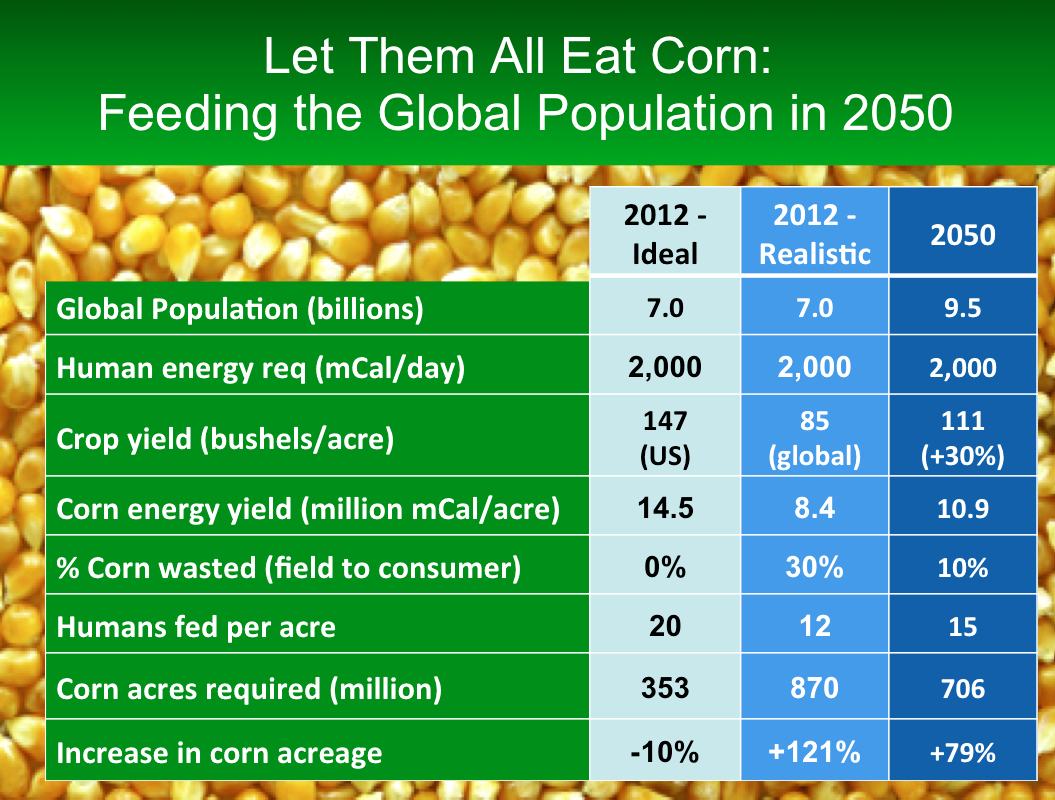
Given the average human nutrient requirement (2,000 kCal/day) and the energy yield of an acre of shelled corn (14.5 million kCal), one acre of corn (at 2011 US yields) could supply 20 people with their energy needs (see table below). On a global basis, we currently harvest around 393.5 million acres of corn, therefore we could supply the entire current global population (7.003 billion) using only 90% of the global corn area. Of course that’s assuming zero waste and US crop yields. If we use a more realistic scenario with global corn yields (85 bushels/acre) and 30% food wastage, we can only feed 12 people per acre and would need to increase current corn acreage by 121% to produce enough food to supply the current population. So what happens by the year 2050 when the population is predicted to reach 9.5 billion people? Assuming that we continue to see increases in yield proportional to those over the past 30 years (30% increase in US yields since 1982), that yield increases are exhibited globally, and that we can cut food waste to 10%, we could feed 15 people per acre and we’ll need to increase corn acreage by 79% to provide sufficient corn to feed the global population.

If our dietary requirements can be met by corn alone, the increase in land use won’t be an issue – land currently devoted to soy, peanuts or wheat can be converted to corn. Yet this simplistic argument for vegetarian/veganism suffers from three major flaws. Firstly, it assumes that the global population would be willing to forgo lower-yielding vegetable crops that add variety to the diet – where are the artichokes, kale or radishes in this dietary utopia?

Secondly, as noted by Simon Fairlie in his excellent book, converting to a vegan monoculture would significantly increase the reliance on chemical fertilizers and fossil fuels due to a lack of animal manures. Given current concern over dwindling natural resources, this is an inherently unsustainable proposition.

Finally, corn is currently vilified by many food pundits. The suggestion that our food supply is controlled by corporations who force monoculture corn upon hapless farmers who are then faced with the choice of complying with big ag or being forced out of business are the purview of food pundits (e.g. Michael Pollan and Joel Salatin) and documentaries such as Food Inc. and King Corn. Not a week goes by without another Mommy blogger or journalist publishing an article on the dangers of high-fructose corn syrup, often concluding that if only this ingredient was removed from our food supply, childhood obesity and pediatric type II diabetes would cease to be an issue for little Johnny and Janie pre-schoolers of the future.

It’s frighteningly easy to visualise the Soylent Green-esque vegan future, whereby food is doled out in pre-measured quantities according to dietary requirements – yet what happens when the whistle-blower of 2050 proclaims “it’s made from CORN!”?

Eating Less Meat, May Not Help You To Live Forever…But It’ll Sure Feel Like It

I know Harvard researchers are smart, I really do. Yet I have to question the latest study reporting that eating red meat is associated with premature death. Published in the Archives of Internal Medicine, the paper analyzed the relationship between mortality and red meat consumption in a total of 121,342 healthcare professionals and concluded that:

Greater consumption of unprocessed and processed red meats is associated with higher mortality risk… replacement of red meat with alternative healthy dietary components may lower the mortality risk.

As a researcher, I know full well that it’s almost impossible to prove a cause-effect relationship. This is particularly difficult in human studies where other dietary and lifestyle factors have to be accounted for. After all, if you have ketchup on your steak, does the lycopene prevent against prostate cancer? “Associated with” is therefore absolutely the correct terminology for the paper’s authors to use. Alas, in the minds of so many, “associated with” translates to “causes” (especially when it’s a bad news story), and everybody panics accordingly.

The results of this report need to be put into context with our other lifestyle choices. If, as reported, eating unprocessed or processed red meat increases the relative risk of mortality by 13% and 20% respectively, how does that compare to all our other daily activities – driving a car, drinking a glass of wine or eating a candy bar? How do we weigh the risk of consuming a steak or slice of pepperoni pizza against the bottle of Mountain Dew or unwashed raw carrot? After all, during the BSE crisis in the UK, data suggested that the risk of dying from falling out of bed and suffering a fatal head injury was far greater than that from contracting vCJD, yet there was immense consumer concern relating to the perceived dangers of beef consumption.

Relative risk is not a measure that many people understand. Within this study, the absolute mortality risks (i.e. the probability of any one person dying) paint a rather different picture. Out of every 100 men, 1.23 men consuming three servings of unprocessed meat (the equivalent of one 9-oz steak) per week were likely to die, versus 1.30 men eating 6 oz of processed meat (bacon, sausage etc) per day (42 oz per week). Given the small difference in those mortality risks (which were similar for women) yet the huge difference (9 oz vs. 42 oz) in weekly meat consumption, we would be better served by focusing more on other factors (bodyweight, exercise, genetic propensity to specific diseases) that contribute the vast majority of our absolute mortality risk rather than assuming that we can live forever if we only replace a hamburger with a vegetarian meatloaf.

Since this study hit the headlines my Facebook newsfeed predictably been over-run by anecdotes about grandparents who lived to the ripe of age of 101 years while eating bacon and eggs for breakfast, corned-beef hash for lunch and three pork chops (with extra heavy cream in the whipped potatoes) for dinner. Without wishing to be flippant, the one certainty in this life is that we’ll all die at some point – if I restricted my meat intake to the suggested 3 oz per day (or less) I have a sneaking feeling that I might not live forever, but it’d sure feel like it.

Forget Widgets and Factory Farms – Beef Production is the Circle of Life

The Chipotle short film “Back to the Start” which was featured in a commercial break during the GRAMMY awards on Sunday has been one of the most discussed topics on Facebook and Twitter in the past week.

It is incredibly powerful film. Beautifully animated and featuring Willie Nelson singing Coldplay’s “The Scientist”, the cartoon pigs are pink and symmetrical; the dairy cattle graze green grass (before their incarceration in a barn) and antibiotics come in cute little capsules. It’s even more potent because it represents a classic human theme – a mistake followed by redemption. Walking alone in the cold winter night, the farmer realizes his mistake in intensifying his production system, tears down his barns and lets his animals roam free. Who doesn’t love a classic redemption film?

Many of my agricultural friends have responded to this film with the entirely valid argument that Chipotle lack integrity by producing this film as they only source natural or local-produced meat where available. This marketing strategy therefore condemns a significant proportion of their suppliers who produce conventional meat and dairy. However, the average consumer, who only sees the film because they’re waiting to watch Adele’s latest GRAMMY acceptance speech, don’t read about the integrity conflict, and if they do, may assume it’s a reactive response by the ‘inherently biased’ animal agriculture industry.

The question then becomes, how do we overcome this powerful, yet discriminatory message with the fact that all systems have a valid place in food production? Bill Donald (Immediate Past President of NCBA) attended the World Food Prize in Des Moines this week and told me that the hot topic was the concept of future farms with ‘circular economies’. This means taking the ‘reduce, reuse, recycle‘ concept of a circular economy and incorporating it into agriculture, so that the consumer can see that every stage within the process reduces waste, saves resources and produces both nutritious food and useful by-products. It’s a huge hit with consumers in China who are becoming more concerned about environmental issues.

Ironically, this is nothing new – it’s the basis upon which beef production is founded. We take a human-inedible product such as grass, feed it to animals that provide us with meat, leather, pharmaceuticals and other by-products, use their manure to fertilize and grow the grass, produce more beef… It’s a closed and continuous circle of life that has used fewer resources and emitted less greenhouse gases year on year. Yet that’s a very different image to the intensive, inefficient system portrayed by the Chipotle film.

Agriculture is not and never has been a collection of factories pumping in antibiotics, churning out identical widget animals and releasing toxic green waste into rivers. The challenge ahead of us is to be proactive and to demonstrate beef’s circle of life to consumers – not only the 3 R’s (reduce, reuse, recycle), but the 4 F’s – food, fertilizer and fuel for the future.

Real Food – Now Available in Plastic!

Remember the all-new singing-and-dancing MyPlate? That handy guide to what to eat that only seems to apply to those of us on a discrete meat/starch/veg  diet eaten off school cafeteria-style segmented tableware?

Now any Home Economics teacher can easily include MyPlate in the curriculum – with this handy MyPlate food kit!

“This fantastic assortment of food replicas provides you with a wide variety of foods so you can create many different meals on MyPlate or you can use these replicas in conjunction with those you already have on hand.”

Or… you could use real food. You know, so students could learn to prepare and eat it rather than gazing at a plastic molded apple. Just a thought.

I can’t express how much it amuses me that the food kit associated with this first-lady-approved-PC-food-ideology doesn’t include tofu in the protein group.