Defending Conventional Beef in The Wall St Journal Today!

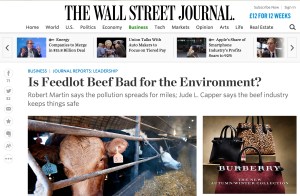
WSJShameless self-promotion, but very excited to have an essay published in The Wall St Journal today defending conventional beef production.

Given my blog subtitle, I thought I should link to it! Would love to read your comments. Article here: http://www.wsj.com/articles/is-feedlot-beef-bad-for-the-environment-1436757037

I Can’t Brie-lieve It’s Nut Cheese

Plastic food, anybody?

Plastic food, anybody?

Am I missing something, or have words ceased to have any meaning? Take the phrase “nut cheese”. Seriously. Now stop giggling like a 12-year old and actually think about it. Would you buy some nut cheese for your grilled cheese sandwich? Fancy some nut cheese on your pizza? Actually, purely from a practical point of view, no, you wouldn’t. Nut cheeses don’t really melt, they are better for spreading on crackers. But, leaving the double entendres  aside, why would we give Edam (sorry…) about nut cheese? Apparently it’s a product that’s made exactly like cheese, if you ignore the fact that (dairy)* milk doesn’t have to be ground with water to separate the solids before the cheesemaking begins. Oh, and the fact that nut cheese made from nuts. Which means that despite the name, it’s not actually cheese.

Why does the concept of nut “cheese” irritate me so? It’s not paranoia that everybody will become so enamoured by nut cheese that the dairy industry will cease to exist (could a non-melting, spreading cheese really compete with a hefty chunk of Wensleydale?); or the suspicion that it’s a dastardly plot to infiltrate nut cheese into our children’s diets and tempt them away from the wonderful world of extra strong Cheddar and ashed-rind goats cheese. It’s simply because it’s yet another fake food. Believe me, I get equally irritated by soy “milk”; orange-colored soft drinks masquerading as “juice” (ahem, Sunny-D); and burgers made of mashed tofu. Why? Because I don’t see the point of plastic fantastic meals. Yes, I’ve eaten vegan cheese, vegetarian sausages and tofu roasts. I ate them when I was vegan** and I felt hypocritical for doing so even then. No, they didn’t taste better than the “real” thing (although one soy ice-cream was amazingly good). No, I couldn’t believe I was tucking into a juicy hot dog when I was simply chewing on something with all the taste and texture of reconstituted shoe leather. No, they didn’t compensate for my brothers gleefully eating bacon sandwiches. They simply seemed like a poor imitation of the diet that I had previously enjoyed as an omnivore.

When I was vegan I loved vegetables, and I still do now as a happy omnivore. I may lose my beef-loving credentials for admitting this, but after presenting a webinar on beef sustainability yesterday, I prepared and ate an entirely vegan meal. Admittedly I didn’t notice that it was vegan until I was chatting with @MomattheMeatCounter afterwards, but more tellingly, I didn’t miss the meat. I love vegetables because they are fabulously diverse. They have a myriad of flavours and textures that no other foods can provide. I could happily eat that same vegan meal two or three times per week. Yet vegetables aren’t meat or dairy, they don’t provide the same flavours and nutrients, and I couldn’t go back to being vegan. Aside from anything else, I’d miss real bacon cheeseburgers.

Which brings me to my major issue with all faux meats and dairy products. If you’re determined to give up animal proteins for ethical reasons, then why eat an ersatz version? Why not celebrate the fabulousness of fruit and vegetables and cook creative plant-based meals rather than eating a make-believe version of an animal-based food? Why are these faux foods often championed by people who otherwise derive their careers from bleating about “natural” foods and telling us that if a third-grader can’t pronounce it, we shouldn’t eat it? Why are millions being invested  in the promise of growing meat in labs or turning pea protein into faux eggs when we could simply eat peas instead?

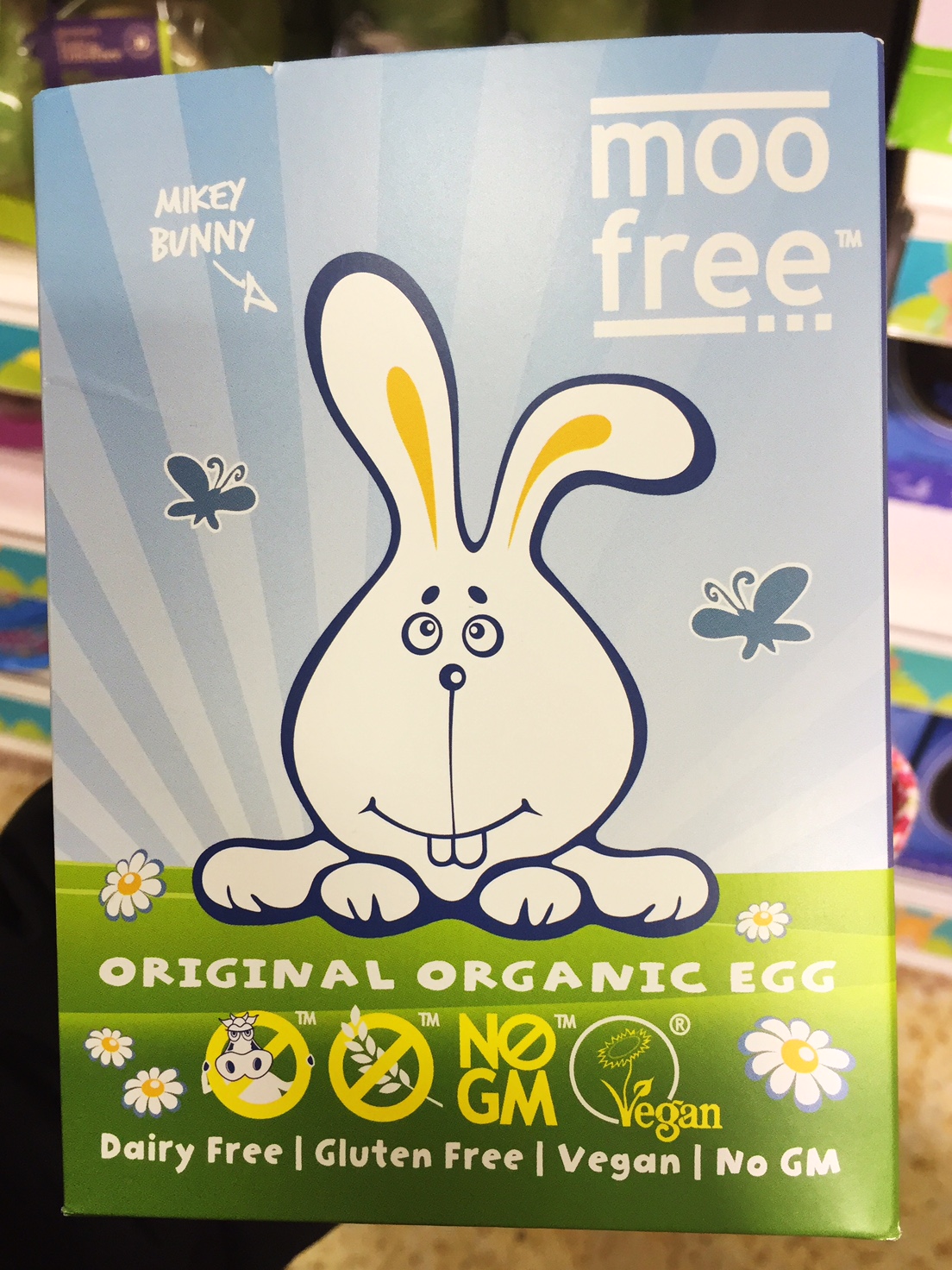
Fake chocolateBelieve me, if I ever have the misfortune to become intolerant to gluten or dairy, I will be seeking real (and naturally gluten and dairy-free!) eggs at Easter rather than a faux chocolate egg with all the supposedly sinful ingredients removed***. Yet this treat was next to the regular chocolate eggs in the supermarket this weekend. A great thing for the small proportion of people who actually have dairy or gluten allergies, but also a clever Easter guilt-inducer to parents everywhere who are convinced that little Crispin and Arabella’s blood chemical levels will otherwise reach “toxic” limits akin to being given an intravenous infusion of the self-proclaimed Food Babe’s nemesis, Starbucks’ Pumpkin Spice Latte.

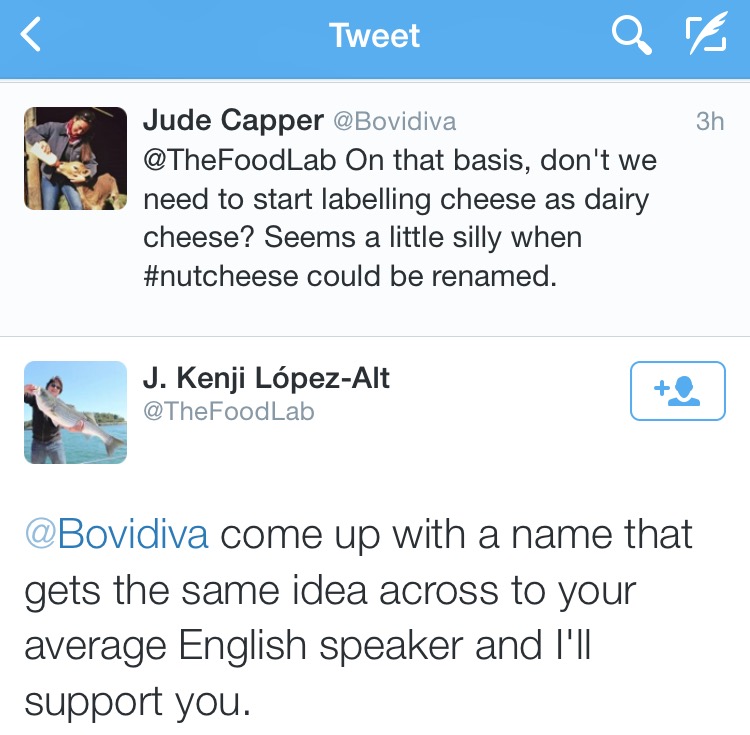
Nut cheese tweetMaybe I’m pedantic, overly irritable about the appropriation of words that are specific to certain foods. Perhaps my European roots run too deeply – after all, I come from a country that designates Stilton cheese as only being produced from milk from cows grazed in three specific counties. Yet it seems like a lazy excuse to suggest that if nut cheese isn’t called cheese it will languish uneaten in the supermarket for months because nobody will understand what it is. In a world where new words are invented every single day (please don’t get my Mother started on the validity of the word “webinar”) is it really conceivable to suggest that marketers can’t find an alternative to “cheese” or “milk” to describe plant-based foods? After all, nobody tries to call tofu “meat”…..yet. Perhaps that will be the next label on the faux food buffet table? I’m sorry, but I Camembert it.

*Even typing (dairy) as a modifier before milk raises my blood pressure a few points.
**I was a strict vegan for 12 months when I was 15. When I was 16 I resumed eating bacon as if pigs were going out of fashion. I still enjoy vegetarian or vegan meals, but I’ve never looked back.
***Yes, I have eaten milk-free milk chocolate – it could easily be used as a substitute for candle wax.

Is It Time We Stopped Shouting About The Dietary Guidelines?

The recent report by the advisory committee to the USDA dietary guidelines has certainly caused a media stir in the past week or so. There’s a lot of nutritional common sense in the report – eat more fruit, veg, and dairy, reduce carbs and sweetened drinks/snacks, and moderate alcohol intake. Yet there’s a kicker – from both a health and a sustainability perspective, Americans should apparently be guided to consume less animal-based foods.

10982813_934682089898559_3461048965358255082_oWhen the report was released, my Twitter notifications, Facebook feed and email inbox exploded. Memes like the one to the left appeared on every (virtual) street corner, and the report was mentioned in every online newsletter, whether agricultural or mainstream media. It’s this press coverage rather than the content of the report, that really concerns me.

Individuals don’t pay a lot of attention to a government report on nutrition. Despite the fact that six updates to the guidelines have been released since their inception in 1980, we are all still eating too many Twinkies in front of the TV and super-sized takeout meals in the car, rather than chowing down on broccoli and lentil quinoa bake.

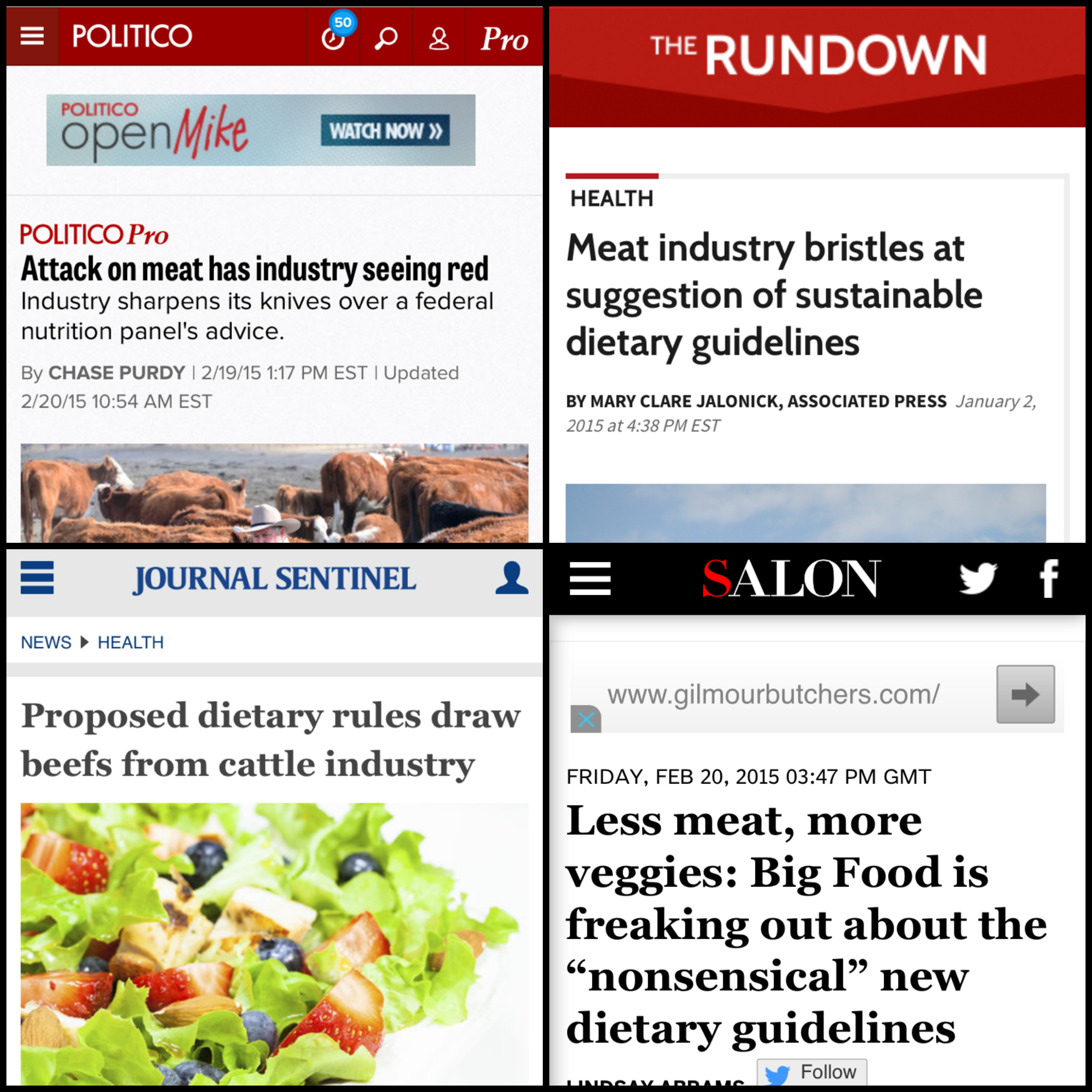
Headlines CollageYet people do pay attention to headlines like “Less meat, more veggies: big food is freaking out about the “nonsensical” new dietary guidelines” and others shown to the left. The media sub-text is that big bad food producers (so different from the lovely local farmer who sells heirloom breed poultry at $18/lb at the farmers market) are appalled by the release of this governmental bad science that’s keeping them from their quest to keep you unhealthily addicted to triple cheeseburgers washed down with a 500-calorie soda, and will do anything to suppress it.

This makes me wonder – at what point do we need quiet, stealthy change, rather than loud protests that attract the attention of people who would otherwise never have read about the guidelines? At what point does industry protesting seem like a modern version of “The lady doth protest too much“?

Rather than posting on Facebook or Twitter that the report is nonsense because the committee of nutritionists ventured into the bottomless pit that is sustainability; why don’t we instead extol the virtues of producing high-quality, nutritious, safe and affordable lean meat, and aim to reach the people who haven’t seen the hyperbolic headlines or read the guidelines simply because they’ve seen a lot of talk about them on Twitter? The old showbiz saying that there’s no such thing as bad publicity certainly applies here – the extent of the reporting on the industry backlash against the report means they have probably been noted by far more people that they otherwise might.

The impact of the dietary guidelines recommendations upon purchasing programs is far higher than on individuals, and does give rise to concern. Globally, one in seven children don’t have enough food, and school lunches are often the only guaranteed source of high-quality protein available to children in impoverished families. I may be being overly sceptical, but I suspect that if meat consumption in schools is reduced, it’s unlikely to be replaced with a visually and gastronomically-appealing, nutritionally-complete vegetarian alternative.

Sustainability doesn’t just mean carbon, indeed, environmentally it extends far further than the land, water and energy use assessed by the dietary guidelines advisory committee into far bigger questions. These include the fact that we cannot grow human food crops on all types of land; water quality vs. quantity; the need to protect wildlife biodiversity in marginal and rangeland environments; the use of animal manures vs. inorganic fertilisers; environmental costs of sourcing replacements for animal by-products in manufacturing and other industries; and many other issues. Simply stating that meat-based diet X has a higher carbon footprint or land use than plant-based diet Y is not sufficient justification for 316 million people to reduce their consumption of a specific food. Indeed, despite the conclusions of the committee, data from the US EPA attributing only 2.1% of the national carbon footprint to meat production suggests that even if everybody reduced their intake of beef, lamb and pork, it would have a negligible effect on carbon emissions.

Could we all reduce our individual environmental impact? Absolutely. Yet as stated with regards to dietary change in the advisory report, it has to be done with consideration for our individual biological, medical and cultural requirements. As humans, we have biological and medical requirements for dietary protein, and some would even argue that grilling a 16-oz ribeye is a cultural event. I have every sympathy for the USDA committee*, who were faced with a Herculean task to fulfill, but in this case, they only succeeded in cutting off one head from the multi-craniumed Hydra – and it grew another 50 in its place.

*Many people have already commented on the suitability (or not) of the committee to evaluate diet sustainability, but to give them their due, they do appear to have looked beyond greenhouse gases to land, water and energy use. They are nutrition specialists, not sustainability experts, but it would be difficult (impossible) to find a committee comprising people who were all experts in nutrition, sustainability, economics, policy, behaviour and all the other facets of the report. Nonetheless, the sustainability recommendations appear to be based on a small number of papers, many of which are based on dietary information from other regions (Germany, UK, Italy) which will also have different levels of animal and crop production. As somebody who was born and bred in the UK before moving to the USA I find it difficult to believe that the average American’s diet uses substantially more land (for example) than the average UK person, as cited in the report.

Are Animals As Innocent As Vehement Vegans Vow?

Another week, another argument with vegans. Reading this blog you could suppose that I spend all my time arguing with the no-meat brigade. Thankfully it’s not that common – it’s just that it always seems to inspire another blog post.

Why arguing is pointlessThis time it was a particularly vehement vegan (VV?) who insisted that I was a rapist and murderer because I work in the animal science industry. It’s not the first time I’ve heard those claims – indeed, I’m beginning to wonder if there’s a vegan argument flow chart out there (see below, click to enlarge), as all the conversations seem to follow the same pattern and use similar (if not identical) phrases.

Vegan flow chartDon’t get me wrong, I don’t believe that the power of my mighty tweets will help these hapless vegans see the light and immediately go out for a steak. I have absolutely no problem with anybody being vegan, vegetarian, pescetarian, fruitarian, or whatever their dietary and ethical choices are. I respect those choices, even more so because I used to be a vegan myself (As a side-note, I was told by VV that it’s not possible to be an ex-vegan, so I obviously wasn’t a “real” vegan in the first place.) However, I do have an issue with being called a rapist* and murderer, particularly a murderer of “innocent animals”. So please, let’s stop the cute, fluffy, anthropomorphic nonsense. If somebody really thinks they know what it feels like to be a cow, maybe they need professional help, rather than arguments on twitter.

Yes, animals are killed to produce meat. If you have a problem with that then perhaps you should indeed consider being vegetarian or vegan. But are animals innocent? Not in the pure, clean-living, non-malicious sense of the word. Consider the billions of predatory animals who murder other (innocent?) animals every single day for food. Consider the penguin. Or more specifically, the penguin prostitute, who will offer sex to single male penguins in exchange for stones with which to build her nest. Consider the male mouse, lion, or hanuman langur (Old World monkey) who practice infanticide – killing entire litters of their mate’s offspring if they suspect that they are not the father. Consider homosexual necrophiliac ducks, who will repeatedly rape a dead male mallard. Even on the farm it’s not all peace and love – the top-ranking cow in the hierarchy gets first pick of the feed and the best mattress to lie on. Why? Because animals aren’t innocent. It’s a good marketing trick to show cute little baby animals that tug at our heartstrings and make us think twice about eating the cheeseburger, but animals are no more innocent than we are.

CarnistThe ultimate vegan insult is one of “carnism” – literally the opposite of veganism (as in carn- or carne-, latin for meat), which includes the theory that that meat-eaters practice speciesism in considering themselves to be superior to animals. Yet by decrying the murder practiced by so many animal species, aren’t vegans the epitome of speciesism? On a higher plane by virtue of a cruelty-free life? Let’s get real. To quote Alfred, Lord Tennyson: “Tho Nature, red in tooth and claw…” – a world where every life is sacred and cruelty does not exist is not a description of planet earth, and if it was, there’s every chance that we humans would have been wiped out eons ago.

*Cows are not raped. The definition of rape is “Unlawful sexual intercourse or any other sexual penetration of the vagina, anus, or mouth of another person, with or without force, by a sex organ, other body part, or foreign object, without the consent of the victim.” and, as any dairy farmer will tell you, a cow will not stand to be served unless she is in heat (estrus). Trying to rape a dairy cow would be an exercise in futility.

A Christmas Wish – May All Your Cows Be Like Your Best Cow

I love conversations that leave my brain firing on a million cylinders and open my mind to new ideas. I was lucky enough to have three such discussions this past week, one at an organic research farm; another at a 300-cow Jersey operation; and the most recent with three faculty at the University of Oxford with regards to the interactions between animal welfare and livestock sustainability.

Animal welfare is a touchy subject – many people appear to define excellent welfare as only including a narrow range of production systems or practices; and although everybody has their own image of what a “happy” animal looks like, it’s not always easy to identify or describe those systems without anthropomorphizing. Indeed, I’ve become increasingly aware that promoting improved productivity and efficiency as a means to improve sustainability can be misconstrued as encouraging the agricultural equivalent of a owning a Victorian dancing bear or cymbal-playing monkey – a “force the animals to perform, regardless of the cost in terms of animal welfare”-type philosophy (see picture below).

Troll


Yet such suggestions entirely miss the point, as any system that is consistently detrimental  to animal welfare is neither productive nor efficient on a long-term basis. We humans don’t perform well if we’re chronically underfed, stressed, sick, or housed in unfavorable environmental conditions – and neither do livestock.

Personally, my agricultural utopia would be one where all livestock operations, regardless of size, location or production system, exhibit both high productivity and excellent animal welfare. Admittedly, this leads to the difficult task of not only defining excellent welfare, but also the metrics and benchmarks by which it can be assessed within each operation. However, there is one overarching metric that can be measured, and improved on any farm or ranch – animal health. By definition, an animal that is chronically sick, lame or in pain cannot be said to be a example of good welfare.

As consumers, we want to know that the animals that provide us with milk, meat and eggs are healthy. Indeed, I imagine that even the most militant vegan opposed to the consumption of animal products would agree that animal health should be paramount. As producers, making sure that livestock are healthy is as ethically important as treating workers well. Plus, healthy animals are easier to manage: they grow faster; they have fewer incidents of  illness or death; and they produce more milk, meat or eggs. These improvements in efficiency and productivity also mean that we need less feed, less land, less water and have a lower carbon footprint per unit of food produced.

Let’s consider lameness in dairy cattle. A major animal welfare issue, it costs between $120 and $216 per incidence (UK costs below)* and is a major cause of cows being culled at or even before the end of their second lactation. Similarly, mastitis has a huge impact on both cow longevity and productivity, and costs the US dairy industry $1.7-2.0 billion per year. If just these two health issues were addressed, how many associated dairy cattle health and welfare issues would be improved; how much could dairy farm profitability be enhanced; and how much would the public image of dairy improve?

Every herd has its best cow – the one who is never lame, doesn’t suffer from mastitis, metritis or ketosis; and gets back in calf easily – all while having a high milk (and components) yield. There is no magic bullet to improve productivity and efficiency –  yet the discussions I’ve had in the past week conclusively demonstrated that that does mean suiting your system to your available resources and, though excellent health, nutrition, breeding and management, allowing every cow to perform like your best cow, every single day. I wish you a Merry Christmas and hope that in 2015, all your cows will be like your best cow.

*Lameness costs £180 pounds per incidence in the UK, or £15,000 per average herd annually. Mastitis costs the UK dairy industry £170 million per year.

Would Being Vegan Really Solve Climate Change? Not if We Don’t Kill the Cows.

OLYMPUS DIGITAL CAMERAA friend of mine drew my attention to this NPR blogger, who makes the point that being “good” isn’t zero sum (a situation where what is gained by one side or cause, is lost by another). If you’re concerned about the environment, you can both recycle cans and buy a more climate-friendly car. If you are passionate about children’s education, you can volunteer in the classroom and financially support literary projects. In most cases, doing good is not an either/or.

Which made me think a little more about the definition of “good”. To that writer it meant being vegan or vegetarian, in the belief that such a diet would improve animal welfare and environmental impact. Yet this is exactly where the conflict arises for me – if we were all vegan or vegetarian, what would happen to the sheep, the cow, the pig and the chicken?

I posed that question to a vegan on Twitter recently and he, in all sincerity, answered that we, as a vegan population, would care for the animals, but would not enslave or control them. Imagine the beautiful utopia where we all have time to calve a cow or throw some grain to feral pigs before we set off to work, expecting nothing in return. Or in a more realistic scenario, we’d have more meat than we knew what to do with simply through car accidents if we suddenly let loose the USA’s 87.7 million cattle (never mind the 62.1 million pigs, 5.2 millon sheep and 9+ billion chickens).

Anti-animal agriculture activists often purport that a cow can live for 20+ years in her “natural” state compared to a farmed animal – so being a data nerd, I did the maths*. Let’s assume that 1) cows first calve at two years of age and that 90% of cows (38.3 million of them in the US at present) have a calf every year**; 2) 85% of those calves survive (mortality would go up due to predation, assuming we wouldn’t shoot wolves, coyotes etc.); and 3) each cow or bull lives for 20 years. Admittedly that doesn’t account for the cattle that would die from starvation through lack of available grazing in 5, 10 or 20 years time, but being good vegans, we’d feed them, right?


Within five years we’d have 602 million cattle in the USA, within 20 years we’d have 3.7 billion – a 40-fold increase on our current national herd. That’s 40x more cattle belching methane, drinking water and producing waste, every single day, all as a result of our changing our diet in an attempt to reduce environmental impact.


It’s a nice, simplistic, oft-suggested argument that we shouldn’t eat meat or dairy products in order to save the planet, yet the conflict between veganism, animal welfare, and environmental impact is clear. Climate change will be solved by us turning vegan? Not unless we reconcile ourselves to killing animals without eating them.

*I’m British, and as such, cannot use the American term “math” as opposed to the British “maths”
**90% is the US average for cow-calf herds, in which few hormones or other reproductive aids are used

Vegetarians May Preach – But We’re Not All Members of the Choir

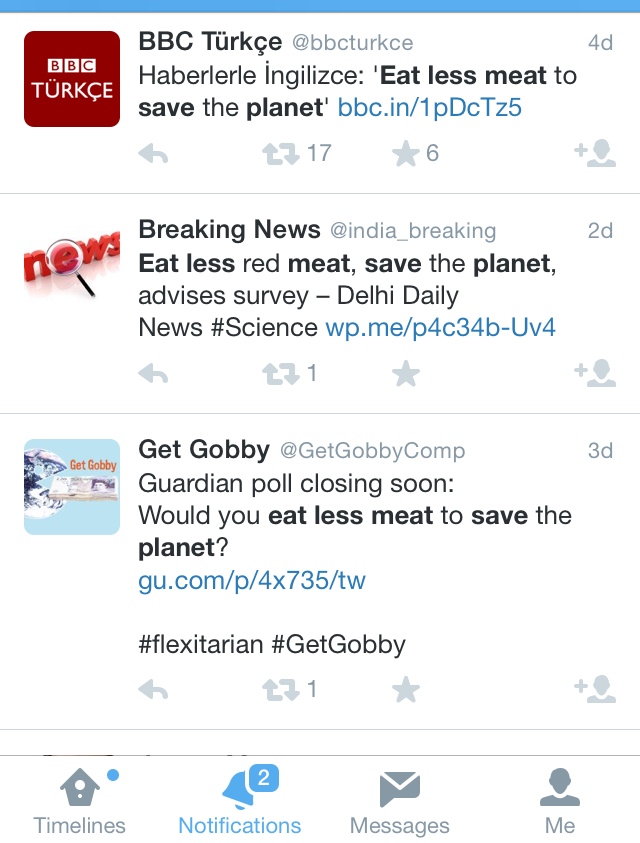
Less meatThe  suggestion that we should eat less meat in order to save the planet pops up with monotonous regularity in my twitter feed. Interestingly, those who make this claim are almost always vegetarian, vegan or profess to eat very little meat. This is rather like me asserting that we could mitigate climate change and save resources by eating fewer bananas and curbing our windsurfing habits. I loathe bananas, and if you ever see me windsurfing you’d better be sure that there’s a nearby hospital bed and neck brace with my name on it. As you can imagine, giving up either activity would have little impact on my life.

This is why I find it interesting and rather facile that those who do not eat meat proclaim fleshy abstinence as the way forwards. It’s easy to preach a solution that has no impact on your life – far harder to make a dietary or lifestyle change that actually impacts you.

The “eat less meat” movement would have far more credibility if it was promoted by a hunting, fishing, grilling, hamburger-lover who publicly declared his/her love for meat in all it’s many forms, and bemoaned the fact that they felt they should forgo the steak in favor of the tofu stir-fry. Yet this doesn’t happen. Why? Because the vast majority of us simply don’t feel that an intangible threat (we can’t see or feel climate change, or conceptualize the quantity of oil reserves remaining) is sufficient to make us give up our carnitas burrito. In reality, meat eating is only likely to decline if it becomes too expensive or subject to regulatory sanctions (e.g. rationing similar to that in Britain during WWII). The influx of papers suggesting that we should reduce consumption therefore fall on deaf ears.

So let’s face the facts. Neither the national or global population is likely to reduce meat consumption in the near future, and the rising income per capita in India and China will increase demand for meat still further. Instead of making recommendations based on notional utopias, let’s focus on areas where we can really improve.

Amazing gains in productivity have allowed the beef, dairy, pork and egg industry to considerably reduce resource use and greenhouse gas emissions over the last century. With a culture of continuous improvement and access to technologies that improve productivity, we can feed the future population using even fewer resources.

Let’s make better use of the multifarious by-products from the human food and fiber industry. Ruminants are blessed with the ability to digest fibers and plant materials that we either can’t or won’t eat – using by-product feeds to replace corn and soy refutes the claim that livestock compete with humans for food.

Finally, take a look at your own plate. Globally, 33% of food is wasted. Just think of the reductions in resource use we could achieve (and people we could feed) if all the crops planted, fruit picked, and milk, meat and eggs produced were consumed, rather than just 2/3 of them.

We evoke change by leading by example – I’m off to enjoy a steak, conventionally-raised using 12% less water, 19% less feed and 33% less land than its equivalent in 1977. You’d better believe that if there’s any left, it’s going in a sandwich tomorrow. As my Grandma used to say: Waste not, want not.

Beef is Killing the Planet…and Elvis is Riding a Rainbow-Belching Unicorn

BurgerMy Twitter feed just exploded. Yet another study has been released claiming that if we all just gave up beef, the planet would be saved, Elvis would come back from the dead, and rainbow-belching unicorns would graze the Northern Great Plains. I may have exaggerated a little with the latter two claims, but the extent of media coverage related to the paper “Land, irrigation water, greenhouse gas and reactive nitrogen burdens of meat, eggs and dairy production in the United States” seems to suggest that the results within are as exciting as seeing Elvis riding one of those unicorns…but they’re also about as believable.

Much as we’d all like to stick our fingers in our ears and sing “La la la la” whenever anybody mentions greenhouse gases or water footprints, we cannot deny that beef has an environmental impact. Yet, here’s the rub – so does every single thing we eat. From apples to zucchini; Twinkies to organically-grown, hand-harvested, polished-by-mountain-virgins, heirloom tomatoes. Some impacts are positive (providing habitat for wildlife and birds), some are negative (nutrient run-off into water courses), but all foods use natural resources (land, water, fossil fuels) and are associated with greenhouse gas emissions.

So is this simply another attack on the beef industry from vegetarian authors out to promote an agenda? Possibly. The inclusion of multiple phrases suggesting that we should replace beef with other protein sources seems to indicate so. But regardless of whether it’s part of the big bad vegan agenda, or simply a paper from a scientist whose dietary choices happen to complement the topic of his scientific papers, the fact remains that it’s been published in a world-renowned journal and should therefore be seen as an example of good science.

Or should it?

I’m the first to rely on scientific, peer-reviewed papers as being the holy grail for facts and figures, but there’s a distressing trend for authors to excuse poor scientific analysis by stating that high-quality data was not available. It’s simple. Just like a recipe – if you put junk in, you get junk out. So if one of the major data inputs to your analysis (in this case, feed efficiency data) is less than reliable, the accuracy of your conclusions is….? Yep. As useful as a chocolate teapot.

Feed efficiency is the cut-and-paste, go-to argument for activist groups opposed to animal agriculture. Claims that beef uses 10, 20 or even 30 lbs of corn per lb of beef are commonly used (as in this paper) as justification for abolishing beef production. However, in this case, the argument falls flat, because, rather than using modern feed efficiency data, the authors employed USDA data, which has not been updated for 30 years. That’s rather like assuming a computer from the early 1980’s (I used to play “donkey” on such a black/green screened behemoth) is as efficient as a modern laptop, or that the original brick-sized “car phones” were equal to modern iPhones. If we look back at the environmental impact of the beef industry 30 years ago, we see that modern beef production uses 30% fewer animals, 19% less feed, 12% less water, 33% less land and has a 16% lower carbon footprint. Given the archaic data used, is it really surprising that this latest paper overestimates beef’s environmental impact?

The authors also seem to assume that feed comes in a big sack labeled “Animal Feed” (from the Roadrunner cartoon ACME Feed Co?) and is fed interchangeably to pigs, poultry and cattle. As I’ve blogged about before, we can’t simply examine feed efficiency as a basis for whether we should choose the steak or the chicken breast for dinner, we also have to examine the potential competition between animal feed and human food. When we look at the proportion of ingredients in livestock diets that are human-edible (e.g. corn, soy) vs. inedible (e.g. grass, other forages, by-products), milk and beef are better choices than pork and poultry due to the heavy reliance of monogastric animals on concentrate feeds. By-product feeds are also completely excluded from the analysis, which makes me wonder precisely what the authors think happens to the millions of tons of cottonseed meal, citrus pulp, distillers grains, sunflower seed meal etc, produced in the USA each year.

Finally, the authors claim that cattle use 28x more land than pigs or poultry – although they acknowledge that cattle are raised on pasture, it’s not included in the calculations, which assume that cattle are fed feedlot diets for the majority of their life. This is a gross error and underlines their complete ignorance of the U.S. beef industry. Without cow-calf operations, the U.S. beef industry simply would not exist – efficient use of rangeland upon which we cannot grow human food crops both provides the foundation for the beef industry and creates and maintains habitats for many rare and endangered species of plants, insects, birds and animals.

Want to know how to reduce the environmental impact of food production overnight? It’s very simple – and it doesn’t involve giving up beef. Globally we waste 30% of food – and in developed countries that’s almost always avoidable at the consumer level. Buy the right amount, don’t leave it in the fridge to go moldy, and learn to use odd bits of food in soups or stews. Our parents and grandparents did it out of necessity – we can do it to reduce resource use and greenhouse gas emissions; and take the wind out of the sails of bean-eating anti-beef activists.

Is Our Modern, Chemical-Laden, Twinkie-Guzzling Lifestyle Killing Us?

Burger4How often do we hear that we’re so much more unhealthy than our ancestors? That our modern chemical-laden diet is responsible for the fact that in 2010, the top three causes of death were heart disease, cancer and chronic airways disease? That if we only ate like our ancestors did (if you can’t pronounce it, it shouldn’t be in your food…) we’d have the secret to eternal life?

Let’s take a trip back to 1900 – the US contained 70 million US inhabitants, McKinley was president, and the first Hershey bar was introduced. Life was so much simpler without those pesky whipper-snapper millenials on social media and everybody lived till they were 95, passing with a smile on their face surrounded by their 17 children…or did they?

It’s a beautiful image – and an absolute fallacy. Life expectancy at birth in 1900 was 47.3 years. To put that into context, Michelle Obama, Keanu Reeves and Elle McPherson would already be dead, and Julia Roberts, Matt LeBlanc and Will Ferrell would be enjoying their final days of celebrity life. The low life expectancy was skewed by the high rates of infant mortality in 1900 – premature birth was the #11 most-common cause of death and up to 10% of infants died before their first birthday. Any child that made it past 5 years old had a pretty good chance of surviving – as long as disease didn’t set in – the top three killers in 1900 were pneumonia/flu, tuberculosis and heart disease.

Hold on… heart disease? Surely that’s a consequence of our modern, slothful, twinkie-guzzling lifestyle? Let’s move on to 1950, when most food was still organic, high-fructose corn syrup hadn’t yet been invented and the majority of beef and dairy cattle were grazed on pasture. Top three killers: heart disease, cancer, stroke.

There’s a reason why Mark Twain’s saying “lies, damned lies and statistics” gets quoted so often. In this case, the data is true. However, when we look at the statistics, i.e. the % of people killed by heart disease or cancer, those have indeed gone up. Why? Because very few people die of pneumonia, flu or TB. If we express something on a percentage basis, a decline in one factor means an increase in another. Simple 3rd-grade math. I hate to point out the obvious, but we’re all going to die – and there will always be a cause.

Many enthusiasts for the “Paleo” diet like to suggest that it must be a healthy lifestyle, because the average lifespan for our ancestors was the same as it is now – providing that they didn’t die in accidents, war or from infection. Way to go for those few ancestors who stayed in their cave and didn’t get attacked by a wildebeest! All that actually suggests is that a human body has a genetic potential for life of 75-80 years. Europeans who died from the Black Death in 1348-1350 weren’t genetically programmed to live shorter lives, they were just unlucky enough to run up against the microorganism Yersinia pestis. We can’t eliminate specific causes of death that don’t suit our theory to “show” that one lifestyle is more healthy than other – everything that we do, every single day will have some positive or negative effect on our eventual lifespan.

We’re lucky enough to live in a society where we have effective sanitation, a wide variety of nutritional choices, antibiotics, vaccines, x-rays and prenatal vitamins. In the US, nowadays only 6 babies die per 1,000 births compared to ~100 per 1,000 births in 1900. Average life expectancy is 78.1 years. If I were to follow the activist “correlation = causation” logic I could point out that in the past 114 years we’ve seen the introduction of cell phones; nuclear bombs; GMO-crops; rbST for dairy cattle; implants and antibiotics for beef cattle; and corn-fed beef… so these technologies must make us live longer!! Hooray!! Instead, I’ll just be thankful that I will be giving birth within the next week in a world where we have a safe, effective food supply and that my baby will have a far better chance of surviving than her great-grandparents did. Thank goodness for technology.

Activism 101 – How to Write Like An Angry Internet “Expert” on GMOs

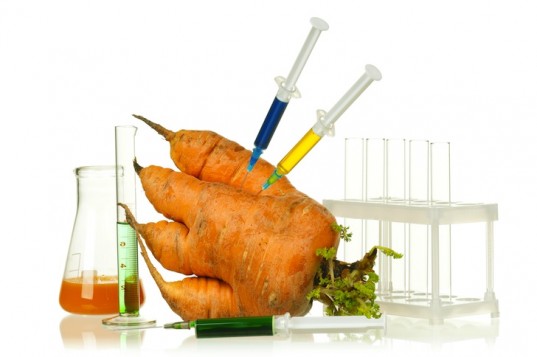
GMO carrotLast week I had the pleasure of speaking at the Montana Grain Growers Association on the topic of agricultural myths – specifically those relating to the wheat and barley industry. It was a whole new experience for me to replace calving rates with seeding rates; and crossbred cows with hybrid corn; but I was intrigued to see how many similarities existed between the grain industry and the beef industry in terms of the challenges we’re faced with in terms of misconceptions and bad science.

In the beef industry we’re often told that cattle are killing the planet by belching greenhouse gases; steak contains so many hormones that our kids are going to look like Pamela Anderson by the age of 5; and that we routinely mistreat our animals in the name of profitability – none of which are remotely true. However, many of the myths relating to the arable crop industry seem to revolve around genetically-modified organisms (GMOs) – the very mention of which appear to evoke rage, sanctimoniousness and downright insanity in many internet pundits.

Researching the GMO topic gave me so many examples of bad science that I could have spoken for three hours and still have had slides left over – so here, for your edification, is my quick cut-out-and-keep guide to writing like an angry internet GMO “expert”.*
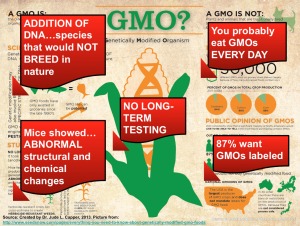
GMOs in capital letters1) Always use capital letters to emphasize the negative. The more capital letters you use, the more powerful your message BECAUSE YOU’RE OBVIOUSLY SHOUTING! Everybody knows that shrieking like a hyena on acid gets your point across, right?

2) Remember that science is the enemy. Yes, it brought us the polio vaccine, organ transplants and the iPhone that’s rapidly giving you repetitive strain injury of the thumbs, but when it comes to food, it’s pure evil. Anybody who has a PhD is less believable than your Great-Aunt Edna’s story about the day she met JFK in Walmart, whereas the opinion of a liberal arts major who cites Wikipedia, Deepak Choprah and Michael Pollan is worth more than rubies.
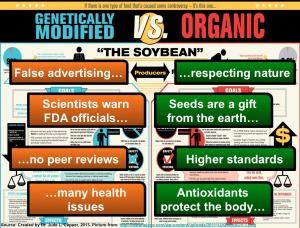
Emotive language3) Make sure you use emotive language. Your food system of choice is entirely populated by fluffy animals that poop rainbows, fart glitter and graze happily upon plants that are identical to those grown by the pilgrim fathers. By contrast, the dark side has mega-herds of mutated hybrid creatures that snack on household pets unwary enough to wander into their pen; malevolent trees that fling apples at Judy Garland; and man-eating, trash-talking plants last seen in the Little Shop of Horrors.
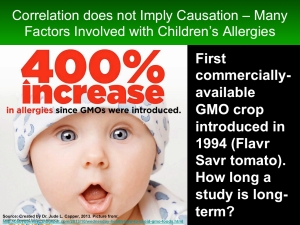
Allergies 14) Cause-effect statistics are only used by scientists (see #2) and thus poison the virtuous well of truth. Far better to make spurious claims based on nebulous associations. If the claims relate to children, the elderly or other vulnerable populations, so much the better. The Flavor-Savr GMO tomato was introduced in 1994 and childhood allergies have increased 400% since then? Excellent. Despite the fact that the World Health Association has stated that there is no link between GMOs and allergies, the two must (MUST!) be related. Since 1994, we’ve also seen the introduction of Obamacare, the death of Princess Diana, and the Green Bay Packers have won the Super Bowl three times. OMG! GMOs killed Princess Diana!

5) The only exception to #’s 2 and 4, are when a paper published in the Obscure Seattle-based Journal of Bad Science and Tomfoolery funded by the People’s Commission for Proving that GMO’s are Gonna Kill Ya Folks reports that if you force-feed three mice with 75x their body weight of pesticide-resistent plants, the resulting death by lab-worker hand (mouse head, meet bench-top) was caused by GMOs, and happens to agree with your views. Cite it as often as possible and gloss over the fact that the journal editors retracted it based on bad science three weeks after publication. They were obviously manipulated by Big Pharma (see #6).

Frankenfoods6) Any food that contains GMOs is a Frankenfood, guaranteed to turn you into a Herman Munster lookalike riddled with tumors the size of cabbages and to result in certain death. The only reason why most death certificates cite cancer, stroke or heart attack as the cause of death is because the medical profession have been paid off by Big Pharma. Anybody who dies in a car accident was assassinated because they knew too much (see #4, Princess Diana).

7) There are only three types of farmers and ranchers. Large farmers (more than 100 cows or acres) sit in their money-pit all day, cackling and swimming in vaults of gold coins like Scrooge McDuck. Everybody knows they have more money than all the European nations combined; force innocent immigrant workers to apply toxic pesticides whilst only clad in a loincloth made from a flour sack; and are singlehandedly responsible for every incidence of cancer, heart disease and diabetes. Midsize farmers (20-100 cows or acres) are utterly at the mercy of Big Pharma/Big Food and have become mindless zombies, planting whatever mutant seed the corporations tell them to. Small farmers (less than 20 cows or acres) are the salt of the earth and will inherit it come the revolution. End of story.

8) Corporations have billion dollar budgets and their CEOs spend all their time partying with tobacco-smoking lobbyists. Lobbying by small organizations is done by worthy volunteers who’re just trying to make the world a better place for your innocent children. For the love of God, won’t somebody think of the children?

9) If all else fails, invoke the name of the evil that must be named….ahem, Monsanto. If you say it three times into a mirror, an ancient agricultural god will appear and wreak vengeance upon the earth. Honestly, I saw it on Oprah.

*Note that being an “expert” does not involve education, higher degrees or being employed within the industry in question. Nowadays you can only be an expert if you are entirely impartial, third-party, and preferably know nothing whatsoever about the system in question. On that basis, I’m off to write a book about Zen Dentistry.