A Christmas Wish – May All Your Cows Be Like Your Best Cow

I love conversations that leave my brain firing on a million cylinders and open my mind to new ideas. I was lucky enough to have three such discussions this past week, one at an organic research farm; another at a 300-cow Jersey operation; and the most recent with three faculty at the University of Oxford with regards to the interactions between animal welfare and livestock sustainability.

Animal welfare is a touchy subject – many people appear to define excellent welfare as only including a narrow range of production systems or practices; and although everybody has their own image of what a “happy” animal looks like, it’s not always easy to identify or describe those systems without anthropomorphizing. Indeed, I’ve become increasingly aware that promoting improved productivity and efficiency as a means to improve sustainability can be misconstrued as encouraging the agricultural equivalent of a owning a Victorian dancing bear or cymbal-playing monkey – a “force the animals to perform, regardless of the cost in terms of animal welfare”-type philosophy (see picture below).

Troll


Yet such suggestions entirely miss the point, as any system that is consistently detrimental  to animal welfare is neither productive nor efficient on a long-term basis. We humans don’t perform well if we’re chronically underfed, stressed, sick, or housed in unfavorable environmental conditions – and neither do livestock.

Personally, my agricultural utopia would be one where all livestock operations, regardless of size, location or production system, exhibit both high productivity and excellent animal welfare. Admittedly, this leads to the difficult task of not only defining excellent welfare, but also the metrics and benchmarks by which it can be assessed within each operation. However, there is one overarching metric that can be measured, and improved on any farm or ranch – animal health. By definition, an animal that is chronically sick, lame or in pain cannot be said to be a example of good welfare.

As consumers, we want to know that the animals that provide us with milk, meat and eggs are healthy. Indeed, I imagine that even the most militant vegan opposed to the consumption of animal products would agree that animal health should be paramount. As producers, making sure that livestock are healthy is as ethically important as treating workers well. Plus, healthy animals are easier to manage: they grow faster; they have fewer incidents of  illness or death; and they produce more milk, meat or eggs. These improvements in efficiency and productivity also mean that we need less feed, less land, less water and have a lower carbon footprint per unit of food produced.

Let’s consider lameness in dairy cattle. A major animal welfare issue, it costs between $120 and $216 per incidence (UK costs below)* and is a major cause of cows being culled at or even before the end of their second lactation. Similarly, mastitis has a huge impact on both cow longevity and productivity, and costs the US dairy industry $1.7-2.0 billion per year. If just these two health issues were addressed, how many associated dairy cattle health and welfare issues would be improved; how much could dairy farm profitability be enhanced; and how much would the public image of dairy improve?

Every herd has its best cow – the one who is never lame, doesn’t suffer from mastitis, metritis or ketosis; and gets back in calf easily – all while having a high milk (and components) yield. There is no magic bullet to improve productivity and efficiency –  yet the discussions I’ve had in the past week conclusively demonstrated that that does mean suiting your system to your available resources and, though excellent health, nutrition, breeding and management, allowing every cow to perform like your best cow, every single day. I wish you a Merry Christmas and hope that in 2015, all your cows will be like your best cow.

*Lameness costs £180 pounds per incidence in the UK, or £15,000 per average herd annually. Mastitis costs the UK dairy industry £170 million per year.
Would Being Vegan Really Solve Climate Change? Not if We Don’t Kill the Cows.

OLYMPUS DIGITAL CAMERAA friend of mine drew my attention to this NPR blogger, who makes the point that being “good” isn’t zero sum (a situation where what is gained by one side or cause, is lost by another). If you’re concerned about the environment, you can both recycle cans and buy a more climate-friendly car. If you are passionate about children’s education, you can volunteer in the classroom and financially support literary projects. In most cases, doing good is not an either/or.

Which made me think a little more about the definition of “good”. To that writer it meant being vegan or vegetarian, in the belief that such a diet would improve animal welfare and environmental impact. Yet this is exactly where the conflict arises for me – if we were all vegan or vegetarian, what would happen to the sheep, the cow, the pig and the chicken?

I posed that question to a vegan on Twitter recently and he, in all sincerity, answered that we, as a vegan population, would care for the animals, but would not enslave or control them. Imagine the beautiful utopia where we all have time to calve a cow or throw some grain to feral pigs before we set off to work, expecting nothing in return. Or in a more realistic scenario, we’d have more meat than we knew what to do with simply through car accidents if we suddenly let loose the USA’s 87.7 million cattle (never mind the 62.1 million pigs, 5.2 millon sheep and 9+ billion chickens).

Anti-animal agriculture activists often purport that a cow can live for 20+ years in her “natural” state compared to a farmed animal – so being a data nerd, I did the maths*. Let’s assume that 1) cows first calve at two years of age and that 90% of cows (38.3 million of them in the US at present) have a calf every year**; 2) 85% of those calves survive (mortality would go up due to predation, assuming we wouldn’t shoot wolves, coyotes etc.); and 3) each cow or bull lives for 20 years. Admittedly that doesn’t account for the cattle that would die from starvation through lack of available grazing in 5, 10 or 20 years time, but being good vegans, we’d feed them, right?


Within five years we’d have 602 million cattle in the USA, within 20 years we’d have 3.7 billion – a 40-fold increase on our current national herd. That’s 40x more cattle belching methane, drinking water and producing waste, every single day, all as a result of our changing our diet in an attempt to reduce environmental impact.


It’s a nice, simplistic, oft-suggested argument that we shouldn’t eat meat or dairy products in order to save the planet, yet the conflict between veganism, animal welfare, and environmental impact is clear. Climate change will be solved by us turning vegan? Not unless we reconcile ourselves to killing animals without eating them.

*I’m British, and as such, cannot use the American term “math” as opposed to the British “maths”
**90% is the US average for cow-calf herds, in which few hormones or other reproductive aids are used

Vegetarians May Preach – But We’re Not All Members of the Choir

Less meatThe  suggestion that we should eat less meat in order to save the planet pops up with monotonous regularity in my twitter feed. Interestingly, those who make this claim are almost always vegetarian, vegan or profess to eat very little meat. This is rather like me asserting that we could mitigate climate change and save resources by eating fewer bananas and curbing our windsurfing habits. I loathe bananas, and if you ever see me windsurfing you’d better be sure that there’s a nearby hospital bed and neck brace with my name on it. As you can imagine, giving up either activity would have little impact on my life.

This is why I find it interesting and rather facile that those who do not eat meat proclaim fleshy abstinence as the way forwards. It’s easy to preach a solution that has no impact on your life – far harder to make a dietary or lifestyle change that actually impacts you.

The “eat less meat” movement would have far more credibility if it was promoted by a hunting, fishing, grilling, hamburger-lover who publicly declared his/her love for meat in all it’s many forms, and bemoaned the fact that they felt they should forgo the steak in favor of the tofu stir-fry. Yet this doesn’t happen. Why? Because the vast majority of us simply don’t feel that an intangible threat (we can’t see or feel climate change, or conceptualize the quantity of oil reserves remaining) is sufficient to make us give up our carnitas burrito. In reality, meat eating is only likely to decline if it becomes too expensive or subject to regulatory sanctions (e.g. rationing similar to that in Britain during WWII). The influx of papers suggesting that we should reduce consumption therefore fall on deaf ears.

So let’s face the facts. Neither the national or global population is likely to reduce meat consumption in the near future, and the rising income per capita in India and China will increase demand for meat still further. Instead of making recommendations based on notional utopias, let’s focus on areas where we can really improve.

Amazing gains in productivity have allowed the beef, dairy, pork and egg industry to considerably reduce resource use and greenhouse gas emissions over the last century. With a culture of continuous improvement and access to technologies that improve productivity, we can feed the future population using even fewer resources.

Let’s make better use of the multifarious by-products from the human food and fiber industry. Ruminants are blessed with the ability to digest fibers and plant materials that we either can’t or won’t eat – using by-product feeds to replace corn and soy refutes the claim that livestock compete with humans for food.

Finally, take a look at your own plate. Globally, 33% of food is wasted. Just think of the reductions in resource use we could achieve (and people we could feed) if all the crops planted, fruit picked, and milk, meat and eggs produced were consumed, rather than just 2/3 of them.

We evoke change by leading by example – I’m off to enjoy a steak, conventionally-raised using 12% less water, 19% less feed and 33% less land than its equivalent in 1977. You’d better believe that if there’s any left, it’s going in a sandwich tomorrow. As my Grandma used to say: Waste not, want not.

Beef is Killing the Planet…and Elvis is Riding a Rainbow-Belching Unicorn

BurgerMy Twitter feed just exploded. Yet another study has been released claiming that if we all just gave up beef, the planet would be saved, Elvis would come back from the dead, and rainbow-belching unicorns would graze the Northern Great Plains. I may have exaggerated a little with the latter two claims, but the extent of media coverage related to the paper “Land, irrigation water, greenhouse gas and reactive nitrogen burdens of meat, eggs and dairy production in the United States” seems to suggest that the results within are as exciting as seeing Elvis riding one of those unicorns…but they’re also about as believable.

Much as we’d all like to stick our fingers in our ears and sing “La la la la” whenever anybody mentions greenhouse gases or water footprints, we cannot deny that beef has an environmental impact. Yet, here’s the rub – so does every single thing we eat. From apples to zucchini; Twinkies to organically-grown, hand-harvested, polished-by-mountain-virgins, heirloom tomatoes. Some impacts are positive (providing habitat for wildlife and birds), some are negative (nutrient run-off into water courses), but all foods use natural resources (land, water, fossil fuels) and are associated with greenhouse gas emissions.

So is this simply another attack on the beef industry from vegetarian authors out to promote an agenda? Possibly. The inclusion of multiple phrases suggesting that we should replace beef with other protein sources seems to indicate so. But regardless of whether it’s part of the big bad vegan agenda, or simply a paper from a scientist whose dietary choices happen to complement the topic of his scientific papers, the fact remains that it’s been published in a world-renowned journal and should therefore be seen as an example of good science.

Or should it?

I’m the first to rely on scientific, peer-reviewed papers as being the holy grail for facts and figures, but there’s a distressing trend for authors to excuse poor scientific analysis by stating that high-quality data was not available. It’s simple. Just like a recipe – if you put junk in, you get junk out. So if one of the major data inputs to your analysis (in this case, feed efficiency data) is less than reliable, the accuracy of your conclusions is….? Yep. As useful as a chocolate teapot.

Feed efficiency is the cut-and-paste, go-to argument for activist groups opposed to animal agriculture. Claims that beef uses 10, 20 or even 30 lbs of corn per lb of beef are commonly used (as in this paper) as justification for abolishing beef production. However, in this case, the argument falls flat, because, rather than using modern feed efficiency data, the authors employed USDA data, which has not been updated for 30 years. That’s rather like assuming a computer from the early 1980’s (I used to play “donkey” on such a black/green screened behemoth) is as efficient as a modern laptop, or that the original brick-sized “car phones” were equal to modern iPhones. If we look back at the environmental impact of the beef industry 30 years ago, we see that modern beef production uses 30% fewer animals, 19% less feed, 12% less water, 33% less land and has a 16% lower carbon footprint. Given the archaic data used, is it really surprising that this latest paper overestimates beef’s environmental impact?

The authors also seem to assume that feed comes in a big sack labeled “Animal Feed” (from the Roadrunner cartoon ACME Feed Co?) and is fed interchangeably to pigs, poultry and cattle. As I’ve blogged about before, we can’t simply examine feed efficiency as a basis for whether we should choose the steak or the chicken breast for dinner, we also have to examine the potential competition between animal feed and human food. When we look at the proportion of ingredients in livestock diets that are human-edible (e.g. corn, soy) vs. inedible (e.g. grass, other forages, by-products), milk and beef are better choices than pork and poultry due to the heavy reliance of monogastric animals on concentrate feeds. By-product feeds are also completely excluded from the analysis, which makes me wonder precisely what the authors think happens to the millions of tons of cottonseed meal, citrus pulp, distillers grains, sunflower seed meal etc, produced in the USA each year.

Finally, the authors claim that cattle use 28x more land than pigs or poultry – although they acknowledge that cattle are raised on pasture, it’s not included in the calculations, which assume that cattle are fed feedlot diets for the majority of their life. This is a gross error and underlines their complete ignorance of the U.S. beef industry. Without cow-calf operations, the U.S. beef industry simply would not exist – efficient use of rangeland upon which we cannot grow human food crops both provides the foundation for the beef industry and creates and maintains habitats for many rare and endangered species of plants, insects, birds and animals.

Want to know how to reduce the environmental impact of food production overnight? It’s very simple – and it doesn’t involve giving up beef. Globally we waste 30% of food – and in developed countries that’s almost always avoidable at the consumer level. Buy the right amount, don’t leave it in the fridge to go moldy, and learn to use odd bits of food in soups or stews. Our parents and grandparents did it out of necessity – we can do it to reduce resource use and greenhouse gas emissions; and take the wind out of the sails of bean-eating anti-beef activists.

Breast is Best…But My Baby and I Are Eternally Grateful for “Udder” Alternatives

BreastisbestJust over 11 months ago my life changed forever. As a breast cancer survivor who underwent 6 years of surgery, chemotherapy, radiation, monoclonal antibodies and hormone treatment, I’d resigned myself to that fact that my chance of having children was less than 4%. As a fiercely independent traveler, I was ok with that (sort of…), diverting my attention to work and celebrating the fact that with no ties, I could go to bed at 3am, attend any social event or fly overseas at a moments notice.

Then I found I was pregnant. The most unexpected, amazing, literally mind-blowing event of my entire life. I become “that” pregnant woman, giving up soft cheeses, beef jerky, champagne, ibuprofen and horse-riding overnight and doing absolutely everything I could to nourish the baby growing inside me. In January my baby girl was born, and (to quote my sister-in-law) every single day since then has been like waking up on Christmas morning. I could never have wished for such a beautiful and perfect gift.

When I saw this PETA video starring Emily Deschanel I absolutely sympathized with her opening statement – nothing compares to the joy of raising my child. Yet, as the video progressed and Ms Deschanel described the atrocities that allegedly occur on dairy farms, accompanied by emotive video footage, I became more and more concerned. At the end of the clip Ms Deschanel suggested that the only way forwards was to end the cruelty on factory farms and go vegan. That’s when I almost lost it.

I’ve always supported the dairy industry – I think I may actually be clinically addicted to cheese and my yogurt consumption could be considered an extreme sport; but now I have an even better reason to celebrate dairy farmers – they ensure that I have a happy, healthy baby girl.

There’s no doubt that the “breast is best” slogan is right – babies are mammals, they thrive on mammalian milk – indeed milk is the most highly digestible food available for their little stomachs. However, because of my cancer treatment, I can’t produce enough milk to nourish my baby; so she’s fed both breast-milk and formula.  Until now, I’d never thought about where formula comes from – I’d rather assumed it was a synthetic mix of amino acids produced in a test-tube. In reality, it’s a combination of nonfat cows’ milk*, lactose, and whey protein concentrate (both of the latter ingredients also from cows’ milk); combined with other ingredients to provide the energy, vitamins, minerals and essential fatty acids that my little girl needs to grow and be healthy.

I would do anything for my little girl – I can’t even imagine what it would be like to try and care for her if formula didn’t exist and I could only provide her with half the nutrients she needed through breast-feeding. Alarmingly, the third result on Google for “vegan baby formula” is a recipe for home-made formula based on coconut water and raw almonds. The mind would boggle if I weren’t just terribly worried that somewhere, a mother thinks that this is the right choice for her child. To raise a baby as vegan because of parental ideology would seem irresponsible, if not dangerous – after all, surely breast-feeding is non-vegan?

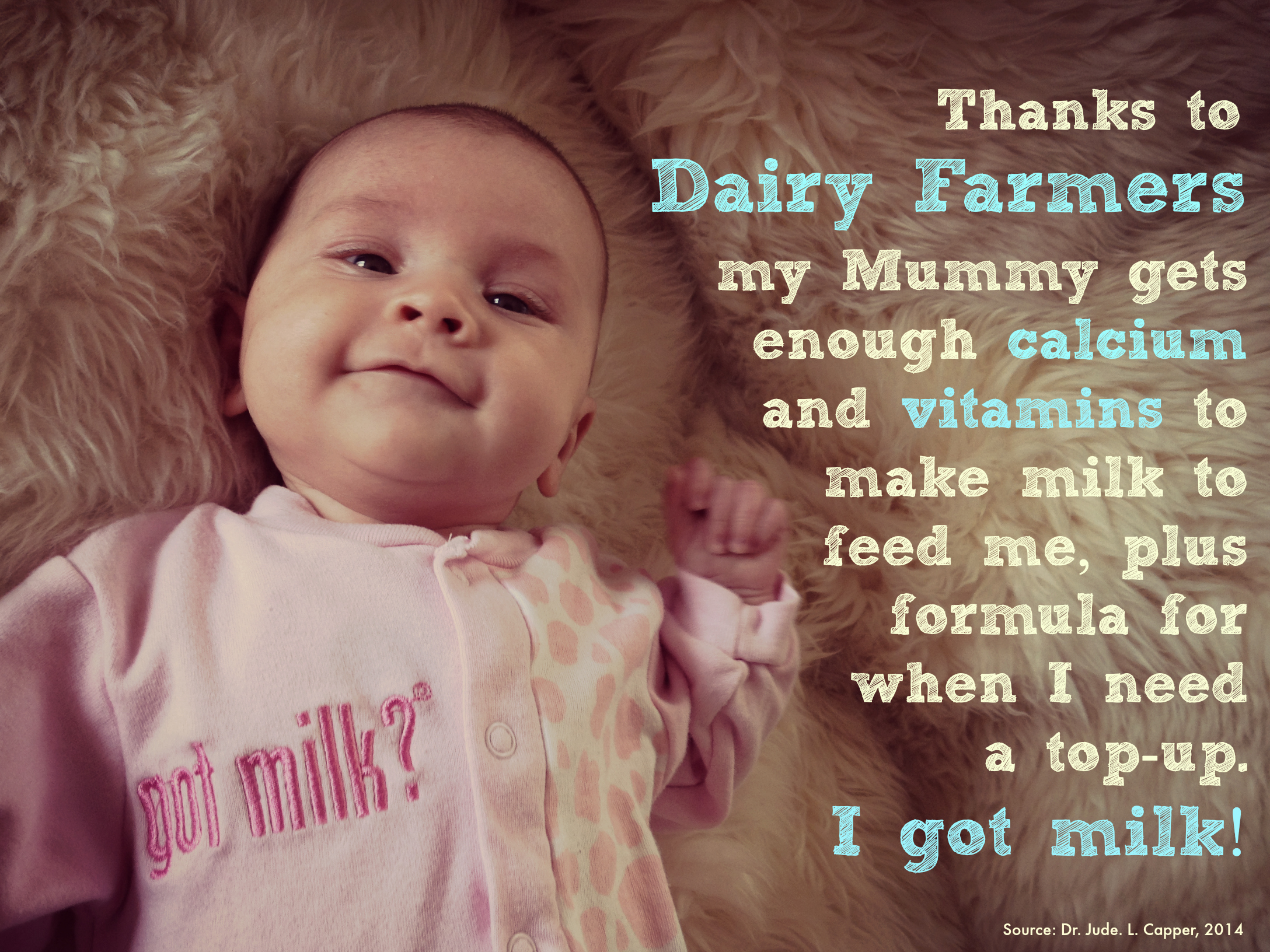
Got milkSo THANK YOU dairy farmers, for the nutrients that I get from my diet and can pass on to my baby, and for the milk that goes into formula to help her grow and thrive. You guys are the best!

 *Soy-based formulas are also available for babies who are allergic to cow’s milk, I’m lucky that my little girl thrives on dairy products! 

Thanks to @DairyCarrie and @AgProudRyan for showing me the PETA video, and to @JodiOleen for reminding me that I’d intended to blog about it.

Vegan is Love. So Omnivore is…Hate?

When I visualize vegans* with kids (and I apologize in advance for the stereotyping but after all, this is a visualization), I have an image of a couple similar to my childhood friend Molly’s** parents. A pair of liberal arts majors, in favor of trying to have rational discussion with a toddler who’s beating her fists on the floor as she has a tantrum in the middle of Safeway, he had a huge beard, she wore hemp and they were both passionately devoted to both Molly’s education and her right to make rational choices as she developed into a miraculous human being.

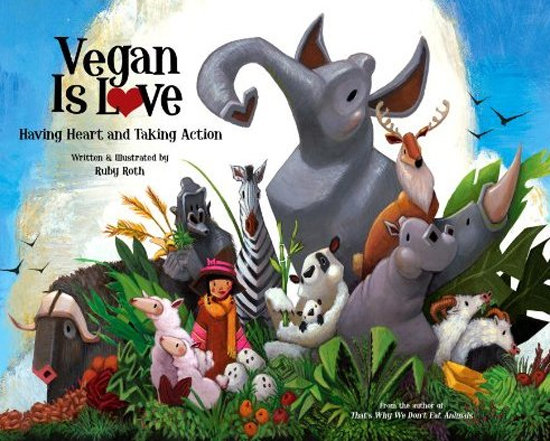
So imagine my surprise when the latest kids book de jour isn’t the beautiful and life-affirming “Guess How Much I Love You“, but “Vegan is Love” a charming tale that paints graphic pictures of the perceived violence that farm animals undergo during slaughter and effectively paints all omnivorous kids as Manson-esque murderers. Reviews on Amazon.com include “Leaping and bounding toward a more peaceable world…” from singer Jason Mraz and similar compliments from the founders of Animal Acres and Farm Sanctuary. Nicely done vegan activists – get the Mommy guilt going and start a “you eat meat so you’re a murderer, get out of my sandbox” clique going in kindergarten.

I never fail to be amazed by just how narrow-minded the focus is of those opposed to animal agriculture, despite their assumed “peace, love and tolerance for all living creatures stance”. Can you imagine the consequences if a similar children’s book was published detailing the horrible life of little Trevor, born with developmental problems due to a severely restricted maternal diet during pregnancy? There would be outrage – how dare the meat-eating majority pick on a vegetable-eating minority… The funny thing is, I’ve yet to hear any omnivorous acquaintance ever seriously assert that vegetarians or vegans should be made to eat meat. Yet the activist vegan contingent are determined to pass their “morals” (note that’s ethical morals, not the delicious fungal morels) onto omnivores and impose dietary choices upon them.

Some states already have abstinence-only sex education, and many schools have “Meatless Mondays”, so what’s next? Vegan-only high school nutrition classes? Herbivorous zoology (no carnivores  allowed)?  The tale of the loaves and fishes rewritten as the loaves and the three-bean-and-lentil-surprise?  Only 1.7% of the population may be actively complaining against modern food production, but they’re not just banging the drum, they’ve hired the whole darn band.

*Before I’m accused of being a meat industry zombie or other such nonsense, I should confess that I was a vegetarian and then a strict vegan from the age of 15-17. I actually turned orange from a sensitivity to beta-carotene.

**Names have been changed 

Is Corn the Soylent Green of the Future?

I recently had the pleasure of watching the 1973 movie Soylent Green starring Charlton Heston. I won’t spoil the ending for those who havent seen it, but the overarching premise of a big company controlling the food supply to an hungry, overcrowded future population strongly resembles some of the current claims made by the more vehement foodies. The anti-animal-agriculture activists appear to have a similar agenda – if only food production was “sustainable” (a word with a million definitions) without any of those “factory farms (that) pose a serious threat to health” and red meats that “have been linked to obesity, diabetes, cardiovascular disease, and certain types of cancer“, life would be much sweeter.

So what’s the answer? It’s very simple. All that animal feed could simply be fed to humans. According to Pimentel at Cornell University, 800 million people could be fed with the grain that livestock eat in the USA each year. If we ignore the fact that field corn (fed to livestock) is not the same as sweet corn (the corn on the cob that we eat), and assume that field corn could easily be processed into a human foodstuff, Pimentel is right.

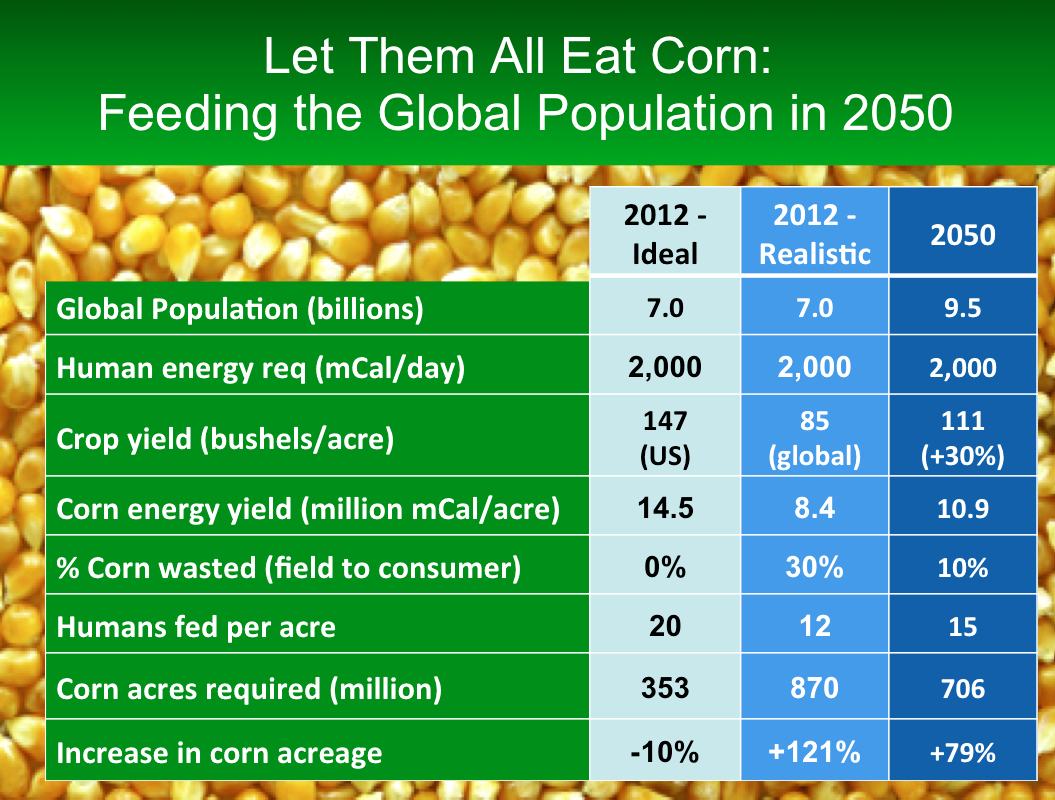
Given the average human nutrient requirement (2,000 kCal/day) and the energy yield of an acre of shelled corn (14.5 million kCal), one acre of corn (at 2011 US yields) could supply 20 people with their energy needs (see table below). On a global basis, we currently harvest around 393.5 million acres of corn, therefore we could supply the entire current global population (7.003 billion) using only 90% of the global corn area. Of course that’s assuming zero waste and US crop yields. If we use a more realistic scenario with global corn yields (85 bushels/acre) and 30% food wastage, we can only feed 12 people per acre and would need to increase current corn acreage by 121% to produce enough food to supply the current population. So what happens by the year 2050 when the population is predicted to reach 9.5 billion people? Assuming that we continue to see increases in yield proportional to those over the past 30 years (30% increase in US yields since 1982), that yield increases are exhibited globally, and that we can cut food waste to 10%, we could feed 15 people per acre and we’ll need to increase corn acreage by 79% to provide sufficient corn to feed the global population.

If our dietary requirements can be met by corn alone, the increase in land use won’t be an issue – land currently devoted to soy, peanuts or wheat can be converted to corn. Yet this simplistic argument for vegetarian/veganism suffers from three major flaws. Firstly, it assumes that the global population would be willing to forgo lower-yielding vegetable crops that add variety to the diet – where are the artichokes, kale or radishes in this dietary utopia?

Secondly, as noted by Simon Fairlie in his excellent book, converting to a vegan monoculture would significantly increase the reliance on chemical fertilizers and fossil fuels due to a lack of animal manures. Given current concern over dwindling natural resources, this is an inherently unsustainable proposition.

Finally, corn is currently vilified by many food pundits. The suggestion that our food supply is controlled by corporations who force monoculture corn upon hapless farmers who are then faced with the choice of complying with big ag or being forced out of business are the purview of food pundits (e.g. Michael Pollan and Joel Salatin) and documentaries such as Food Inc. and King Corn. Not a week goes by without another Mommy blogger or journalist publishing an article on the dangers of high-fructose corn syrup, often concluding that if only this ingredient was removed from our food supply, childhood obesity and pediatric type II diabetes would cease to be an issue for little Johnny and Janie pre-schoolers of the future.

It’s frighteningly easy to visualise the Soylent Green-esque vegan future, whereby food is doled out in pre-measured quantities according to dietary requirements – yet what happens when the whistle-blower of 2050 proclaims “it’s made from CORN!”?

Would you like a side of corpse with your meal, Sir?

I was interested to see the following description of Hitler’s* (*see disclaimer below) behavior in a recent Drover’s article:

…[Hitler] was offered a piece of ham and refused, saying “it is like eating a corpse.”

Is it me, or is that remarkably similar language to that used by PETA and HSUS? Before somebody opens a can of Godwin’s Law whoop-ass, I’d like to point out that I’m not trying to prove my point by referring everything I don’t agree with back to Nazism (although it’s a popular way for internet trolls to try to end arguments), nor am I comparing PETA and HSUS to Hitler. After all, PETA are inherently amusing – without PETA we wouldn’t see so many pictures of Pamela Anderson or marvel at the faux-pornographic inventiveness of “Milk Gone Wild“, let alone snigger at their attempts to get Ben & Jerry’s to use human breast milk. However, I can imagine this a headline in the National Enquirer: “Animal Rights Groups Use Hitler Soundbites” – could be a PR nightmare (take note PETA publicity dept)

Still, it’s interesting that simple words can evoke such a violent reaction. As an unrepentant omnivore, I’m well aware that the meat that I eat originates from animals that have been slaughtered (yes, slaughtered – carrots are harvested, animals are slaughtered) in order to provide human food. Therefore according to the definition of a corpse “A dead body, esp. of a human being rather than an animal”, the juicy burger I’m planning to eat for lunch is a 1/4 lb patty of flesh from the corpse of a cow. What is it about human frailties that such a definition instantly makes me feel like Jeffrey Dahmer, whereas “meat” sounds tasty and innocuous like something grown on a tree in a sunlit California valley?

In high school, my friends and I eschewed meat for animal welfare reasons, horrified by the vivisection pictures prominently displayed by the animal rights activists at the local mall. Yet once we grew out of the teenage rebellion stage, these issues seemed to be less important: during my 12-month vegan stint (aged 15) over half the girls in my high-school class were vegetarian, yet my college class contained less than five vegetarians and I only have two in my current circle of friends. If we took children on tours of slaughterhouses as well as farms and museums would the number of adult vegetarians increase? Or would the fact that meat generally appeals to the human palate overcome those images?

The vast majority of farm animals are well cared for and slaughtered in a humane manner in accordance with the regulations applicable to that region. Yet continuing to disguise the facts of food production by replacing “slaughter” with “harvest” (I’ve been rebuked several times by industry colleagues for refusing to use “harvest”) and playing into the consumer fantasy that meat is produced without death occurring may lead us into dangerous waters in future. So are we ready to pick up a package of ground beef flesh and to baste the Christmas turkey corpse? Its unlikely…but it sure would take the wind out of the PETA and HSUS sails wouldn’t it?

*If the name Hitler instantly ticks your “Alert! Cheap rhetoric!” button, feel free to replace with Idi Amin, Pol Pot or “small angry fanatic with ridiculous moustache”