Vegetarians May Preach – But We’re Not All Members of the Choir

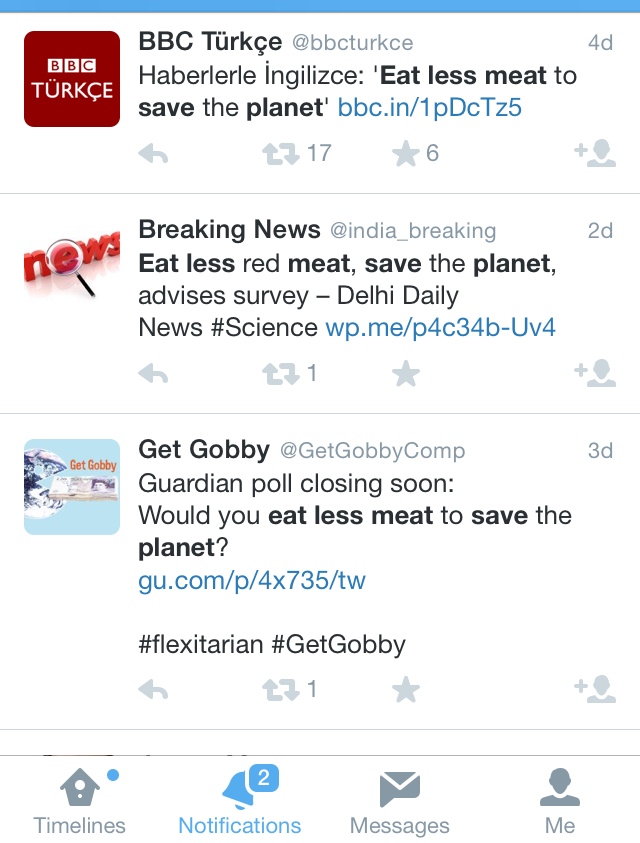
Less meatThe  suggestion that we should eat less meat in order to save the planet pops up with monotonous regularity in my twitter feed. Interestingly, those who make this claim are almost always vegetarian, vegan or profess to eat very little meat. This is rather like me asserting that we could mitigate climate change and save resources by eating fewer bananas and curbing our windsurfing habits. I loathe bananas, and if you ever see me windsurfing you’d better be sure that there’s a nearby hospital bed and neck brace with my name on it. As you can imagine, giving up either activity would have little impact on my life.

This is why I find it interesting and rather facile that those who do not eat meat proclaim fleshy abstinence as the way forwards. It’s easy to preach a solution that has no impact on your life – far harder to make a dietary or lifestyle change that actually impacts you.

The “eat less meat” movement would have far more credibility if it was promoted by a hunting, fishing, grilling, hamburger-lover who publicly declared his/her love for meat in all it’s many forms, and bemoaned the fact that they felt they should forgo the steak in favor of the tofu stir-fry. Yet this doesn’t happen. Why? Because the vast majority of us simply don’t feel that an intangible threat (we can’t see or feel climate change, or conceptualize the quantity of oil reserves remaining) is sufficient to make us give up our carnitas burrito. In reality, meat eating is only likely to decline if it becomes too expensive or subject to regulatory sanctions (e.g. rationing similar to that in Britain during WWII). The influx of papers suggesting that we should reduce consumption therefore fall on deaf ears.

So let’s face the facts. Neither the national or global population is likely to reduce meat consumption in the near future, and the rising income per capita in India and China will increase demand for meat still further. Instead of making recommendations based on notional utopias, let’s focus on areas where we can really improve.

Amazing gains in productivity have allowed the beef, dairy, pork and egg industry to considerably reduce resource use and greenhouse gas emissions over the last century. With a culture of continuous improvement and access to technologies that improve productivity, we can feed the future population using even fewer resources.

Let’s make better use of the multifarious by-products from the human food and fiber industry. Ruminants are blessed with the ability to digest fibers and plant materials that we either can’t or won’t eat – using by-product feeds to replace corn and soy refutes the claim that livestock compete with humans for food.

Finally, take a look at your own plate. Globally, 33% of food is wasted. Just think of the reductions in resource use we could achieve (and people we could feed) if all the crops planted, fruit picked, and milk, meat and eggs produced were consumed, rather than just 2/3 of them.

We evoke change by leading by example – I’m off to enjoy a steak, conventionally-raised using 12% less water, 19% less feed and 33% less land than its equivalent in 1977. You’d better believe that if there’s any left, it’s going in a sandwich tomorrow. As my Grandma used to say: Waste not, want not.

Who Needs Scientists? Just Let Mother Nature Design Your Greek Yogurt.

Chobani.jpgHow you get to 100 calories matters. Most companies use artificial sweeteners. We think Mother Nature is sweet enough”. Clever marketing from the greek yogurt company Chobani, simultaneously disparaging alternative brands, and playing the ultimate caring, sharing, natural card with the mention of “Mother Nature”. However, earlier this week, Chobani’s #howmatters hashtag set the twitter feeds alight after their new “witty” tagline on the underside of yogurt lids was posted (below).

howmattersThe wording plays beautifully into what is fast becoming a universal fear of science intruding on our food supply – we want real food; food like our grandparents ate; food from traditional breeds and heirloom varieties – providing it doesn’t take us over 2,000 cal per day or increase our cholesterol levels. Rightly or wrongly, many people blame processed foods with hidden sugars and added chemical preservatives for many health issues in developed countries – the epitome of a #firstworldproblem, given that the corresponding #thirdworldproblem is hunger and malnutrition.

However, this time the twitter anger wasn’t from rampaging mommy bloggers, or infuriated activists, but scientists. After all, without science, would Chobani have a product? Yogurt was first developed in ancient times, but the modern pasteurized, long-shelf-life, greek yogurt is rather different to the cultured milk our ancestors would have enjoyed.

FAGEI have a 100-calorie greek yogurt from a rival brand in my fridge, so let’s examine the ingredients (left). Simply pasteurized skimmed milk and live active yogurt cultures (note, no added sweeteners). Louis Pasteur, a 19th century French scientist developed pasteurization (in addition to his discoveries relating to vaccines and microbial fermentation); biologists developed methods to identify and classify the bacteria that ferment milk into yogurt; and food scientists experimented with the exact mixture of bacteria to produce the desired flavor, texture and color of yogurt,  as well as developing the range of other processes needed to make the yogurt safe, appealing and shelf-stable.

Yes, we could make greek yogurt without scientists – after all, the original recipe didn’t originate in a corporate experimental kitchen. But without hundreds of years of scientific input, could we make Greek yogurt that, at 100 calories per serving, is desirable to the consumer and is a safe, affordable source of vitamins, minerals and protein? No. To imply that we could does a huge disservice to food scientists.

It appears that being a modern-day scientist appears to be somewhat equivalent to clubbing baby seals to death. Caring little for human suffering and illness, the cold and clinical scientist rubs his hands together with glee as he removes all nutrients from real food, replacing them with chemicals, additives and genetically-modified ingredients. As a side-line, he develops cocktails of toxic elements, pesticides and embalming fluid and markets them as vaccines. Yes, science is the enemy. Just remember that next time you take an aspirin for a hangover from pasteurized, fermented beverages.

Breast is Best…But My Baby and I Are Eternally Grateful for “Udder” Alternatives

BreastisbestJust over 11 months ago my life changed forever. As a breast cancer survivor who underwent 6 years of surgery, chemotherapy, radiation, monoclonal antibodies and hormone treatment, I’d resigned myself to that fact that my chance of having children was less than 4%. As a fiercely independent traveler, I was ok with that (sort of…), diverting my attention to work and celebrating the fact that with no ties, I could go to bed at 3am, attend any social event or fly overseas at a moments notice.

Then I found I was pregnant. The most unexpected, amazing, literally mind-blowing event of my entire life. I become “that” pregnant woman, giving up soft cheeses, beef jerky, champagne, ibuprofen and horse-riding overnight and doing absolutely everything I could to nourish the baby growing inside me. In January my baby girl was born, and (to quote my sister-in-law) every single day since then has been like waking up on Christmas morning. I could never have wished for such a beautiful and perfect gift.

When I saw this PETA video starring Emily Deschanel I absolutely sympathized with her opening statement – nothing compares to the joy of raising my child. Yet, as the video progressed and Ms Deschanel described the atrocities that allegedly occur on dairy farms, accompanied by emotive video footage, I became more and more concerned. At the end of the clip Ms Deschanel suggested that the only way forwards was to end the cruelty on factory farms and go vegan. That’s when I almost lost it.

I’ve always supported the dairy industry – I think I may actually be clinically addicted to cheese and my yogurt consumption could be considered an extreme sport; but now I have an even better reason to celebrate dairy farmers – they ensure that I have a happy, healthy baby girl.

There’s no doubt that the “breast is best” slogan is right – babies are mammals, they thrive on mammalian milk – indeed milk is the most highly digestible food available for their little stomachs. However, because of my cancer treatment, I can’t produce enough milk to nourish my baby; so she’s fed both breast-milk and formula.  Until now, I’d never thought about where formula comes from – I’d rather assumed it was a synthetic mix of amino acids produced in a test-tube. In reality, it’s a combination of nonfat cows’ milk*, lactose, and whey protein concentrate (both of the latter ingredients also from cows’ milk); combined with other ingredients to provide the energy, vitamins, minerals and essential fatty acids that my little girl needs to grow and be healthy.

I would do anything for my little girl – I can’t even imagine what it would be like to try and care for her if formula didn’t exist and I could only provide her with half the nutrients she needed through breast-feeding. Alarmingly, the third result on Google for “vegan baby formula” is a recipe for home-made formula based on coconut water and raw almonds. The mind would boggle if I weren’t just terribly worried that somewhere, a mother thinks that this is the right choice for her child. To raise a baby as vegan because of parental ideology would seem irresponsible, if not dangerous – after all, surely breast-feeding is non-vegan?

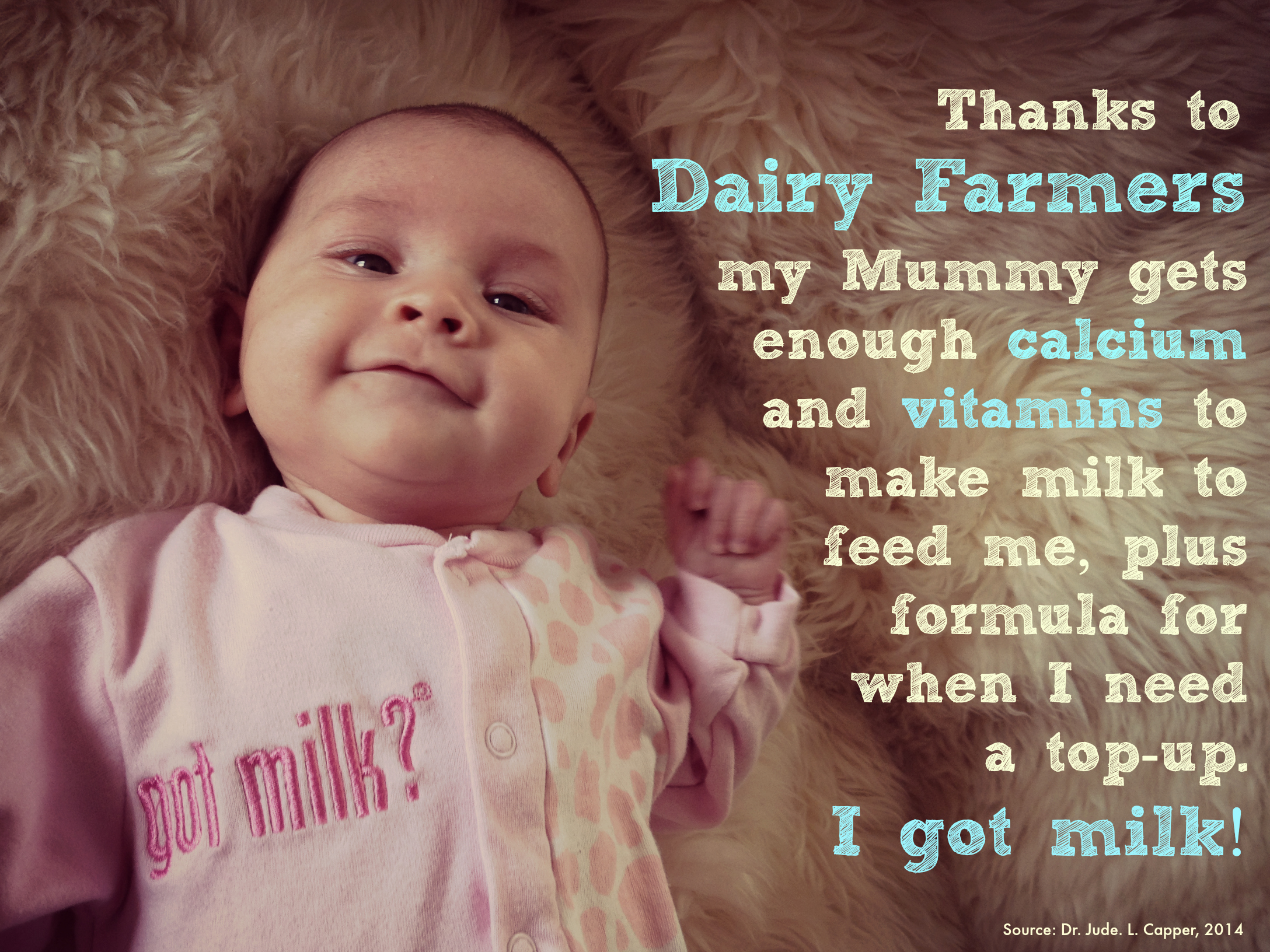
Got milkSo THANK YOU dairy farmers, for the nutrients that I get from my diet and can pass on to my baby, and for the milk that goes into formula to help her grow and thrive. You guys are the best!

 *Soy-based formulas are also available for babies who are allergic to cow’s milk, I’m lucky that my little girl thrives on dairy products! 

Thanks to @DairyCarrie and @AgProudRyan for showing me the PETA video, and to @JodiOleen for reminding me that I’d intended to blog about it.