Meatless Mondays.. or More Veg Mondays?

I consider myself to be an omnivore. I love meat – the smell of grilling beef or lamb turns me into a human version of Scooby Doo drooling and begging for a Scooby snack, and I’ve been known to arm-wrestle people for the last bratwurst. I love vegetables even more than meat – anyone examining my grocery-shopping list might conclude that I have an entire colony of rabbits to support with radishes, asparagus and zucchini, and I simply don’t understand those people who don’t find immense pleasure in eating “green stuff”. Given that the Meatless Mondays campaign apparently aims to “introduce consumers to the wide variety of healthy, delicious plant-based foods available”, you might think I’d be all over it like butter on a baked potato (be still my beating heart). Yet the very phrase causes my blood pressure to rise. Snacking on carrots, celery and olives in Delta Airlines’ Sky Lounges rather than buying deep-fried Taco Bell at the airport fills me with joy, but when I order a pizza, it’s always the vegetarian supreme…with added Italian sausage.

There it is – the added sausage. Meaty, spicy goodness that adds another layer of flavor to my pizza and that, as meat, I consider to be an essential component of my diet. In the US we are more food-centered than ever before – Facebook albums are titled “food porn” and chefs are celebrities. Yet we also seem to be moving towards a culture where individual foods or nutrients are demonized. “Fat-free” and “sugar-free” are marketing terms that imply that specific nutrients are undesirable in our diet; whole aisles are devoted to gluten-free foods despite the fact that celiac disease found in less than 1% of the population; and who doesn’t have a friend who is diligently avoiding carbs, dairy or red meat on “health grounds”? Why has our society evolved to the point where those who can afford the greatest variety of foods are the most likely to demand a gluten-free, dairy-free, low-carbohydrate, macrobiotic diet as a mark of their elite status?*

Abstinence, whether on dietary or moral grounds, has always been synonymous with purity, sacrifice, and a certain level of sanctimoniousness. I am purer than you because I don’t give in to my dark desires for <<insert your sin of choice here>>. The Meatless Mondays campaign plays the abstinence hand beautifully – give up your selfish meat-eating habits for one day per week and you too can save the world by eating a bean burrito. The Humane Society of the United States inevitably supports the Meatless Mondays campaign, their comment (expressed verbatim in almost every press-release) being that it “helps spare animals from factory farms, helps our environment, and improves our health”. If “meatless” is the way forwards, meat must be an undesirable food and vegetarian diets must be healthier, just as fat-free Oreo cookies would be presumed to be a wiser nutritional choice than regular Oreos (interestingly, their calorie contents are almost identical). Yet the national carbon footprint would be reduced by less than half of one percent if everybody adopted Meatless Mondays for an entire year, and the propounded effects of meat consumption on health have not been borne out by science.

When a school district or college campus adopts the Meatless Mondays campaign, I don’t hear the buzz of black helicopters and see the hand of Wayne Pacelle on the throttle. However, I am deeply disappointed that a campaign demonizing meat consumption, suggesting that eating a hamburger is comparable to the environmental equivalent of driving at 120 mph in a Hummer or the health effects of smoking 20 cigarettes per day, is considered by so many to be a positive move forwards in feeding a hungry world. I am not suggesting that we should all eat a 16 oz T-bone steak for every meal, or that vegetarianism or veganism are not valid dietary choices. Indeed, I propose that meat-eaters be afforded the same courtesy as vegetarians or vegans – to choose foods according to their individual or religious beliefs.

So what is the future for Meatless Mondays? It’s very simple. If this campaign really aims to expose people to a wider range of vegetables and plant-based food choices, let’s simply christen it “More Veg Mondays”. Have an extra helping of broccoli with your steak, try eggplant parmegana alongside your hotdog, or replace crackers with raw celery and radishes. Rather than demonizing individual foods, let’s celebrate the fabulous variety of choices that are available to us and that allow us the opportunity to eat a balanced diet every single day. Ironically, yesterday my Monday was almost meatless – I spent the day traveling and subsisting on dried mango, chocolate-covered coffee beans and vitamin water in Chilean airports. However, I made up for it once I reached Córdoba – the Iberian ham on my pizza was the best I ever tasted, and made better by the rocket, tomatoes and olives that accompanied it (see picture above). Eat more vegetables? In an instant. Give up meat on Mondays? As Charlton Heston would say: only when you pry it from my cold dead hands.

*Please note that I do not include those who have demonstrable food allergies in this group

Can We Please Have Calls for Moderating Meat Consumption… in Moderation?

Do we need to moderate meat consumption in order to feed the world in 2050? Given beef producers’ track record of ingenuity, it’s possible but not probable.

A Twitter follower (Tweep? Twriend? Twquaintance?) asked yesterday whether we could really supply 9+ billion people with 250 lb of meat per capita in 2050. The question stemmed from a recent paper in which Stockholm scientists claimed that we would all have to reduce meat consumption by 75% by 2050 in order to have enough water to supply the population, and a subsequent rejoinder from the American Society of Animal Science in which several scientists noted the flaws in the Swedish paper, the importance of animal-source foods in the diet and the use of marginal land for grazing livestock.

On Twitter, the comment was made that there appear to be two distinct sides to this argument – one side (the environmentalists and anti-animal agriculture groups) warning that we need to drastically cut meat consumption in order to feed everybody, and the other (the meat industry) turning a blind eye and effectively promoting the idea that we can eat all the meat that we like without having any environmental impact.

Globally, we’re nowhere near 250 lb meat consumption per capita, even US consumers who are often portrayed as meat-guzzling bacon-o-philes by the Huffington Post et al. have an average annual consumption of 171 lb according to the USDA. As current beef consumption is 58 lb per capita in the USA, that’s a lot of pork and chicken that will presumably make up the difference. There’s no doubt that increases in both population size and per capita income in regions such as China and India will have a significant impact on global meat consumption by 2050. However, I have to admit I find the “blind eye” comment a little hard to swallow, given, for example, the beef industry’s commitment to measuring and mitigating both resource use and carbon emissions through current life cycle analysis research, and involvement with groups such as the Global Roundtable for Sustainable Beef.

There is no doubt that beef production uses considerable amounts of land and water, yet should we expect producers to effectively shoot themselves in the foot and suggest that consumers forgo a cheeseburger in favor of an alfalfa sprout salad? Isn’t improved efficiency a characteristic of every successful industry? The motor industry is a major contributor to environmental concerns, yet automobile manufacturers aren’t saying “we’re going to produce cars in the same way that we did in the ‘50s, you’ll just have to drive less”. Instead, the message is something akin to “we’re making cars more energy-efficient so that you can continue to drive without worrying about your car’s environmental impact.

That’s exactly what the beef industry has done, is doing and will continue to do into the future. Since 1977, the US beef industry has cut water use by 12%, land use by 33% and the carbon footprint of one lb of beef by 16%. Providing that producers are still able to use management practices and technologies that improve efficiency, further reductions should be seen in future. Yet we have to look beyond the idea that the USA can feed the world by itself. I’m writing this post from Brazil, which has a huge beef industry, yet on average, Brazilian beef cattle first calve at 4 years of age, only 67% of cows have a calf each year and beef animals take 3 years to reach slaughter weight. Comparisons to the equivalent US figures (2 years, 91% and 15 months respectively), show the potential for amazing reductions in resource use from Brazilian beef production, and this, along with other less-efficient systems, is where we have to focus in future. It’s not about forcing US-style production on every producer; it’s about enabling producers to make the best and most efficient use of resources according to their management system and region. Brazil has just approved the use of beta-agonists in beef production, which will allow the production of more beef using fewer resources. This is just one step on the road to improved efficiency.

So do we need to moderate meat consumption in order to feed the world in 2050? I’d love to be able to answer this by citing a published paper that has taken improvements in meat industry productivity over the next 40 years into account rather than assuming a “business as normal” outcome. In the absence of such a paper, I’ll give a Magic 8-Ball type answer: Given beef producers’ track record of ingenuity, it’s possible but not probable. Globally, there are huge opportunities for improved efficiency and concurrent reductions in resource use from all meat production systems – the key is not to reduce meat production but simply to produce it more efficiently.

Vegan is Love. So Omnivore is…Hate?

When I visualize vegans* with kids (and I apologize in advance for the stereotyping but after all, this is a visualization), I have an image of a couple similar to my childhood friend Molly’s** parents. A pair of liberal arts majors, in favor of trying to have rational discussion with a toddler who’s beating her fists on the floor as she has a tantrum in the middle of Safeway, he had a huge beard, she wore hemp and they were both passionately devoted to both Molly’s education and her right to make rational choices as she developed into a miraculous human being.

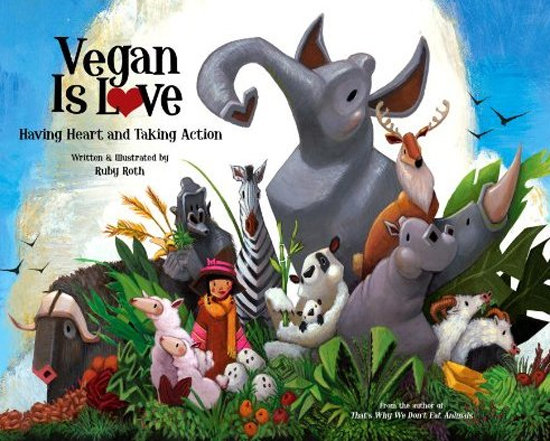
So imagine my surprise when the latest kids book de jour isn’t the beautiful and life-affirming “Guess How Much I Love You“, but “Vegan is Love” a charming tale that paints graphic pictures of the perceived violence that farm animals undergo during slaughter and effectively paints all omnivorous kids as Manson-esque murderers. Reviews on Amazon.com include “Leaping and bounding toward a more peaceable world…” from singer Jason Mraz and similar compliments from the founders of Animal Acres and Farm Sanctuary. Nicely done vegan activists – get the Mommy guilt going and start a “you eat meat so you’re a murderer, get out of my sandbox” clique going in kindergarten.

I never fail to be amazed by just how narrow-minded the focus is of those opposed to animal agriculture, despite their assumed “peace, love and tolerance for all living creatures stance”. Can you imagine the consequences if a similar children’s book was published detailing the horrible life of little Trevor, born with developmental problems due to a severely restricted maternal diet during pregnancy? There would be outrage – how dare the meat-eating majority pick on a vegetable-eating minority… The funny thing is, I’ve yet to hear any omnivorous acquaintance ever seriously assert that vegetarians or vegans should be made to eat meat. Yet the activist vegan contingent are determined to pass their “morals” (note that’s ethical morals, not the delicious fungal morels) onto omnivores and impose dietary choices upon them.

Some states already have abstinence-only sex education, and many schools have “Meatless Mondays”, so what’s next? Vegan-only high school nutrition classes? Herbivorous zoology (no carnivores  allowed)?  The tale of the loaves and fishes rewritten as the loaves and the three-bean-and-lentil-surprise?  Only 1.7% of the population may be actively complaining against modern food production, but they’re not just banging the drum, they’ve hired the whole darn band.

*Before I’m accused of being a meat industry zombie or other such nonsense, I should confess that I was a vegetarian and then a strict vegan from the age of 15-17. I actually turned orange from a sensitivity to beta-carotene.

**Names have been changed 

Is Corn the Soylent Green of the Future?

I recently had the pleasure of watching the 1973 movie Soylent Green starring Charlton Heston. I won’t spoil the ending for those who havent seen it, but the overarching premise of a big company controlling the food supply to an hungry, overcrowded future population strongly resembles some of the current claims made by the more vehement foodies. The anti-animal-agriculture activists appear to have a similar agenda – if only food production was “sustainable” (a word with a million definitions) without any of those “factory farms (that) pose a serious threat to health” and red meats that “have been linked to obesity, diabetes, cardiovascular disease, and certain types of cancer“, life would be much sweeter.

So what’s the answer? It’s very simple. All that animal feed could simply be fed to humans. According to Pimentel at Cornell University, 800 million people could be fed with the grain that livestock eat in the USA each year. If we ignore the fact that field corn (fed to livestock) is not the same as sweet corn (the corn on the cob that we eat), and assume that field corn could easily be processed into a human foodstuff, Pimentel is right.

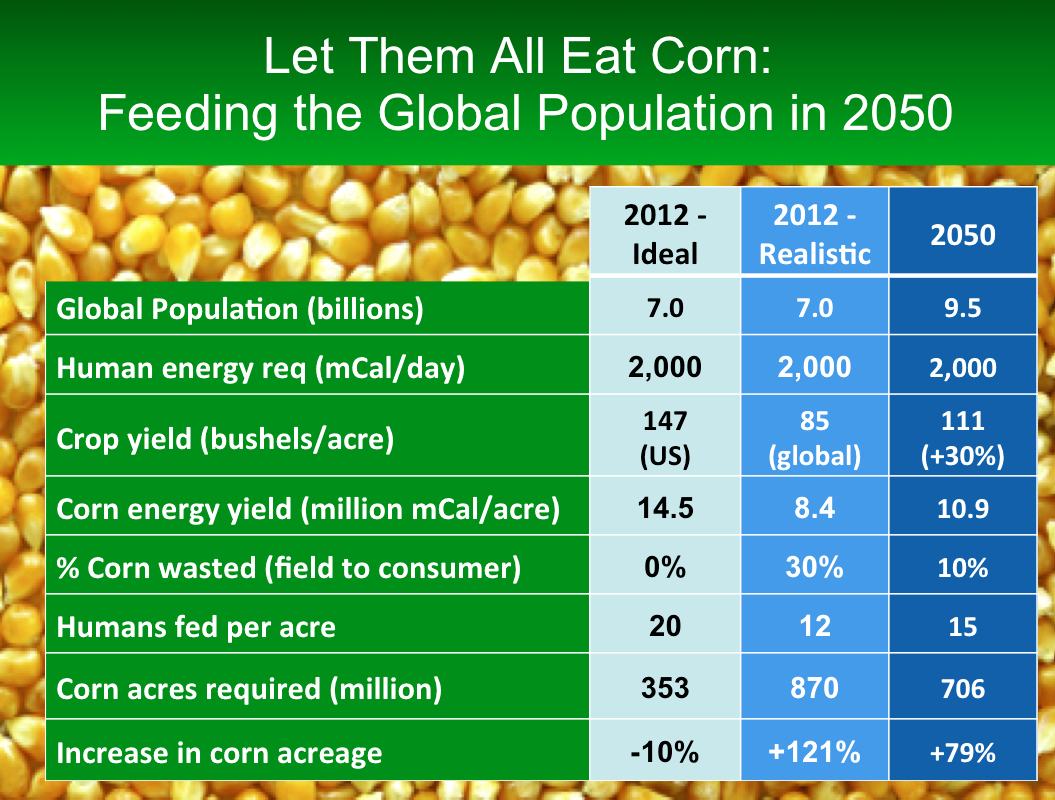
Given the average human nutrient requirement (2,000 kCal/day) and the energy yield of an acre of shelled corn (14.5 million kCal), one acre of corn (at 2011 US yields) could supply 20 people with their energy needs (see table below). On a global basis, we currently harvest around 393.5 million acres of corn, therefore we could supply the entire current global population (7.003 billion) using only 90% of the global corn area. Of course that’s assuming zero waste and US crop yields. If we use a more realistic scenario with global corn yields (85 bushels/acre) and 30% food wastage, we can only feed 12 people per acre and would need to increase current corn acreage by 121% to produce enough food to supply the current population. So what happens by the year 2050 when the population is predicted to reach 9.5 billion people? Assuming that we continue to see increases in yield proportional to those over the past 30 years (30% increase in US yields since 1982), that yield increases are exhibited globally, and that we can cut food waste to 10%, we could feed 15 people per acre and we’ll need to increase corn acreage by 79% to provide sufficient corn to feed the global population.

If our dietary requirements can be met by corn alone, the increase in land use won’t be an issue – land currently devoted to soy, peanuts or wheat can be converted to corn. Yet this simplistic argument for vegetarian/veganism suffers from three major flaws. Firstly, it assumes that the global population would be willing to forgo lower-yielding vegetable crops that add variety to the diet – where are the artichokes, kale or radishes in this dietary utopia?

Secondly, as noted by Simon Fairlie in his excellent book, converting to a vegan monoculture would significantly increase the reliance on chemical fertilizers and fossil fuels due to a lack of animal manures. Given current concern over dwindling natural resources, this is an inherently unsustainable proposition.

Finally, corn is currently vilified by many food pundits. The suggestion that our food supply is controlled by corporations who force monoculture corn upon hapless farmers who are then faced with the choice of complying with big ag or being forced out of business are the purview of food pundits (e.g. Michael Pollan and Joel Salatin) and documentaries such as Food Inc. and King Corn. Not a week goes by without another Mommy blogger or journalist publishing an article on the dangers of high-fructose corn syrup, often concluding that if only this ingredient was removed from our food supply, childhood obesity and pediatric type II diabetes would cease to be an issue for little Johnny and Janie pre-schoolers of the future.

It’s frighteningly easy to visualise the Soylent Green-esque vegan future, whereby food is doled out in pre-measured quantities according to dietary requirements – yet what happens when the whistle-blower of 2050 proclaims “it’s made from CORN!”?

Eating Less Meat, May Not Help You To Live Forever…But It’ll Sure Feel Like It

I know Harvard researchers are smart, I really do. Yet I have to question the latest study reporting that eating red meat is associated with premature death. Published in the Archives of Internal Medicine, the paper analyzed the relationship between mortality and red meat consumption in a total of 121,342 healthcare professionals and concluded that:

Greater consumption of unprocessed and processed red meats is associated with higher mortality risk… replacement of red meat with alternative healthy dietary components may lower the mortality risk.

As a researcher, I know full well that it’s almost impossible to prove a cause-effect relationship. This is particularly difficult in human studies where other dietary and lifestyle factors have to be accounted for. After all, if you have ketchup on your steak, does the lycopene prevent against prostate cancer? “Associated with” is therefore absolutely the correct terminology for the paper’s authors to use. Alas, in the minds of so many, “associated with” translates to “causes” (especially when it’s a bad news story), and everybody panics accordingly.

The results of this report need to be put into context with our other lifestyle choices. If, as reported, eating unprocessed or processed red meat increases the relative risk of mortality by 13% and 20% respectively, how does that compare to all our other daily activities – driving a car, drinking a glass of wine or eating a candy bar? How do we weigh the risk of consuming a steak or slice of pepperoni pizza against the bottle of Mountain Dew or unwashed raw carrot? After all, during the BSE crisis in the UK, data suggested that the risk of dying from falling out of bed and suffering a fatal head injury was far greater than that from contracting vCJD, yet there was immense consumer concern relating to the perceived dangers of beef consumption.

Relative risk is not a measure that many people understand. Within this study, the absolute mortality risks (i.e. the probability of any one person dying) paint a rather different picture. Out of every 100 men, 1.23 men consuming three servings of unprocessed meat (the equivalent of one 9-oz steak) per week were likely to die, versus 1.30 men eating 6 oz of processed meat (bacon, sausage etc) per day (42 oz per week). Given the small difference in those mortality risks (which were similar for women) yet the huge difference (9 oz vs. 42 oz) in weekly meat consumption, we would be better served by focusing more on other factors (bodyweight, exercise, genetic propensity to specific diseases) that contribute the vast majority of our absolute mortality risk rather than assuming that we can live forever if we only replace a hamburger with a vegetarian meatloaf.

Since this study hit the headlines my Facebook newsfeed predictably been over-run by anecdotes about grandparents who lived to the ripe of age of 101 years while eating bacon and eggs for breakfast, corned-beef hash for lunch and three pork chops (with extra heavy cream in the whipped potatoes) for dinner. Without wishing to be flippant, the one certainty in this life is that we’ll all die at some point – if I restricted my meat intake to the suggested 3 oz per day (or less) I have a sneaking feeling that I might not live forever, but it’d sure feel like it.

Would you like a side of corpse with your meal, Sir?

I was interested to see the following description of Hitler’s* (*see disclaimer below) behavior in a recent Drover’s article:

…[Hitler] was offered a piece of ham and refused, saying “it is like eating a corpse.”

Is it me, or is that remarkably similar language to that used by PETA and HSUS? Before somebody opens a can of Godwin’s Law whoop-ass, I’d like to point out that I’m not trying to prove my point by referring everything I don’t agree with back to Nazism (although it’s a popular way for internet trolls to try to end arguments), nor am I comparing PETA and HSUS to Hitler. After all, PETA are inherently amusing – without PETA we wouldn’t see so many pictures of Pamela Anderson or marvel at the faux-pornographic inventiveness of “Milk Gone Wild“, let alone snigger at their attempts to get Ben & Jerry’s to use human breast milk. However, I can imagine this a headline in the National Enquirer: “Animal Rights Groups Use Hitler Soundbites” – could be a PR nightmare (take note PETA publicity dept)

Still, it’s interesting that simple words can evoke such a violent reaction. As an unrepentant omnivore, I’m well aware that the meat that I eat originates from animals that have been slaughtered (yes, slaughtered – carrots are harvested, animals are slaughtered) in order to provide human food. Therefore according to the definition of a corpse “A dead body, esp. of a human being rather than an animal”, the juicy burger I’m planning to eat for lunch is a 1/4 lb patty of flesh from the corpse of a cow. What is it about human frailties that such a definition instantly makes me feel like Jeffrey Dahmer, whereas “meat” sounds tasty and innocuous like something grown on a tree in a sunlit California valley?

In high school, my friends and I eschewed meat for animal welfare reasons, horrified by the vivisection pictures prominently displayed by the animal rights activists at the local mall. Yet once we grew out of the teenage rebellion stage, these issues seemed to be less important: during my 12-month vegan stint (aged 15) over half the girls in my high-school class were vegetarian, yet my college class contained less than five vegetarians and I only have two in my current circle of friends. If we took children on tours of slaughterhouses as well as farms and museums would the number of adult vegetarians increase? Or would the fact that meat generally appeals to the human palate overcome those images?

The vast majority of farm animals are well cared for and slaughtered in a humane manner in accordance with the regulations applicable to that region. Yet continuing to disguise the facts of food production by replacing “slaughter” with “harvest” (I’ve been rebuked several times by industry colleagues for refusing to use “harvest”) and playing into the consumer fantasy that meat is produced without death occurring may lead us into dangerous waters in future. So are we ready to pick up a package of ground beef flesh and to baste the Christmas turkey corpse? Its unlikely…but it sure would take the wind out of the PETA and HSUS sails wouldn’t it?

*If the name Hitler instantly ticks your “Alert! Cheap rhetoric!” button, feel free to replace with Idi Amin, Pol Pot or “small angry fanatic with ridiculous moustache”