Passionate about sustainability and livestock production, dedicated to giving farmers and food industry stakeholders the data and messages to explain why we do, what we do, every single day.
Today’s Thursday, so presumably we can all enjoy a hamburger without being made to feel guilty by the virtuous soy-eaters who are saving the planet (thanks Environmental Working Group). But what happens when the weekend is over, Monday morning appears in all it’s miserable beginning-of-the-week glory and we’re choosing lunch? According to many schools, universities, hospitals, retirement complexes and workplaces, Monday is the day when you can make a difference!
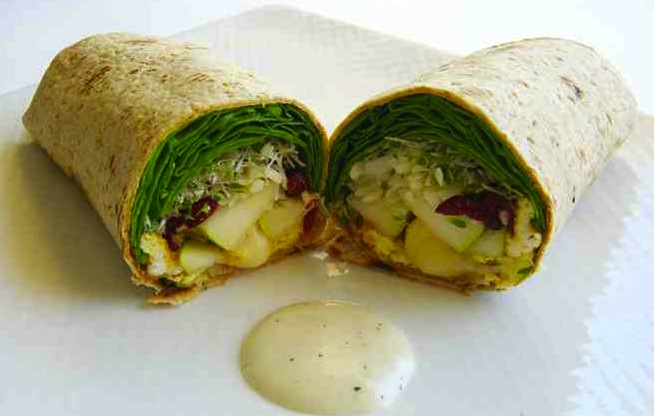
Simply by replacing that ham and cheese with a nice alfalfa and hummus wrap, we can all sleep safely knowing that our hummer driving and air-conditioning set at 65 degrees isn’t harming the environment – after all, we went meatless today! So what’s the real impact of Meatless Mondays?
If you believe the hyperbolic text of the EWG’s recently released report, animal agriculture is the root of all environmental evil. Yet buried on page 21 is the admission that animal agriculture only accounts for 4.5% of the US’s carbon footprint. The EPA has a somewhat smaller, but similar figure at 3.1% of total emissions. The original Meatless Mondays claim appears to have been derived from a paper from Carnegie Mellon that concludes:
Shifting less than one day per week’s worth of calories from red meat and dairy products to chicken, fish, eggs, or a vegetable-based diet achieves more GHG reduction than buying all locally sourced food.
So let’s do the math. Removing poultry and horses from the EPA’s animal agriculture total of 3.1% gives a red meat/dairy impact of 3.05%. Divide that by 7, and the impact of one meatless day per week is equal to 0.44% of the US carbon footprint – and that’s assuming that the US population of 311 million people all adopt this lifestyle change.
0.44% is minuscule. A tiny fraction of the impact that we could make on the carbon footprint. But if we put it in consumer-friendly numbers, it’s like taking 5.7 million cars off the road each year, or planting 4.5 billion trees. Sounds far more compelling now doesn’t it? But how does that compare to the impact of powering the MacBook upon which I’m currently writing this post during a 3 hour cross-country airplane flight, followed by a 90 minute drive home? Not to mention all the other environmentally-damaging actions I’ll execute before the day is out.
In a world where we have a wildly tenuous grasp on the immediate or long-term environmental consequences of the majority of our actions, we really need to assess the environmental impact of simply existing as a human. Forget demonizing specific foods, or pretending that one single action can save the planet – we need to understand and quantify how all our choices have consequences – and act accordingly.
Would you replace your hamburger with a soy burger?
Ah, the power of a report from an earnest non-governmental organization, out to save the consumer from themselves. Destined to be selectively quoted for the next 20 years and to prove once and for all that, as the comedian Ron White would say: “You can’t fix stupid”.
Released this week, the Environmental Working Group’s report, claimed not only that everybody should eat less meat, but that “Meat, eggs and dairy products that are certified organic, humane and/or grass-fed are generally the least environmentally damaging…Overall, these products are the least harmful, most ethical choices.” This is a surprisingly intuitive conclusion in that it utterly contradicts the body of scientific knowledge to date, and as the report doesn’t contain any data on anything other than conventional production systems, let alone ethics.
The requisite environmental activist components are there: stylized pastoral scene on the cover and such a liberal sprinkling of emotive words such as “confined” and “polluting” it seems like an ice-cream sundae assembled by a small child with a sugar addiction. It’s even been peer-reviewed by “experts” (as you may have gathered, when reading this post, words in quote marks should be accompanied by an ironic raised eyebrow).
It’s a bona-fide report with colorful graphs, acknowledgements, a whole separate report on the methodology (which guarantees nobody will read it) and data! As we all know, data is powerful. According to their “calculations”, lamb has the greatest impact, generating 39.3 kg (86.4 lbs) of carbon dioxide equivalents (CO2e) for each kilo eaten, and beef has the second-highest emissions, generating 27.1 kilos (59.6 lbs) of CO2e per kilo consumed. Cheese generates the third-highest emissions, 13.5 kilos (29.7 lbs) of CO2e per kilo eaten. Everybody knows that data doesn’t lie. Cold hard numbers are based on science. Yet just as I can replace ground beef with tofu and make something that looks like a burger, yet tastes like… soy, so has the EWG have used poor-quality data and erroneous assumptions to create a vegetarian ideology that is a poor substitute for real science.
They claim that if everyone in the U.S. chose a vegetarian diet, it would reduce US carbon emissions by 4.5%. This is an impressive achievement since the Environmental Protection Agency cites livestock production (including dairy, eggs and horses) in the US as accounting for 3.12% of total emissions. Who knows where that extra 1.4 percent comes from?
The animal component of the report shows a lamentable lack of basic livestock production knowledge. In the beef example, the cow-calf and stocker operations are based on a lot feeding system in Nebraska rather than rangeland production and by-product/forage feeding. All the animals raised are steers (what on earth happens to the heifers?) and there appear to be no bulls in the system, not to mention the lack of dairy calves entering the feedlot and cull beef or dairy cows entering the production chain. Crucially there is no data on herd dynamics, bodyweights, growth rates, and total time required for animals to reach slaughter weight – the most important factors that affect the carbon footprint of a unit of beef.
The lamb system does contain rams as well as ewes, but there is no data relating to the flock, and most crucially, to the lambing rate. US farm flocks average 1.5 to 2.5 lambs per ewe per year whereas range flocks average 1.0-1.5 lambs per ewe. If we compare this to the US average for beef according to the most recent USDA/NAHMS report of 87% of cows producing a live calf, that means we need roughly twice as many beef cows to produce offspring as we do ewes, even considering the fact that lamb produce slightly less meat per carcass on a percentage basis (for a more realistic estimate of meat yields than those quoted in the EWG report, the University of KY have a nice extension publication on the subject).
So here it is, the issue that every single life cycle assessment involving animals and executed by LCA engineers to date misses – the fact that for every day an animal is alive, it needs a certain amount of energy and protein (and therefore feed, land, fertilizers, fossil fuels etc) simply to stay alive. This is called the maintenance requirement and it’s exactly the same principle that leads to that nifty “The average woman requires 2,000 calories, the average man requires 2,500 calories” credo that’s on almost every nutritional label. It doesn’t take a giant deductive leap to realize that if a certain amount of feed is needed to maintain an animal, there’s going to be a certain amount of waste too – which means manure and greenhouse gases. Breeding animals in meat production are the biggest contributors to the total carbon footprint precisely because they consume resources and emit greenhouse gases each day, yet only end up in the human food chain after a number of years, if at all.
If I’m making a bun for my tofu burger, it’s more efficient to cook it in an oven that can produce two or three buns rather than one. Exactly the same analogy applies to breeding herds – a larger breeding herd with reduced reproductive efficiency (i.e. fewer offspring per female), means more resources and a greater carbon footprint per unit of milk or meat. Lamb’s carbon footprint would be expected to be approximately half to two-thirds that of beef given the greater reproductive efficiency, yet the EWG’s estimation has lamb at 44% higher – a clear reflection of the invalidity of their results.
Comparing the carbon footprint of different meat products is an elegantly futile competition in which nobody wins. According to their “data” beef is a better choice than lamb, chicken is better than pork. Yet who fancies chicken Wellington for dinner? Or egg pot pie? Or a pea McMuffin? The idea that we should be happy, saving the world on a diet of tofu and lentils is somewhat ironic given their propensity to produce increased methane from the human gastro-intestinal tract.
Are all 311 million people in the US going to rush to the grocery store and fulfill the EWG’s somewhat desperate cry for Meatless Mondays? Until all human activity can be put into context and the effect of driving to work vs. buying French wine vs. eating an 18-oz T-bone vs. having a third child can be compared objectively, this report is simply another one-week-wonder, destined to be quoted in every vegetarian manifesto and vegan twitter post (presumably vegans don’t tweet, as that would be exploiting birds?) but forgotten as soon as Katherine Middleton wears a new dress on a royal visit or yet another politician demonstrates their indirect support for the pork industry by increasing Google searches for “wiener”.
For a little light relief, here’s Ron White’s take on “Stupid” (please do not watch if easily offended)
I love Forbes.com. Not because they put out a nice article on our previous work a couple of years ago (although it did make a refreshing change) but because of the following quote in a Forbes blog post by Trevor Butterworth:
Yes, the topic of industry funding of scientific research is tantalizing for journalists because it implies corruption, but the reality is that most universities depend on their science departments to bring in research grants from private as well as government sources (35 percent or more is taken by the university as “overhead”). Grants for research on Shakespeare do not, a university’s upkeep, pay for. More to the point, scientific research is good if it is done well, not simply because the researchers doing it are independent.
Picture the scene, just as it has occurred so many times. I’m at the end of a conversation with a journalist, during which the interviewer seems to genuinely “get” that improving productivity and efficiency in livestock systems has beneficial environmental and economic effects, just as it does in any other industry.
“Just one last question,” says the interviewer, in a casual tone, “Where do you get your funding?”
“Why, the livestock industry.” I answer.
Stunned silence. I can almost hear the crackling and hissing as the interviewer’s hair spontaneously combusts. Surely that simple 2+2=4 math that we just discussed is now biased! Flawed! Bought and paid for! This “impartial” University researcher is nothing but a pawn of big ag! An industry zombie!
Don’t get me wrong, I’m not claiming that my research is flawless. Any mathematical modeling work is only as good as the data that goes into it and our models are evolving all the time. However, I am really tired of the old adage that industry dictates the results of scientific, peer-reviewed research. If anyone has a bright idea as to who will fund applied livestock research aside from industry, send me a link to the call for proposals and if mine gets funded I’ll laud you to the heavens in the acknowledgements section.
Remember the all-new singing-and-dancing MyPlate? That handy guide to what to eat that only seems to apply to those of us on a discrete meat/starch/veg diet eaten off school cafeteria-style segmented tableware?
Now any Home Economics teacher can easily include MyPlate in the curriculum – with this handy MyPlate food kit!
“This fantastic assortment of food replicas provides you with a wide variety of foods so you can create many different meals on MyPlate or you can use these replicas in conjunction with those you already have on hand.”
Or… you could use real food. You know, so students could learn to prepare and eat it rather than gazing at a plastic molded apple. Just a thought.
I can’t express how much it amuses me that the food kit associated with this first-lady-approved-PC-food-ideology doesn’t include tofu in the protein group.
I had one of those “What the XXX?” moments when reading a blog post today. The “Accidental Hedonist” posted the following:
“Ultimately, my guess is that the flavor of grass fed beef comes down to the quality of care given given to the cattle by the rancher”
I’m glad she put guess in italics, because she may as well have substituted the second half of the sentence for <<insert your own half-baked idea here>>.
Obviously the way that animals are cared for makes a difference. If animals are diseased, have a high parasite burden or are exposed to extreme temperatures or weather conditions, their productivity, growth and potentially meat flavor may be affected.
Yet her post seems to imply a utopian grass-fed paradise where the rancher goes out and tenderly caresses each animal, whispering sweet nothings into their ears and telling them about the happy ranch in the sky where they’ll frolic and kick their heels some day soon. Those efficiency-driven feedlot guys produce identical, anonymous widget cattle that by implication, must taste bland.
I’m an animal scientist not a meat scientist (for great meat science info head on over to itweetmeat’s blog) but I know that cattle diet, age at slaughter and post-harvest processing have a huge influence on meat flavor.
If only every self-proclaimed expert* (I eat food, so I know all about it, right?) did a little research before they published their guesses. La, la, la, la, luddite?
*Please note – I do not claim to be an expert in anything. Apart from perhaps eating carrots for 33 years on four continents (and even that expertise is debatable).
“Product D is better for the planet than Product E”
But what if it’s not? What if claims are based on one single paper out of 1,000 published papers?
What if the next human health claim “Product F contains increased concentrations of fatty acids that improve heart health and prevent cancer” is true… but the fatty acid concentrations are so low that you’d need to eat 500 lb of the food product per day to have a significant human health effect?
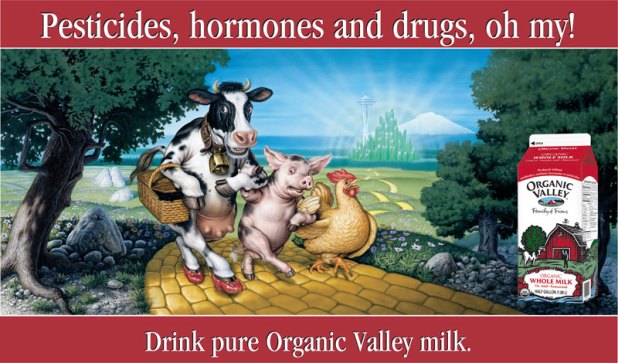
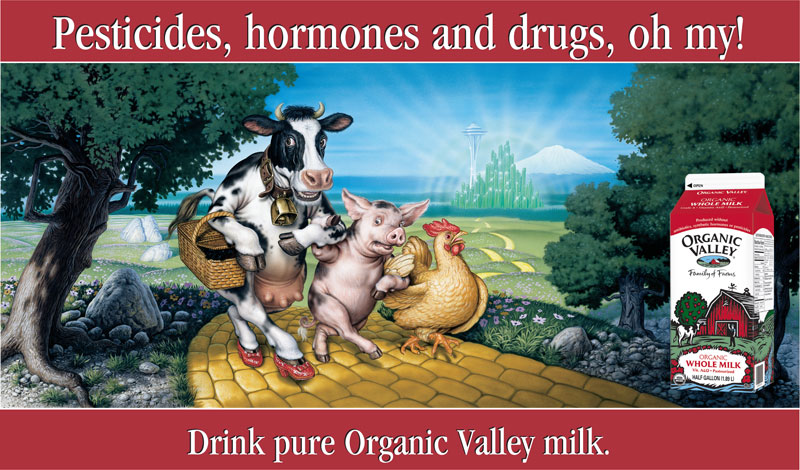
My all-time favorite food advertisement is posted below. It’s an amazing concept, beautifully-drawn, thought-provoking… and it says nothing. Yet if you buy any other milk, aren’t you feeding your children, grandchildren or partner with pesticides, hormones and drugs?
Marketing is awesome. Mis-marketing does nothing but confuse the consumer, the policy-maker and the retailer.


 Bovidiva