Vegan is Love. So Omnivore is…Hate?

When I visualize vegans* with kids (and I apologize in advance for the stereotyping but after all, this is a visualization), I have an image of a couple similar to my childhood friend Molly’s** parents. A pair of liberal arts majors, in favor of trying to have rational discussion with a toddler who’s beating her fists on the floor as she has a tantrum in the middle of Safeway, he had a huge beard, she wore hemp and they were both passionately devoted to both Molly’s education and her right to make rational choices as she developed into a miraculous human being.

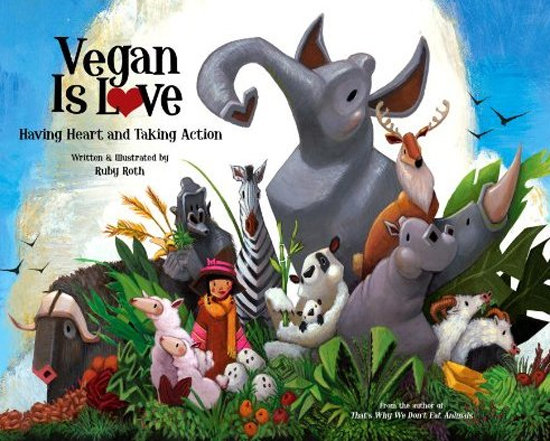
So imagine my surprise when the latest kids book de jour isn’t the beautiful and life-affirming “Guess How Much I Love You“, but “Vegan is Love” a charming tale that paints graphic pictures of the perceived violence that farm animals undergo during slaughter and effectively paints all omnivorous kids as Manson-esque murderers. Reviews on Amazon.com include “Leaping and bounding toward a more peaceable world…” from singer Jason Mraz and similar compliments from the founders of Animal Acres and Farm Sanctuary. Nicely done vegan activists – get the Mommy guilt going and start a “you eat meat so you’re a murderer, get out of my sandbox” clique going in kindergarten.

I never fail to be amazed by just how narrow-minded the focus is of those opposed to animal agriculture, despite their assumed “peace, love and tolerance for all living creatures stance”. Can you imagine the consequences if a similar children’s book was published detailing the horrible life of little Trevor, born with developmental problems due to a severely restricted maternal diet during pregnancy? There would be outrage – how dare the meat-eating majority pick on a vegetable-eating minority… The funny thing is, I’ve yet to hear any omnivorous acquaintance ever seriously assert that vegetarians or vegans should be made to eat meat. Yet the activist vegan contingent are determined to pass their “morals” (note that’s ethical morals, not the delicious fungal morels) onto omnivores and impose dietary choices upon them.

Some states already have abstinence-only sex education, and many schools have “Meatless Mondays”, so what’s next? Vegan-only high school nutrition classes? Herbivorous zoology (no carnivores  allowed)?  The tale of the loaves and fishes rewritten as the loaves and the three-bean-and-lentil-surprise?  Only 1.7% of the population may be actively complaining against modern food production, but they’re not just banging the drum, they’ve hired the whole darn band.

*Before I’m accused of being a meat industry zombie or other such nonsense, I should confess that I was a vegetarian and then a strict vegan from the age of 15-17. I actually turned orange from a sensitivity to beta-carotene.

**Names have been changed 

Is Corn the Soylent Green of the Future?

I recently had the pleasure of watching the 1973 movie Soylent Green starring Charlton Heston. I won’t spoil the ending for those who havent seen it, but the overarching premise of a big company controlling the food supply to an hungry, overcrowded future population strongly resembles some of the current claims made by the more vehement foodies. The anti-animal-agriculture activists appear to have a similar agenda – if only food production was “sustainable” (a word with a million definitions) without any of those “factory farms (that) pose a serious threat to health” and red meats that “have been linked to obesity, diabetes, cardiovascular disease, and certain types of cancer“, life would be much sweeter.

So what’s the answer? It’s very simple. All that animal feed could simply be fed to humans. According to Pimentel at Cornell University, 800 million people could be fed with the grain that livestock eat in the USA each year. If we ignore the fact that field corn (fed to livestock) is not the same as sweet corn (the corn on the cob that we eat), and assume that field corn could easily be processed into a human foodstuff, Pimentel is right.

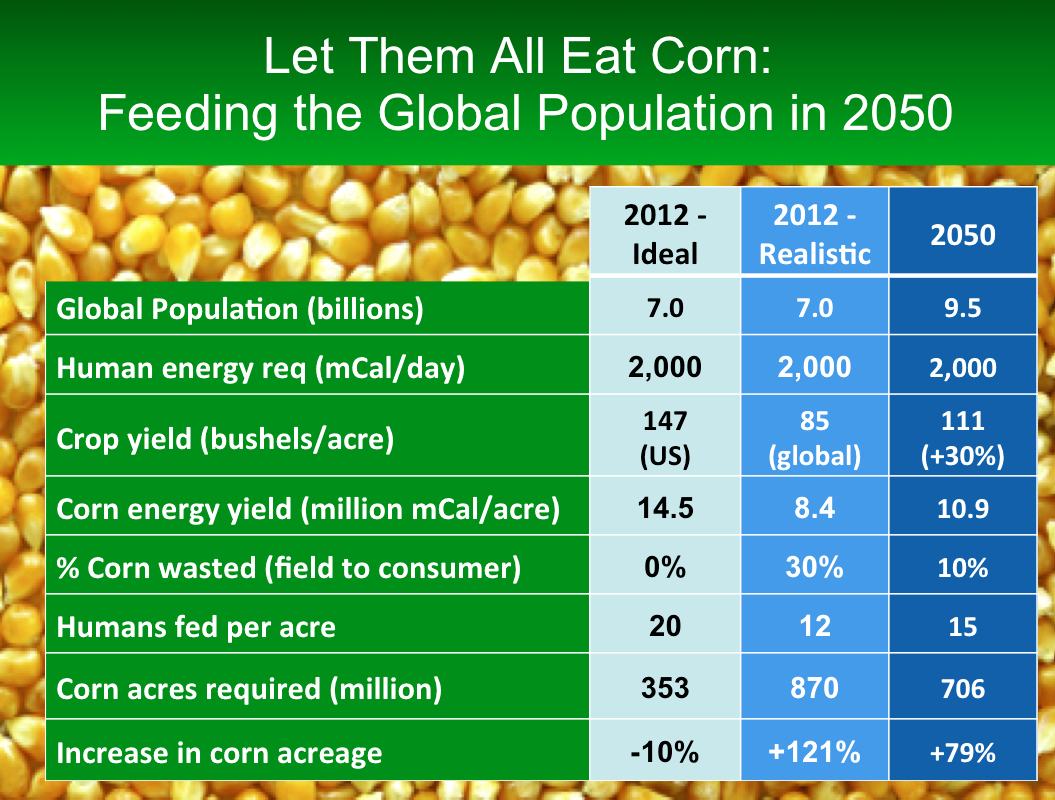
Given the average human nutrient requirement (2,000 kCal/day) and the energy yield of an acre of shelled corn (14.5 million kCal), one acre of corn (at 2011 US yields) could supply 20 people with their energy needs (see table below). On a global basis, we currently harvest around 393.5 million acres of corn, therefore we could supply the entire current global population (7.003 billion) using only 90% of the global corn area. Of course that’s assuming zero waste and US crop yields. If we use a more realistic scenario with global corn yields (85 bushels/acre) and 30% food wastage, we can only feed 12 people per acre and would need to increase current corn acreage by 121% to produce enough food to supply the current population. So what happens by the year 2050 when the population is predicted to reach 9.5 billion people? Assuming that we continue to see increases in yield proportional to those over the past 30 years (30% increase in US yields since 1982), that yield increases are exhibited globally, and that we can cut food waste to 10%, we could feed 15 people per acre and we’ll need to increase corn acreage by 79% to provide sufficient corn to feed the global population.

If our dietary requirements can be met by corn alone, the increase in land use won’t be an issue – land currently devoted to soy, peanuts or wheat can be converted to corn. Yet this simplistic argument for vegetarian/veganism suffers from three major flaws. Firstly, it assumes that the global population would be willing to forgo lower-yielding vegetable crops that add variety to the diet – where are the artichokes, kale or radishes in this dietary utopia?

Secondly, as noted by Simon Fairlie in his excellent book, converting to a vegan monoculture would significantly increase the reliance on chemical fertilizers and fossil fuels due to a lack of animal manures. Given current concern over dwindling natural resources, this is an inherently unsustainable proposition.

Finally, corn is currently vilified by many food pundits. The suggestion that our food supply is controlled by corporations who force monoculture corn upon hapless farmers who are then faced with the choice of complying with big ag or being forced out of business are the purview of food pundits (e.g. Michael Pollan and Joel Salatin) and documentaries such as Food Inc. and King Corn. Not a week goes by without another Mommy blogger or journalist publishing an article on the dangers of high-fructose corn syrup, often concluding that if only this ingredient was removed from our food supply, childhood obesity and pediatric type II diabetes would cease to be an issue for little Johnny and Janie pre-schoolers of the future.

It’s frighteningly easy to visualise the Soylent Green-esque vegan future, whereby food is doled out in pre-measured quantities according to dietary requirements – yet what happens when the whistle-blower of 2050 proclaims “it’s made from CORN!”?

Would you like a side of corpse with your meal, Sir?

I was interested to see the following description of Hitler’s* (*see disclaimer below) behavior in a recent Drover’s article:

…[Hitler] was offered a piece of ham and refused, saying “it is like eating a corpse.”

Is it me, or is that remarkably similar language to that used by PETA and HSUS? Before somebody opens a can of Godwin’s Law whoop-ass, I’d like to point out that I’m not trying to prove my point by referring everything I don’t agree with back to Nazism (although it’s a popular way for internet trolls to try to end arguments), nor am I comparing PETA and HSUS to Hitler. After all, PETA are inherently amusing – without PETA we wouldn’t see so many pictures of Pamela Anderson or marvel at the faux-pornographic inventiveness of “Milk Gone Wild“, let alone snigger at their attempts to get Ben & Jerry’s to use human breast milk. However, I can imagine this a headline in the National Enquirer: “Animal Rights Groups Use Hitler Soundbites” – could be a PR nightmare (take note PETA publicity dept)

Still, it’s interesting that simple words can evoke such a violent reaction. As an unrepentant omnivore, I’m well aware that the meat that I eat originates from animals that have been slaughtered (yes, slaughtered – carrots are harvested, animals are slaughtered) in order to provide human food. Therefore according to the definition of a corpse “A dead body, esp. of a human being rather than an animal”, the juicy burger I’m planning to eat for lunch is a 1/4 lb patty of flesh from the corpse of a cow. What is it about human frailties that such a definition instantly makes me feel like Jeffrey Dahmer, whereas “meat” sounds tasty and innocuous like something grown on a tree in a sunlit California valley?

In high school, my friends and I eschewed meat for animal welfare reasons, horrified by the vivisection pictures prominently displayed by the animal rights activists at the local mall. Yet once we grew out of the teenage rebellion stage, these issues seemed to be less important: during my 12-month vegan stint (aged 15) over half the girls in my high-school class were vegetarian, yet my college class contained less than five vegetarians and I only have two in my current circle of friends. If we took children on tours of slaughterhouses as well as farms and museums would the number of adult vegetarians increase? Or would the fact that meat generally appeals to the human palate overcome those images?

The vast majority of farm animals are well cared for and slaughtered in a humane manner in accordance with the regulations applicable to that region. Yet continuing to disguise the facts of food production by replacing “slaughter” with “harvest” (I’ve been rebuked several times by industry colleagues for refusing to use “harvest”) and playing into the consumer fantasy that meat is produced without death occurring may lead us into dangerous waters in future. So are we ready to pick up a package of ground beef flesh and to baste the Christmas turkey corpse? Its unlikely…but it sure would take the wind out of the PETA and HSUS sails wouldn’t it?

*If the name Hitler instantly ticks your “Alert! Cheap rhetoric!” button, feel free to replace with Idi Amin, Pol Pot or “small angry fanatic with ridiculous moustache”