Defending beef daily! Passionate about livestock production, dedicated to giving producers the tools and messages to explain why we do what we do, every single day.
The Chipotle short film “Back to the Start” which was featured in a commercial break during the GRAMMY awards on Sunday has been one of the most discussed topics on Facebook and Twitter in the past week.
It is incredibly powerful film. Beautifully animated and featuring Willie Nelson singing Coldplay’s “The Scientist”, the cartoon pigs are pink and symmetrical; the dairy cattle graze green grass (before their incarceration in a barn) and antibiotics come in cute little capsules. It’s even more potent because it represents a classic human theme – a mistake followed by redemption. Walking alone in the cold winter night, the farmer realizes his mistake in intensifying his production system, tears down his barns and lets his animals roam free. Who doesn’t love a classic redemption film?
Many of my agricultural friends have responded to this film with the entirely valid argument that Chipotle lack integrity by producing this film as they only source natural or local-produced meat where available. This marketing strategy therefore condemns a significant proportion of their suppliers who produce conventional meat and dairy. However, the average consumer, who only sees the film because they’re waiting to watch Adele’s latest GRAMMY acceptance speech, don’t read about the integrity conflict, and if they do, may assume it’s a reactive response by the ‘inherently biased’ animal agriculture industry.
The question then becomes, how do we overcome this powerful, yet discriminatory message with the fact that all systems have a valid place in food production? Bill Donald (Immediate Past President of NCBA) attended the World Food Prize in Des Moines this week and told me that the hot topic was the concept of future farms with ‘circular economies’. This means taking the ‘reduce, reuse, recycle‘ concept of a circular economy and incorporating it into agriculture, so that the consumer can see that every stage within the process reduces waste, saves resources and produces both nutritious food and useful by-products. It’s a huge hit with consumers in China who are becoming more concerned about environmental issues.
Ironically, this is nothing new – it’s the basis upon which beef production is founded. We take a human-inedible product such as grass, feed it to animals that provide us with meat, leather, pharmaceuticals and other by-products, use their manure to fertilize and grow the grass, produce more beef… It’s a closed and continuous circle of life that has used fewer resources and emitted less greenhouse gases year on year. Yet that’s a very different image to the intensive, inefficient system portrayed by the Chipotle film.
Agriculture is not and never has been a collection of factories pumping in antibiotics, churning out identical widget animals and releasing toxic green waste into rivers. The challenge ahead of us is to be proactive and to demonstrate beef’s circle of life to consumers – not only the 3 R’s (reduce, reuse, recycle), but the 4 F’s – food, fertilizer and fuel for the future.
I was interested to see the following description of Hitler’s* (*see disclaimer below) behavior in a recent Drover’s article:
…[Hitler] was offered a piece of ham and refused, saying “it is like eating a corpse.”
Is it me, or is that remarkably similar language to that used by PETA and HSUS? Before somebody opens a can of Godwin’s Law whoop-ass, I’d like to point out that I’m not trying to prove my point by referring everything I don’t agree with back to Nazism (although it’s a popular way for internet trolls to try to end arguments), nor am I comparing PETA and HSUS to Hitler. After all, PETA are inherently amusing – without PETA we wouldn’t see so many pictures of Pamela Anderson or marvel at the faux-pornographic inventiveness of “Milk Gone Wild“, let alone snigger at their attempts to get Ben & Jerry’s to use human breast milk. However, I can imagine this a headline in the National Enquirer: “Animal Rights Groups Use Hitler Soundbites” – could be a PR nightmare (take note PETA publicity dept)
Still, it’s interesting that simple words can evoke such a violent reaction. As an unrepentant omnivore, I’m well aware that the meat that I eat originates from animals that have been slaughtered (yes, slaughtered – carrots are harvested, animals are slaughtered) in order to provide human food. Therefore according to the definition of a corpse “A dead body, esp. of a human being rather than an animal”, the juicy burger I’m planning to eat for lunch is a 1/4 lb patty of flesh from the corpse of a cow. What is it about human frailties that such a definition instantly makes me feel like Jeffrey Dahmer, whereas “meat” sounds tasty and innocuous like something grown on a tree in a sunlit California valley?
In high school, my friends and I eschewed meat for animal welfare reasons, horrified by the vivisection pictures prominently displayed by the animal rights activists at the local mall. Yet once we grew out of the teenage rebellion stage, these issues seemed to be less important: during my 12-month vegan stint (aged 15) over half the girls in my high-school class were vegetarian, yet my college class contained less than five vegetarians and I only have two in my current circle of friends. If we took children on tours of slaughterhouses as well as farms and museums would the number of adult vegetarians increase? Or would the fact that meat generally appeals to the human palate overcome those images?
The vast majority of farm animals are well cared for and slaughtered in a humane manner in accordance with the regulations applicable to that region. Yet continuing to disguise the facts of food production by replacing “slaughter” with “harvest” (I’ve been rebuked several times by industry colleagues for refusing to use “harvest”) and playing into the consumer fantasy that meat is produced without death occurring may lead us into dangerous waters in future. So are we ready to pick up a package of ground beef flesh and to baste the Christmas turkey corpse? Its unlikely…but it sure would take the wind out of the PETA and HSUS sails wouldn’t it?
*If the name Hitler instantly ticks your “Alert! Cheap rhetoric!” button, feel free to replace with Idi Amin, Pol Pot or “small angry fanatic with ridiculous moustache”
A recent article by Andrew Jack in the Financial Times (the iconic pink-colored newspaper carried by all self-respecting business men on London tube trains each morning) reports that developing countries in Africa will be responsible for the greatest increases in population growth over the next 90 years, with the global population predicted to hit 10 billion by 2100. Given the number of dire predictions currently being bandied around regarding population increases, food demand and climate change it’s easy to become blasé and dismiss it as just another issue that will be solved by the next generation. After all, what difference can we possibly make to rural communities in developing countries?
Rises in per capita are predicted for developing countries over the next century and as Andrew Jack notes, increasing affluence results in improved healthcare, urbanisation and a decline in birth rates. Nonetheless, this pattern is not being currently being exhibited by regions in Africa and S. Asia, which are unable to improve per capita income as population increases overcome economic growth.
So how do we curtail the rise in population growth? Even in a developed country such as the USA, mentioning the politically-charged phrase “population control” often leads to an uncomfortable silence, images of an Orwellian constraint on family size (1 child good, 2 children bad?) or debate over the rights and wrongs of abortion. Yet simply providing access to contraception, considered to be an inherent human right by many women in the developed world, could conceivably (pardon the pun) improve future sustainability.
Reducing the number of children born in developing countries would improve female health and lessen the burden on economic and environmental resources placed by increasing population size. This would be a crucial step forwards in mitigating future food shortages, yet it does not solve the underlying problem. One of the major drivers behind population growth is parental reliance on support from the younger generation. As discussed in Jared Diamond’s excellent book “Guns, Germs and Steel“, higher birth rates potentially allow for a greater number of children to work on the land and improve societal stability. However, the promise of future affluence is a major stimulant that causes young people to migrate from rural areas to urban regions that are already suffering from significant overcrowding.
A considerable yield gap exists between developing and developed countries, both in terms of animal and crop production. If productivity could be improved and the yield gap reduced, food security would improve in rural areas with positive effects on per capita income and infrastructure, and potential reductions in the number of inner-city migrants. Nonetheless, the major question remains unanswered - how to improve productivity?
If we use dairy farming as an example, a recent report from the Food and Agriculture Organisation noted a negative relationship between productivity and carbon footprint – as we move across the globe from developed to developing regions, productivity decreases and the carbon footprint per kg of milk increases (see graph). Carbon can also be considered a proxy for land, water and energy use, thus reduced productivity increases both resource use and environmental impact. The logical conclusion would therefore be to implement systems and management practices currently seen in N. America, Europe and Australasia in an attempt to educate farmers in S. Asia and Africa. However, sustainability cannot be improved by implementing a one-size-fits-all solution, but calls for a region-specific approach.
Identifying traits within indigenous and imported animal breeds and plant varieties that will make the best use of available resources allows development of production systems that match environmental, social and economic demands. Further implementation of continuous improvement and best management practices in developing countries is crucial in order to improve affluence, reduce population growth and mitigate environmental impact both now and in future. However, this is not a situation that can simply be solved by improving yield per acre, but requires a multifactorial approach coordinating population control, education, food security and human health and welfare. Providing contraception without a concurrent effort to improve agricultural productivity will fail in its prophylactic intent to control either population growth or world hunger.
Can we feed up to 10 billion people in 2100 by improving crop yields, reducing deforestation, and reducing meat and dairy consumption? These solutions are among those suggested by Jonathan Foley at the University of Minnesota’s Institute of the Environment to enable the increase in food production required by the future global population. These are logical suggestions, yet the proposal that meat and dairy consumption should be reduced is likely to be the most-debated, particularly as livestock industry stakeholders may regard this as yet another attack on animal agriculture.
The futility of the “Meatless Mondays” campaign has been discussed ad infinitum, yet in contrast to the EWG’s recent report, Foley does not attempt to promote a vegetarian or vegan ideology or to suggest that climate change could be reversed if only we all ate humanely-certified or organic meat. Instead, the report concludes that resources could be saved if we shifted to meat consumption towards pork and poultry production as:
…it takes 30 kilos [66 lb] of grain to produce one kilo [2.2lb] of boneless beef… We’re better off producing grass-fed beef or more chicken and pork, which requires far less grain feed
Based on those data, Foley’s conclusion is entirely logical. However, as Carl Sagan said, “Extraordinary claims require extraordinary evidence” – and here the evidence is lacking. A recent review of feed efficiency by Wilkinson reports that monogastric animals require 4.0 kg (swine) or 2.3 kg (poultry) of feed per kg of gain. Monogastrics are indeed considerably more efficient than their ruminant counterparts as beef animals require 8.8 kg feed per kg gain – considerably more than swine or poultry, but far less than Foley’s estimate.
It would be convenient to argue that the errors in Foley’s feed efficiency data (not to mention religious limitations on pork consumption) negate the report’s conclusions. But isn’t it logical to argue that we should eat meat produced in systems that use fewer resources to produce animal protein? Personally, I spend more than half my time traveling to present precisely that message to the animal industry and to encourage livestock producers to improve efficiency. I absolutely believe that we need to improve productivity and efficiency in order to feed the growing population. However, traditional feed efficiency data have a major flaw – it’s assumed that all animal feed could otherwise be used to feed humans.
Wilkinson suggests that the traditional concept of feed efficiency be re-examined to reflect the quantity of human-edible crop inputs that are used to produce a unit of energy or protein from animal products. For example, humans cannot digest pasture, only 20% of the nutritional value of oilseed meals can be utilized for human food and yet 80% of nutrients within cereals, pulses and soybean meal are human-edible. By partitioning out the human-edible component of animal feed, Wilkinson demonstrates that the human-edible energy feed efficiency ratios for pork and cereal beef are similar (Figure 1*) and that dairy production actually produces twice the amount of human-edible energy than it uses (input:output ratio of 0.5). On a protein basis, cereal beef has a higher human-edible protein feed efficiency ratio (3.0) than pork (2.6), but suckler beef systems where cattle are grazed on pasture again produce more human-edible protein than they consume (input:output ratio of 0.9, Figure 2*). Not only are these revised feed efficiency estimates considerably lower than those quoted by Foley, but they underline the importance of herbivorous grazing animals in utilizing human-inedible forage to produce animal protein.
Numbers have power – it’s always tempting to base a suggestion around a single data point that “proves” the argument. Feed efficiency is a useful metric, but as we face an ever-increasing challenge in balancing food demand, resource availability and consumer expectations, it’s critical that we examine the bigger picture. The ruminant animal has a major evolutionary advantage in its ability to digest forages – we may be better acquainted with the human dietary advantages of probiotic bacteria than our ancestors, but until we are equipped with human rumens (humens?) we cannot hope to effectively make use of all crop resources.
*The importance of acknowledging the human-edible component of feed efficiency was part of my presentation at the Alltech Ruminant Solutions Seminar in Ireland this week – to go to a PDF copy of my presentation please click here.
Consumer trust. It’s paramount. It’s possibly the only way to ensure sustainability (by which I mean the balance of economic viability, environmental responsibility and social acceptability) of any agricultural practice, system or industry.
Yet there’s an inherent issue with consumer trust – no matter how many times I’m reassured that the consumer trusts science, trusts academics, trusts farmers, there’s one group that they’ll trust above all others – the amateur scientist.
You know the one – they did a back of an envelope calculation based on some data from Wikipedia and a couple of those statistics that “everybody knows” (but nobody can source….). They published it on Twitter, it got picked up in a couple of media articles and now it’s FACT. They have a degree in liberal arts with a minor in German organ music from a small school out East and they’ve read everything ever published with “sustainable” in the title. Next thing you know they’ll have their own slot on Food Network and be touring the “sustainable” speaking circuit. After all, they eat food – so they must be an expert!
Everybody knows amateur scientists aren’t biased and have no agenda, because they’re just an enquiring mind – and enquiring minds want to know. They’re more dangerous than an activist with a ready supply of dynamite and as many balaclavas as their Grandma can knit.
My Grandpa, a strict Methodist, took the pledge to abstain from alcohol back in the 1940′s when the church was endorsing Prohibition via the Temperance movement in the UK. It was an entirely personal choice for him, one that he felt was right for his lifestyle and a cause that he didn’t try to recruit other people to join. Admittedly it filtered down to his children and even had some influence on his grandchildren, although for my brothers, cousins and me the effect is now somewhat akin to adding a single ice-cube to a tumbler of whiskey.
In 1889, George Sim described slum areas where drinking was commonplace thus:
The gin-palace is heaven to them compared to the hell of their pestilent homes… The drink dulls every sense of shame, takes the sharp edge from sorrow, and leaves the drinker for awhile in a fools’ paradise… It is not only crime and vice and disorder flourish luxuriantly in these colonies, through the dirt and discomfort bred of intemperance of the inhabitants, but the effect upon the children is terrible. The offspring of drunken fathers and mothers inherit not only a tendency to vice, but they come into the world physically and mentally unfit to conquer in life’s battle. The wretched, stunted, misshapen child-object one comes upon in these localities is the most painful part of our explorers’ experience. The country asylums are crowded with pauper idiots and lunatics, who owe their wretched condition of the sin of the parents, and the rates are heavily burdened with the maintenance of the idiot offspring of drunkenness.
Given such strong words, it’s not surprising that alcohol was considered by many to be the root of all evil. In this modern world, where a myriad of organizations exist to help us with our addictions to the more insidiously hedonistic pleasures in life*, surely we are beyond taking the pledge?
Alas no, the Environmental Working Group is at it again, this time with a pledge that they aim to get 100,000 supporters to sign. That’s right, you can save the planet by simply clicking a button on the internet stating that:
I pledge to skip meat one day a week and to include more healthy fruits and vegetables in my diet. Not only will I be doing something good for my body, I’ll also be doing something good for the environment.
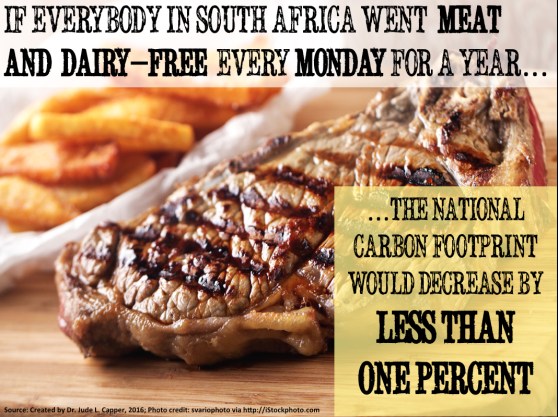
So, let’s assume 100,000 people sign up for this. That will cut the USA’s carbon footprint by 0.00014% (it would only be 0.44% if the entire population took the pledge *and* actually stuck to it). Hardly a significant environmental effect.
What would you replace meat with? Jack-in-a-Box Jalapeno poppers? A couple of Twinkies? A 1/2 lb soy burger? It’s rational to assume that giving up meat for one day a week will not suddenly cause everybody to have more time to cook, or to prepare fresh exotic salads from scratch – the basic food preferences will stay the same, simply without meat.
So the chicken breast, hamburger or pork chop is replaced by a vegetarian burrito – one from Chipotle no less, which has made a big play of not using rbST and other hormones. According to USDA’s nutrient database, the calorie content of an 8 oz steak is 581 calories with 35 grams of fat. An 8 oz pork chop has 524 calories with 38 grams of fat. The vegetarian burrito? Chipotle lists nutritional information by ingredient, luckily the handy dandy My Fitness Pal website has put together all those ingredients - 750 calories with 27 grams of fat. Hardly a short-cut to becoming a lean, mean fitness machine.
Life is all about choices, and all dietary choices have environmental and health consequences. The Temperance movement believed abstaining from alcohol made for a better life and (via Methodism) a promise of a better afterlife. Can the same really said of abstaining from meat for one day per week? Should meat be renamed Mephistopheles – or is abstention simply another short-term panacea by which we can feel better about our health, environment and karma via bad science and vegetarian spin?
*Personally, I need a “Cinnabon Lovers Anonymous” help-group
Today’s Thursday, so presumably we can all enjoy a hamburger without being made to feel guilty by the virtuous soy-eaters who are saving the planet (thanks Environmental Working Group). But what happens when the weekend is over, Monday morning appears in all it’s miserable beginning-of-the-week glory and we’re choosing lunch? According to many schools, universities, hospitals, retirement complexes and workplaces, Monday is the day when you can make a difference!
Simply by replacing that ham and cheese with a nice alfalfa and hummus wrap, we can all sleep safely knowing that our hummer driving and air-conditioning set at 65 degrees isn’t harming the environment – after all, we went meatless today! So what’s the real impact of Meatless Mondays?
If you believe the hyperbolic text of the EWG’s recently released report, animal agriculture is the root of all environmental evil. Yet buried on page 21 is the admission that animal agriculture only accounts for 4.5% of the US’s carbon footprint. The EPA has a somewhat smaller, but similar figure at 3.1% of total emissions. The original Meatless Mondays claim appears to have been derived from a paper from Carnegie Mellon that concludes:
Shifting less than one day per week’s worth of calories from red meat and dairy products to chicken, fish, eggs, or a vegetable-based diet achieves more GHG reduction than buying all locally sourced food.
So let’s do the math. Removing poultry and horses from the EPA’s animal agriculture total of 3.1% gives a red meat/dairy impact of 3.05%. Divide that by 7, and the impact of one meatless day per week is equal to 0.44% of the US carbon footprint – and that’s assuming that the US population of 311 million people all adopt this lifestyle change.
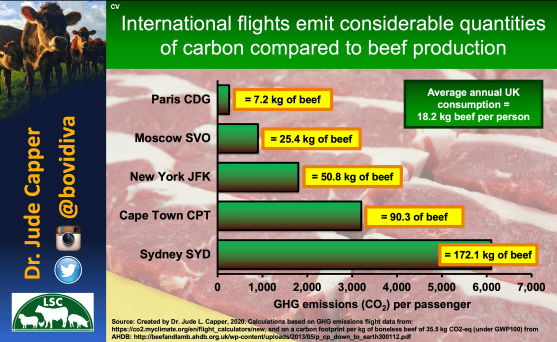
0.44% is minuscule. A tiny fraction of the impact that we could make on the carbon footprint. But if we put it in consumer-friendly numbers, it’s like taking 5.7 million cars off the road each year, or planting 4.5 billion trees. Sounds far more compelling now doesn’t it? But how does that compare to the impact of powering the MacBook upon which I’m currently writing this post during a 3 hour cross-country airplane flight, followed by a 90 minute drive home? Not to mention all the other environmentally-damaging actions I’ll execute before the day is out.
In a world where we have a wildly tenuous grasp on the immediate or long-term environmental consequences of the majority of our actions, we really need to assess the environmental impact of simply existing as a human. Forget demonizing specific foods, or pretending that one single action can save the planet – we need to understand and quantify how all our choices have consequences - and act accordingly.
Would you replace your hamburger with a soy burger?
Ah, the power of a report from an earnest non-governmental organization, out to save the consumer from themselves. Destined to be selectively quoted for the next 20 years and to prove once and for all that, as the comedian Ron White would say: “You can’t fix stupid”.
Released this week, the Environmental Working Group’s report, claimed not only that everybody should eat less meat, but that “Meat, eggs and dairy products that are certified organic, humane and/or grass-fed are generally the least environmentally damaging…Overall, these products are the least harmful, most ethical choices.” This is a surprisingly intuitive conclusion in that it utterly contradicts the body of scientific knowledge to date, and as the report doesn’t contain any data on anything other than conventional production systems, let alone ethics.
The requisite environmental activist components are there: stylized pastoral scene on the cover and such a liberal sprinkling of emotive words such as “confined” and “polluting” it seems like an ice-cream sundae assembled by a small child with a sugar addiction. It’s even been peer-reviewed by “experts” (as you may have gathered, when reading this post, words in quote marks should be accompanied by an ironic raised eyebrow).
It’s a bona-fide report with colorful graphs, acknowledgements, a whole separate report on the methodology (which guarantees nobody will read it) and data! As we all know, data is powerful. According to their “calculations”, lamb has the greatest impact, generating 39.3 kg (86.4 lbs) of carbon dioxide equivalents (CO2e) for each kilo eaten, and beef has the second-highest emissions, generating 27.1 kilos (59.6 lbs) of CO2e per kilo consumed. Cheese generates the third-highest emissions, 13.5 kilos (29.7 lbs) of CO2e per kilo eaten. Everybody knows that data doesn’t lie. Cold hard numbers are based on science. Yet just as I can replace ground beef with tofu and make something that looks like a burger, yet tastes like… soy, so has the EWG have used poor-quality data and erroneous assumptions to create a vegetarian ideology that is a poor substitute for real science.
They claim that if everyone in the U.S. chose a vegetarian diet, it would reduce US carbon emissions by 4.5%. This is an impressive achievement since the Environmental Protection Agency cites livestock production (including dairy, eggs and horses) in the US as accounting for 3.12% of total emissions. Who knows where that extra 1.4 percent comes from?
The animal component of the report shows a lamentable lack of basic livestock production knowledge. In the beef example, the cow-calf and stocker operations are based on a lot feeding system in Nebraska rather than rangeland production and by-product/forage feeding. All the animals raised are steers (what on earth happens to the heifers?) and there appear to be no bulls in the system, not to mention the lack of dairy calves entering the feedlot and cull beef or dairy cows entering the production chain. Crucially there is no data on herd dynamics, bodyweights, growth rates, and total time required for animals to reach slaughter weight – the most important factors that affect the carbon footprint of a unit of beef.
The lamb system does contain rams as well as ewes, but there is no data relating to the flock, and most crucially, to the lambing rate. US farm flocks average 1.5 to 2.5 lambs per ewe per year whereas range flocks average 1.0-1.5 lambs per ewe. If we compare this to the US average for beef according to the most recent USDA/NAHMS report of 87% of cows producing a live calf, that means we need roughly twice as many beef cows to produce offspring as we do ewes, even considering the fact that lamb produce slightly less meat per carcass on a percentage basis (for a more realistic estimate of meat yields than those quoted in the EWG report, the University of KY have a nice extension publication on the subject).
So here it is, the issue that every single life cycle assessment involving animals and executed by LCA engineers to date misses – the fact that for every day an animal is alive, it needs a certain amount of energy and protein (and therefore feed, land, fertilizers, fossil fuels etc) simply to stay alive. This is called the maintenance requirement and it’s exactly the same principle that leads to that nifty “The average woman requires 2,000 calories, the average man requires 2,500 calories” credo that’s on almost every nutritional label. It doesn’t take a giant deductive leap to realize that if a certain amount of feed is needed to maintain an animal, there’s going to be a certain amount of waste too – which means manure and greenhouse gases. Breeding animals in meat production are the biggest contributors to the total carbon footprint precisely because they consume resources and emit greenhouse gases each day, yet only end up in the human food chain after a number of years, if at all.
If I’m making a bun for my tofu burger, it’s more efficient to cook it in an oven that can produce two or three buns rather than one. Exactly the same analogy applies to breeding herds – a larger breeding herd with reduced reproductive efficiency (i.e. fewer offspring per female), means more resources and a greater carbon footprint per unit of milk or meat. Lamb’s carbon footprint would be expected to be approximately half to two-thirds that of beef given the greater reproductive efficiency, yet the EWG’s estimation has lamb at 44% higher – a clear reflection of the invalidity of their results.
Comparing the carbon footprint of different meat products is an elegantly futile competition in which nobody wins. According to their “data” beef is a better choice than lamb, chicken is better than pork. Yet who fancies chicken Wellington for dinner? Or egg pot pie? Or a pea McMuffin? The idea that we should be happy, saving the world on a diet of tofu and lentils is somewhat ironic given their propensity to produce increased methane from the human gastro-intestinal tract.
Are all 311 million people in the US going to rush to the grocery store and fulfill the EWG’s somewhat desperate cry for Meatless Mondays? Until all human activity can be put into context and the effect of driving to work vs. buying French wine vs. eating an 18-oz T-bone vs. having a third child can be compared objectively, this report is simply another one-week-wonder, destined to be quoted in every vegetarian manifesto and vegan twitter post (presumably vegans don’t tweet, as that would be exploiting birds?) but forgotten as soon as Katherine Middleton wears a new dress on a royal visit or yet another politician demonstrates their indirect support for the pork industry by increasing Google searches for “wiener”.
For a little light relief, here’s Ron White’s take on “Stupid” (please do not watch if easily offended)
I love Forbes.com. Not because they put out a nice article on our previous work a couple of years ago (although it did make a refreshing change) but because of the following quote in a Forbes blog post by Trevor Butterworth:
Yes, the topic of industry funding of scientific research is tantalizing for journalists because it implies corruption, but the reality is that most universities depend on their science departments to bring in research grants from private as well as government sources (35 percent or more is taken by the university as “overhead”). Grants for research on Shakespeare do not, a university’s upkeep, pay for. More to the point, scientific research is good if it is done well, not simply because the researchers doing it are independent.
Picture the scene, just as it has occurred so many times. I’m at the end of a conversation with a journalist, during which the interviewer seems to genuinely “get” that improving productivity and efficiency in livestock systems has beneficial environmental and economic effects, just as it does in any other industry.
“Just one last question,” says the interviewer, in a casual tone, “Where do you get your funding?”
“Why, the livestock industry.” I answer.
Stunned silence. I can almost hear the crackling and hissing as the interviewer’s hair spontaneously combusts. Surely that simple 2+2=4 math that we just discussed is now biased! Flawed! Bought and paid for! This “impartial” University researcher is nothing but a pawn of big ag! An industry zombie!
Don’t get me wrong, I’m not claiming that my research is flawless. Any mathematical modeling work is only as good as the data that goes into it and our models are evolving all the time. However, I am really tired of the old adage that industry dictates the results of scientific, peer-reviewed research. If anyone has a bright idea as to who will fund applied livestock research aside from industry, send me a link to the call for proposals and if mine gets funded I’ll laud you to the heavens in the acknowledgements section.
Remember the all-new singing-and-dancing MyPlate? That handy guide to what to eat that only seems to apply to those of us on a discrete meat/starch/veg diet eaten off school cafeteria-style segmented tableware?
Now any Home Economics teacher can easily include MyPlate in the curriculum – with this handy MyPlate food kit!
“This fantastic assortment of food replicas provides you with a wide variety of foods so you can create many different meals on MyPlate or you can use these replicas in conjunction with those you already have on hand.”
Or… you could use real food. You know, so students could learn to prepare and eat it rather than gazing at a plastic molded apple. Just a thought.
I can’t express how much it amuses me that the food kit associated with this first-lady-approved-PC-food-ideology doesn’t include tofu in the protein group.